Best Stem Kits for 7 Year Olds: Creative Robots, Chemistry and Hands-on Learning
Exploring science through play helps early learners build foundational skills in engineering, problem-solving, and critical thinking. The following hand-picked stem kits are well-suited for curious 7-year-olds, offering age-appropriate challenges that blend creativity with education. Each kit emphasizes hands-on building, safe materials, and engaging activities that keep kids motivated to explore science at home or in the classroom. The selections below highlight variety—from robotics and circuitry to earth science and physics—so you can match a kit to your child’s interests and learning pace.
| Product | Brand |
|---|---|
| STEM Kits for Kids Crafts 6-8 8-12 | BeAndge |
| Blue Marble National Geographic Magic Chemistry Set | Blue Marble |
| National Geographic Earth Science Kit | Blue Marble |
| KLUTZ Lego Race Cars STEM Activity Kit | Klutz |
| Thames & Kosmos Mega Cyborg Hand STEM Kit | Thames & Kosmos |
BeAndge STEM Kits For Kids Crafts 6-8 8-12

BeAndge’s multi-kit set includes a solar powered car, wind powered car, an obstacle avoidance robot, a transmission tank, and a glider. This collection provides hands-on exposure to basic robotics concepts, energy transfer, and motion ideas. It’s designed for kids in the 8–12 range but also engages younger ages with guided play. Batteries are required (not included), and the set is packaged as a gift-ready option, which can make it appealing for celebrations like birthdays or holidays. The kits support family STEM activities, enabling collaborative learning and shared problem solving.
Why this matters for seven-year-olds: diverse models encourage experimentation and iterative thinking. As kids assemble, they learn about circuitry, solar power, wind energy, and simple mechanisms. The varied builds help sustain interest and reduce boredom by offering fresh challenges in a single purchase. For parents, it provides a structured yet open-ended framework to discuss scientific concepts in everyday language.
Blue Marble National Geographic Magic Chemistry Set
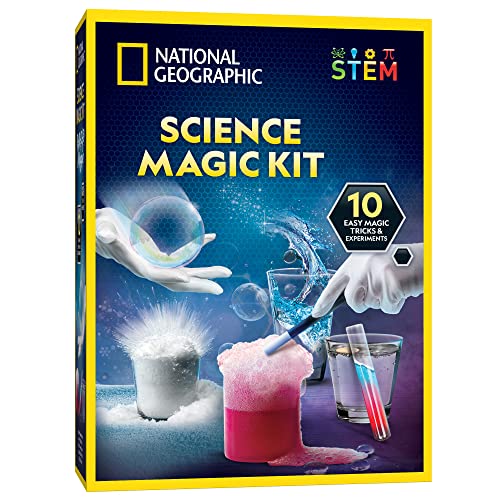
This chemistry-focused kit offers 10 science experiments presented as magic tricks, designed to captivate young scientists with visible, dramatic results. The included wand and gloves enhance the theatrical element, making lessons memorable while reinforcing curiosity about chemical reactions and observation. The illustrated, kid-friendly guide explains the science behind the tricks, helping children connect the magic to real-world concepts rather than relying on mystery alone.
What makes it suitable for a 7-year-old: the blend of performative tricks and straightforward steps builds confidence and encourages practice with simple lab routines. It provides an accessible way to introduce scientific thinking, measurement, and careful observation. The magic framing often increases engagement, which can translate into better retention of basic scientific ideas and vocabulary.
National Geographic Earth Science Kit

National Geographic’s Earth Science Kit centers on a broad exploration of geology, crystals, volcanology, and earth history. With more than 15 experiments, kids can build a volcano, grow crystals, and conduct geologic digs. The kit encourages teamwork and sharing discoveries, making it well-suited for family STEM sessions or small classroom groups. A color-based learning guide supports structured exploration, while activities emphasize observation, hypothesis testing, and scientific narration.
Why it’s relevant for seven-year-olds: the kit covers earth science themes in a hands-on manner, pairing tangible activities with clear explanations. Kids gain an intuitive sense of how natural processes work, including rock formation and volcanic activity, which complements reading and science curriculum at an early age. The group-friendly design fosters collaboration and communication about discoveries.
KLUTZ Lego Race Cars STEM Kit

KLUTZ combines a book with hands-on materials to guide kids through building 10 LEGO race cars and a racetrack. The activity emphasizes spatial reasoning, logical thinking, and creativity while reinforcing core STEM skills. Step-by-step instructions help children follow a sequence and learn from success or error as they iterate designs. The kit appeals to kids who enjoy building and racing, offering a tangible route to apply math concepts like counting, measurement, and symmetry.
Key considerations for this age: the project-driven format supports persistence and task planning. As children build multiple vehicles, they compare designs, estimate outcomes, and adjust strategies. This kit is particularly effective for kids who love hands-on construction and storytelling around speed, trajectories, and engineering challenges.
Thames & Kosmos Mega Cyborg Hand

The Mega Cyborg Hand is a hydraulic-powered system that enables a wearable hand to grip objects. No motors or batteries are required; rather, it uses air pressure and water power, plus the user’s own hand actions to control finger movement. Adjustable finger joints allow customization of grip strength and motion precision. This kit blends engineering with anatomy-inspired design, inviting questions about hydraulics, pneumatics, and mechanics while offering a visually exciting, interactive experience.
Why it’s appropriate for seven-year-olds: it provides an age-appropriate challenge that introduces pneumatic systems in a tangible way. Kids can observe cause-and-effect as squeezing triggers movement, and the adjustable joints encourage experimentation with range of motion. It’s a strong choice for visual learners who enjoy physical manipulation and engineering storytelling.
Buying Guide: Key Purchase Considerations For Young STEM Learners
Age and safety: Select kits clearly labeled for early elementary learners, with non-toxic materials and age-appropriate complexity. Look for items designed to minimize small parts that could pose choking hazards. Consider parental or teacher involvement levels and whether guided instructions will be needed.
Learning objectives: Identify whether the kit emphasizes robotics, earth science, circuitry, or engineering fundamentals. A diverse set that includes multiple disciplines can foster broader interest and knowledge, while more focused kits suit a child who shows a strong preference for a particular topic.
Hands-on engagement: Prioritize kits that combine building with experimentation and observation. Projects that encourage testing hypotheses, recording results, and revising designs help develop scientific thinking and problem-solving skills. Visual guides and step-by-step manuals support young researchers in following through.
Scalability and durability: Consider whether the kit offers multiple models or experiments from a single set to extend learning over time. Durable components and safe storage solutions help sustain long-term engagement and reduce clutter after play sessions.
Educational value and narration: Kits that pair activities with accessible explanations or a learning guide help families discuss concepts in kid-friendly terms. Hands-on kits that include explanations of the science behind each activity promote deeper understanding beyond the excitement of the build.
Social learning potential: Look for kits that enable collaborative play, classroom group work, or family projects. Sharing discoveries and competing designs can reinforce communication, teamwork, and peer learning, which are valuable in early STEM education.
Budget and value: While prices vary, consider the long-term value of a kit containing multiple projects versus a single-build set. A diverse range of activities from one purchase often provides better engagement and a broader educational return.
Storage and organization: Kits with a sturdy storage solution or labeled compartments simplify clean-up and encourage ongoing exploration without losing components. Organized kits lower friction for repeated use and classroom deployment.
Starter vs. advanced paths: Some kits include tiered challenges or expandable parts, allowing progression as a child’s skills grow. This can keep a child motivated once initial curiosity is satisfied and ready for a more complex project.
In sum, the best stem kits for a 7-year-old blend engaging, hands-on building with clear, accessible explanations that connect play to core science ideas. By choosing a kit that aligns with your child’s interests and provides room to grow, you support lifelong curiosity and foundational STEM skills.