Best Toys for Brain Development in Babies and Toddlers
Parents seek toys that spark curiosity, boost fine motor skills, and support early cognitive growth. This guide highlights five evidence-based options that align with brain development milestones for infants and young children. Each product emphasizes hands-on exploration, problem-solving, and sensory play to foster neural connections during critical years.
| Product | Brand | Key Benefit | Age Range |
|---|---|---|---|
| Fat Brain InnyBin Shape Learning Toy | Fat Brain Toys | Fine motor skills and tactile exploration | 10 months+ |
| Peg Board Toy Set 73Pcs | Ggiibro | Creative design, STEM thinking, color/shapes | 3-6 years |
| Fat Brain Dimpl Baby Toy | Fat Brain Toys | Sensory exploration and fine motor activity | 10 months+ |
| JUXUE Spinning Stacking Toys | JUXUE | Hand-eye coordination, cause-and-effect, color recognition | 6-12 months |
| Fat Brain PlayTab Essentials | Fat Brain Toys | Cause-and-effect, fine motor, tactile variety | 12 months+ |
Fat Brain InnyBin Shape Learning Toy

The Fat Brain InnyBin offers a tactile, problem-solving experience for babies and toddlers. Its six chunky blocks push through elastic bands, strengthening hand-eye coordination and grasping abilities while promoting fine motor skills. The textured blocks invite tactile exploration, supporting sensory development as little ones learn to differentiate shapes and textures. Pushing and pulling the blocks also sparks experimentation, encouraging curious minds to test different configurations and observe outcomes. This toy is designed to adapt to growing motor skills, making it a long-lasting brain-building companion for early years.
Designed for age-appropriate play, InnyBin integrates sensory stimuli with motor challenges. Babies develop precision in finger movements as they guide blocks through elastic constraints, while toddlers practice problem-solving and spatial awareness by predicting where each piece fits best. The combination of texture variety and modular play fosters cognitive flexibility, an essential trait for later learning tasks. The compact form makes it easy to pack for travel, providing on-the-go brain-boosting opportunities for families seeking portable brain development play.
Peg Board Toy Set 73Pcs

The 73-piece pegboard set from Ggiibro is a versatile toolkit for early STEM learning. With multiple base plates, plates, nails, and cords, children can design bridges, towers, and abstract structures. The kit supports creative imagination while introducing basic engineering concepts, like balance, spacing, and color matching. The included storage bag keeps pieces organized, encouraging responsibility and independent play. This activity can evolve from simple stacking to complex, multi-step builds as a child’s cognitive and motor skills mature.
In addition to construction play, the set doubles as a counting and sequencing exercise. Children can group nails by color, count pieces, and explore patterns, reinforcing mathematical thinking in a playful context. The rich color palette and varied shapes also promote visual discrimination and design thinking. For caregivers, the set provides opportunities to scaffold learning with age-appropriate challenges, from basic color matching to more advanced structural designs as skills develop.
Fat Brain Dimpl Sensory Toy

The Dimpl by Fat Brain Toys is a compact sensory toy designed to engage babies and toddlers with push-and-pop actions. The five vibrant silicone bubbles sit in a sturdy frame, inviting tactile exploration and visual attention. This activity supports fine motor development as little fingers learn to press and release, while the interactive bubbles reinforce cause-and-effect understanding. Its portability means it can accompany families on daily routines, playdates, or travel, ensuring consistent brain-building moments no matter the setting.
Beyond motor skills, Dimpl promotes focus and concentration as children anticipate the response of each push. The sensory feedback—soft, satisfying clicks—helps regulate attention and can serve as a calming, self-regulation tool for young learners. With its simple, open-ended design, the toy invites children to experiment with patterns, sequences, and even pretend play scenarios, broadening cognitive flexibility in early years.
JUXUE Spinning Stacking Toys
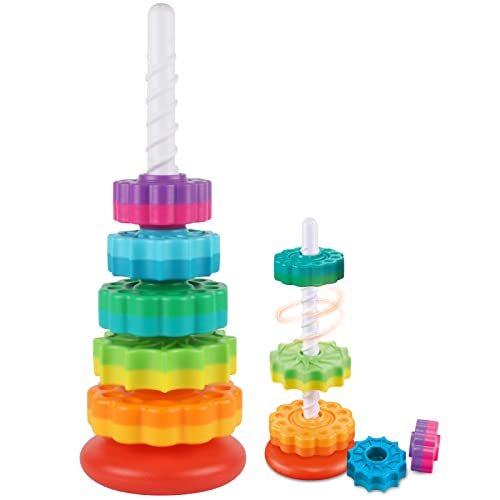
JUXUE’s spinning stacking toy blends stacking, spinning, and rotational play to support early cognitive development. The design features a screw rod and rainbow-colored discs that children can spin and arrange by size, color, or shape. When play is complete, pulling the pole off the base triggers a satisfying cascade of discs, reinforcing cause-and-effect learning. The toy also emphasizes fine motor precision as children maneuver discs and engage in hand-eye coordination tasks during assembly and spinning.
As a Montessori-inspired option, it fosters independent exploration and flexible thinking. Children can experiment with color matching and sequencing, while caregivers can introduce vocabulary for colors, sizes, and patterns. The dynamic motion also helps with spatial reasoning as kids observe how pieces move relative to each other. This toy supports sustained attention through a loop of building, observing, and adjusting, which is central to early problem-solving skills.
Fat Brain PlayTab Essentials

The PlayTab Essentials is a modular sensory activity board designed for travel and home use. The six magnetic tiles can be rearranged into multiple configurations, creating endless ways to explore. Activities include pushing switches, turning gears, rolling dual-colored balls, and spinning a color wheel, all of which promote fine motor control and tactile exploration. The device is compact enough for stroller rides or car trips, turning car time into brain-building sessions without sacrificing portability.
PlayTab Essentials supports cognitive development by encouraging planning and experimentation. Children learn through trial and error as they trial different tile arrangements, observe outcomes, and adjust strategies. The tile variety—colors, textures, and mechanical tasks—also aids sensory processing and attention, helping kids discriminate features like color, shape, and motion. The toy’s grid-based design supports sequencing and pattern recognition, foundational skills for math and science learning as children grow.
Buying Guide: Key Purchase Considerations
- Age appropriateness and developmental targets: Choose toys that align with a child’s current stage—fine motor mastery, sensory processing, or early problem-solving. Look for items labeled for infants through toddlers or early preschoolers to match growth spurts and readiness.
- Motor skills vs. cognitive challenge: Some toys emphasize hand-eye coordination and grip strength, while others focus on cause-and-effect reasoning, color recognition, or spatial planning. A good mix supports holistic development.
- Materials and safety: Opt for non-toxic, durable materials, especially for mouthing infants. Smooth edges, secure fasteners, and easy-clean surfaces help ensure safe play experiences.
- Portability and storage: For busy families, portable options that can travel well are advantageous. Consider storage solutions for organizing pieces to sustain independent play and reduce clutter.
- Open-ended play vs. guided play: Toys that encourage open-ended exploration support flexible thinking, while those with built-in activities can help structure play for younger children. A blend accommodates varying days and moods.
- Multi-sensory engagement: Toys that combine sight, touch, and sound can accelerate neural connections by stimulating multiple brain regions simultaneously. This is particularly beneficial for early sensory processing development.
- Caregiver involvement: Some toys invite guided play, introducing vocabulary and concepts. The right toy strengthens caregiver-child interactions, which are essential for social and cognitive development.
- Longevity and adaptability: Select items that can grow with the child—either through modular components, adjustable challenges, or multiple play modes—to maximize value and learning over time.
When selecting toys for brain development, consider variety: a balance of fine motor challenges, sensory exploration, and cognitive tasks. Rotating a small set of high-quality toys can prevent overstimulation and sustain interest, while enabling repeated practice of essential skills. Tracking progress over weeks—note how a child solves a puzzle, the time they stay engaged, and how they narrate their actions—helps tailor future play to optimize learning outcomes.