Best Battery Chargers for Rc Cars: Fast, Safe, and Versatile Models
The market offers a wide range of RC battery chargers designed to handle LiPo, Li-ion, LiFe, NiMH, NiCd, Pb, and smart batteries. This guide highlights five top options, detailing their capabilities, compatibility, and safety features to help enthusiasts pick the right charger for their RC cars, drones, and other micro-vehicles. Each model balances power, precision, and user-friendly controls to keep packs healthy and ready for action.
Summary of Selected Products
| Product | Brand | Key Strength | Voltage Range |
|---|---|---|---|
| LiPo Battery Charger, 150W 10A RC Balance Fast Battery Charger Discharger | HTRC | High power, dual input, broad compatibility | 1S-6S LiPo; 1S-15S NiMH/NiCd; Pb |
| LiPo Battery Charger RC Balance Fast Battery Charger Discharger 80W 6A | HTRC | Compact, multi-mode with memory | 1S-6S LiPo/LiFe/Li-ion; 1-15S NiCD/NiMH; Pb |
| Hiyiton C6X2 Dual LiPo Battery Charger DC 240W 10A | Hiyiton | Dual channels, LCD real-time monitoring | 1S-6S LiPo/LiFe/Li-ion/LiHv; NiMH/NiCd; Pb |
| LiPo Battery Charger Fast Balance Battery Chargers Discharger for 1S-6S LiPo/LiHV | Aorika | Dual charger channels, broad battery support | 1S-6S LiPo/LiHV/Li-ion/LiFe; 1S-15S NiCd/NiMH; Pb |
| Prettyia Rc Battery Charger 19 Groups NiMH Charger | Prettyia | Wide NiMH/NiCd support with auto-cutoff | NiMH/NiCd; 1.2-12V NiMH/NiCd |
HTRC LiPo Charger 150W 10A With Dual Input

This high-power charger is built for serious RC sessions. It provides up to 150W of output power with a maximum 10A discharge capacity, making it suitable for rapid topping up LiPo, Li-ion, LiFe, and LiHV packs from 1S to 6S, and even Pb or memory-enabled smart batteries in some configurations. It includes AC/DC dual input, but users should not connect both power cords at the same time. The device supports a wide voltage range and offers smart features like delta-peak sensing, automatic charge current limit, and memory storage for up to 20 configurations. It requires careful battery type selection to avoid damage and ensures safe management of high-capacity packs during charging and balancing.
Key considerations:
- Ideal for enthusiasts who routinely switch between multiple pack chemistries and need a single, powerful unit.
- Ensure proper power source and battery type before charging to prevent damage.
- Dual input increases versatility in setups with available outlets or car power adapters.
HTRC 80W 6A RC Battery Charger Balancer
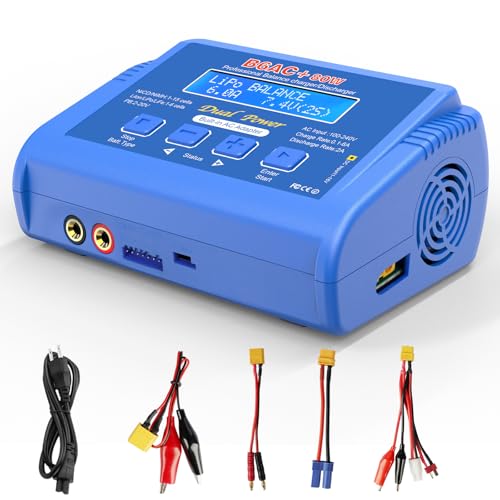
This charger delivers 80W of power with a 6A maximum current, supporting LiPo, LiFe, Li-ion, NiMH, NiCd, and Pb chemistries for packs up to 1S-6S on LiPo-based packs and up to 15S on NiMH/NiCd packs. It features multiple modes (charge, balance, discharge, storage) and automatic cut-off when charging completes. A shell made from fire-retardant material adds safety for hobbyists who frequently test different battery configurations. The unit is designed for straightforward operation with auto-adjusting balance charging, though it is advised not to connect AC and DC power cords simultaneously.
What to know:
- Good option for hobbyists who want a compact yet capable charger for common RC batteries.
- Balance charging simplifies maintaining even cell voltages across a pack.
Hiyiton C6X2 Dual LiPo Charger DC 240W

The C6X2 provides two independent charging channels, enabling simultaneous charging of two different packs with separate parameters. It supports a broad range of chemistries (LiPo, LiFe, Li-ion, LiHv, NiMH, NiCd, Pb) across 1S-6S, and 1S-15S for NiMH/NiCd, plus a clear LCD monitor for real-time status. With AC input up to 150W across both channels and 240W DC input, users can allocate power between channels as needed. It offers charge, balance, storage, and discharge modes, along with current and voltage regulation to suit diverse packs.
Practical notes:
- Dual-channel design saves time when handling two packs for the same vehicle or project.
- Watch the cooling needs during high-power balancing to maintain performance.
Aorika Dual Battery Charger For 1S-6S And 1S-15S Packs

This dual-channel charger supports a wide array of battery types including LiPo, LiHV, Li-ion, LiFe, NiMH, NiCd, Pb, and smart batteries. It accepts AC input of up to 150W and DC input up to 240W, with two independent charge paths (0.1-10A per channel) and 10W discharge capacity per channel. It emphasizes careful battery type selection before charging and provides multiple modes such as Charge, Balance Charge, Discharge, and Storage. The unit can store up to 20 memories for different battery configurations, helping users quickly select preferred settings for future sessions.
Key insights:
- Excellent for users who rotate through many pack types and require reliable memory presets.
- Ensure you match the voltage and chemistry to prevent misconfiguration.
Prettyia 19-Group NiMH/NiCd Charger

This charger focuses on NiMH and NiCd packs with smart charging features. It includes built-in protections against over-charge, over-current, short circuits, and reverse polarity to extend battery life. Automatic detection of battery voltage helps set appropriate current, reducing the risk of under- or overcharging. The unit supports a broad range of NiMH/NiCd capacities (often 1.2V to 12V pack configurations) and includes indicators that guide users through charging status. It’s a practical option for RC enthusiasts who rely heavily on NiMH/NiCd packs and want an affordable, auto-cutoff solution.
Usage notes:
- Best for NiMH/NiCd dominated fleets and educational kits where classic chemistry remains common.
- Monitor LED indicators to identify potential bad connections or incorrect polarity.
Hilldow B6 80W Mini Lipo Charger With LCD

The Hilldow B6 charger combines compact size with robust features. With 80W of charging power, it supports LiPo, Li-ion, LiFe, NiMH, NiCd, and Pb packs across a broad voltage range. The device includes an LCD display for real-time status and settings, along with protections against short circuits, overcharge, overcurrent, and overheating. It is suitable for users who want a dependable, multi-chemistry charger in a portable form factor, enabling parallel or single-pack charging depending on configuration. It emphasizes correct battery type selection and safe operation to maintain battery health over many charges.
Considerations:
- Compact design is ideal for field work or limited bench space.
- Ensure the selected mode matches the battery chemistry to avoid damage.
Buying Guide: Key Purchase Considerations For RC Battery Chargers
When choosing a charger for RC cars and related gear, consider these dimensions to balance performance, safety, and value:
- Power and speed: Higher wattage and current ratings reduce charge time for larger packs but require an adequate power supply. Dual-channel units can charge two packs at once, improving throughput for multiple cars or parts of a project.
- Battery chemistry support: Ensure the charger covers LiPo, LiHV, Li-ion, LiFe, NiMH, NiCd, Pb, and smart batteries if your inventory includes diverse pack types. Verify the maximum cell count (S) supported for each chemistry.
- Balance and safety features: Balancing is essential for LiPo longevity. Look for delta-peak detection, auto cut-off, temperature safeguards, and memory presets to protect both the battery and the charger.
- User interface: A clear LCD or digital readout helps monitor voltage, current, and cell balance in real time. Easy-to-navigate menus reduce setup time and mistakes.
- Portability vs. permanence: Compact units are great for travel or field work; larger models offer more power and feature breadth for a fixed bench setup.
- Power inputs: Note whether a charger uses AC, DC, or dual inputs. Some require separate power sources or may need to avoid simultaneous use of AC and DC cords for safety.
- Memory and programmability: Chargers with multiple memory slots simplify switching between common packs, saving configuration time during routine builds or races.
- Build quality and safety certifications: Fire-retardant casings and overheat protections are important for long-term reliability in environments with heat buildup during fast charging.
Bottom-line guidance: For frequent multi-pack sessions, prioritize dual-channel models with high wattage, broad chemistry support, and clear monitoring. For small projects or field use, portable chargers with essential safety features and straightforward operation may be sufficient. Always verify the compatibility of your specific RC packs and adhere to manufacturer recommendations to maximize battery life and performance.