Best Lab Kits for Kids: Hands-on Science Sets for Young Explorers
Discover engaging, age-appropriate science kits designed to spark curiosity and cultivate critical thinking in children. The right lab kit blends real-world experiments with safe, kid-friendly tools, turning learning into an immersive experience. The following selections are among the top-rated options for aspiring scientists, offering a mix of chemistry, earth science, and STEM activities that fit various ages and interests.
| Product | Brand | What Makes It Stand Out |
|---|---|---|
| National Geographic Junior Chemistry Set | Blue Marble | 50 hands-on experiments; easy illustrated guides; safe for young learners |
| National Geographic Mega Science Lab | Blue Marble | Three science kits in one; earth science, chemistry, and magic projects |
| UNGLINGA 150 Experiments Science Kit | UNGLINGA | Broad topic coverage; beginner-friendly manual; included tools |
| National Geographic Earth Science Kit | Blue Marble | Earth science focus; crystal growing; volcano and dig activities |
| Discovery Super Reactions Science Kit | Discovery Kids | 66 experiments; real chemistry concepts; slime and volcano projects |
Note: This article highlights five top-rated lab kits chosen for versatility, educational value, and kid-friendly design. Each product focuses on hands-on experimentation, safety, and clear guidance to support independent exploration.
National Geographic Junior Chemistry Set

What it offers: A complete chemistry lab designed for budding scientists aged four and up. This kit provides everything needed to start exploring chemistry with common household items, such as baking soda and vinegar. It includes 50 hands-on experiments with illustrated, step-by-step instructions, making it suitable for early learners to follow independently.
Why it works for kids: The combination of numerous experiments and accessible visuals helps children connect everyday activities to scientific concepts. The kit emphasizes curiosity and experimentation while supporting safe, supervised exploration at home or in the classroom.
Educational focus: Foundational chemistry concepts are introduced in a practical format, reinforcing observation skills, hypothesis testing, and basic measurement. Materials and tools are sized for small hands to enhance dexterity during experiments.
National Geographic Mega Science Lab
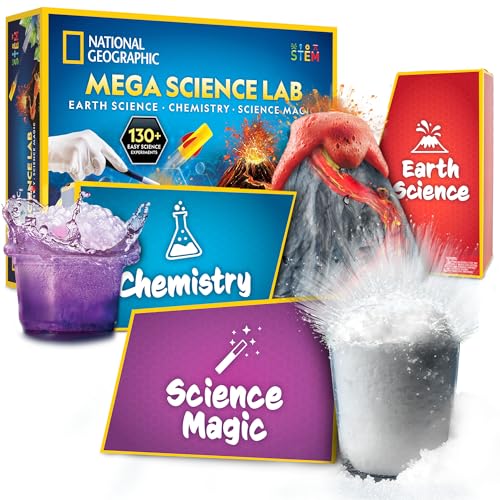
What it offers: A three-in-one science kit featuring earth science, chemistry, and science magic projects, plus an extra guide with 30 additional experiments. The package includes a selection of real rock, mineral, and crystal specimens for hands-on exploration.
Why it works for kids: The diverse activities maintain engagement by offering multiple disciplines in one kit. From erupting volcanoes to crystal growth, children experience a broad range of scientific topics, reinforcing curiosity and retention.
Educational focus: Students explore observational science, geologic concepts, chemical reactions, and basic laboratory reasoning. The kit emphasizes experiential learning and the joy of discovery in a structured format.
UNGLINGA 150 Experiments Science Kit

What it offers: A broad science kit with 150 experiments spanning earth science, chemistry, physics, and more. It includes a well-illustrated, step-by-step manual and kid-friendly lab tools and materials to support many experiments.
Why it works for kids: The wide range of topics keeps motivated learners engaged, while the clear instructions and included tools reduce setup friction. It’s suitable for ongoing projects and family science sessions.
Educational focus: The kit promotes critical thinking, problem solving, and a growing toolkit of science skills. It encourages kids to connect everyday observations to experiments and outcomes.
National Geographic Earth Science Kit

What it offers: A massive Earth science kit featuring experiments like dueling water tornadoes, erupting volcanoes, crystal growth, and dig activities. It includes a geologic dig kit and a diverse learning guide.
Why it works for kids: The kit blends exploration with structured learning, allowing children to work individually or with peers while discovering Earth science concepts in a tangible way.
Educational focus: Emphasizes geology, meteorology, and environmental science. The included learning guide helps kids understand the science behind each activity and relate it to real-world phenomena.
Discovery Super Reactions Science Kit

What it offers: A 66-experiment science kit focusing on chemistry, including real chemistry concepts like acid-base reactions, states of matter, and pH indicators. It includes volcano molds, slime, and other engaging projects.
Why it works for kids: The kit blends exciting activities with foundational science principles, helping kids see how chemical reactions translate to visible, dramatic results while maintaining safety and accessibility.
Educational focus: Encourages hands-on experimentation to build foundational chemistry knowledge, measurement, and scientific reasoning—without requiring advanced equipment.
Buying Guide: Key Purchase Considerations For Kids’ Lab Kits
- Age appropriateness: Select kits with clear age recommendations and simple instructions for younger children to promote independence and reduce supervision needs.
- Curriculum alignment: Consider whether the kit aligns with foundational science topics your child is studying, such as chemistry basics, Earth science, or engineering concepts.
- Hands-on vs. guided learning: Some kits emphasize open exploration with minimal instructions, while others provide step-by-step guides. A mix can support both creativity and structured learning.
- Safety and materials: Check for non-toxic materials, child-safe tools, and clear safety guidelines. Look for kits that use household items or included safe lab gear.
- Expandability: If your child enjoys a kit, choose options that offer future experiments or compatible add-ons to extend engagement over time.
- Interdisciplinary value: Kits that blend science with observation, math, and problem-solving tend to strengthen overall STEM skills and critical thinking.
- Storage and organization: Consider how easily components can be stored and organized after experiments to encourage ongoing use and reduce clutter.
- Social and family learning: Some kits are designed for group activity, which can enhance collaboration, communication, and peer learning experiences.
- Durability and reuse: Look for sturdy tools and reusable components, which can provide long-term value beyond a single project cycle.
- Real-world relevance: Kits that connect experiments to real-world phenomena (volcanoes, crystals, fossils) can help children see science as meaningful and interesting.
In sum, the best lab kits for kids balance safety, instructional clarity, and engaging experiments that nurture curiosity. Whether a budding chemist or an aspiring geologist, the right set fosters hands-on learning, scientific reasoning, and a lifelong interest in discovery.