Best Technology Toys for 8-Year-Olds: STEM Gift Ideas
For parents seeking engaging, screen-free ways to foster curiosity in 8-year-olds, a well-chosen tech toy can spark lifelong learning. The following selections emphasize hands-on building, programming, and problem-solving without excessive screen time. Each product below aligns with core STEM skills—from robotics to engineering fundamentals—while offering clear instructions and durable parts for growing minds.
The quick reference table below highlights five strong options, focusing on build-quality, educational value, and broad age suitability.
| Product | Brand | Type |
|---|---|---|
| Smartivity DIY Robotic Mechanical Hand | Smartivity | Mechanical robotics kit |
| Smartivity DIY Pinball Machine | Smartivity | Mechanical arcade game |
| Henoda Remote & APP Controlled Robot | Henoda | Remote/app-controlled robot |
| Henoda 443+ Piece Stem Robot | Henoda | Multi-piece STEM building robot |
| Klever Kits 36-in-1 Motor Robotic Kit | Klever Kits | Modular robotic builds |
The selections emphasize durability, clear educational value, and broad appeal for ages around eight and up. Each entry below includes a concise overview, a quick look at its strengths, and how it supports developing critical STEM skills in a real-world context.
Smartivity Robotic Mechanical Hand

The Smartivity DIY Robotic Mechanical Hand provides an action-packed, hands-on build that helps kids explore basic engineering concepts. The step-by-step manual guides builders through assembling a functional mechanical hand, promoting fine motor skills and spatial reasoning. It’s designed for children aged 8 to 14, with a clear focus on reducing screen time while teaching scientific ideas in a tangible way. A standout feature is the promise of a lifetime supply of replacement parts, which supports ongoing play and learning beyond the initial model.
Smartivity Pinball Machine

The Smartivity DIY Pinball Machine turns a classic arcade game into an engaging STEM project. It emphasizes 100% screen-free engagement, helping kids practice cause-and-effect reasoning, planning, and mechanical problem-solving as they assemble a functional, interactive game. The kit appeals to both boys and girls within the 8–14 age range and includes replacement parts to support extended learning sessions without interruption. Clear, hands-on instructions promote independent exploration and confidence in engineering tasks.
Henoda Remote & APP Controlled Robot
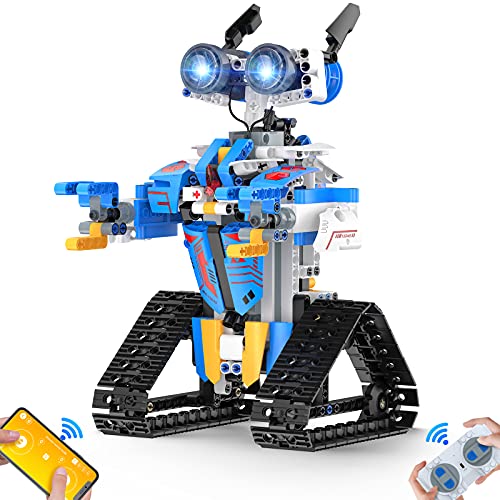
This Henoda robot combines both remote control and smartphone app interaction, offering multiple modes including path, voice, gravity sensor, and STEM programming. With 468+ pieces, it supports extensive building and experimentation, enabling kids to explore robotics concepts such as motion control, joint articulation, and simple programming logic. The remote and Bluetooth connectivity expand play options, which can help maintain sustained interest in engineering challenges and hands-on problem solving.
Henoda 443+ Piece Stem Robot
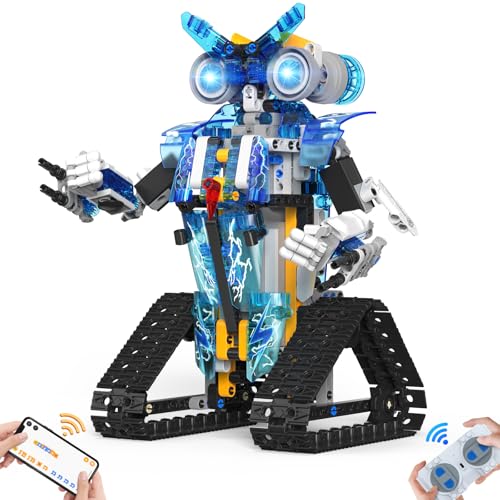
This Henoda kit emphasizes multi-part STEM building with 443+ pieces and adjustable robot components. The design supports creative construction, hand-eye coordination, and problem-solving as kids assemble, customize, and program their robot—encouraging logical thinking and imaginative engineering. It includes both remote and Bluetooth smartphone control, allowing a flexible approach to learning and play in varied settings.
Klever Kits 36-in-1 Motor Robotic Kit
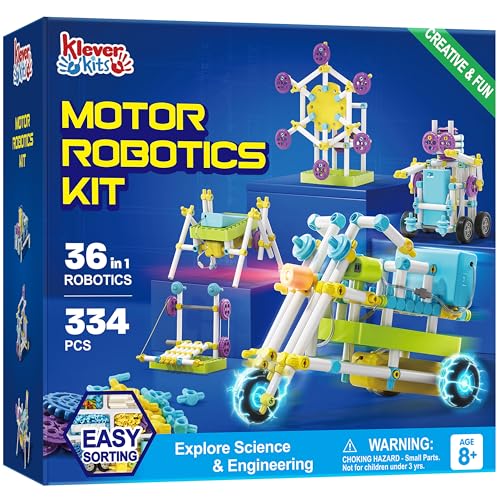
The Klever Kits offering provides 36 different robot designs, including 14 motorized models, encouraging kids to explore a wide range of mechanical configurations. This modular approach supports ongoing experimentation, problem-solving, and iterative design, with a parts tray that helps keep components organized. It’s well-suited for learners who enjoy a broad exploration of robotics concepts, from gears and motion to control mechanisms and simple automation.
Buying Guide
- Age appropriateness and safety: Check recommended ages and ensure parts are sized for eight-year-olds to minimize choking hazards and maximize handling ease. Look for durable plastics and secure fasteners that withstand repeated assembly.
- Learning objectives: Define whether you want focus on robotics, programming, or general engineering. Some kits emphasize motorized construction, while others introduce Bluetooth control, app integration, or solar power for environmental awareness.
- Complexity and progression: Choose a kit that offers a clear learning curve. Starter kits that unlock more advanced models over time can sustain interest as a child’s skills grow.
- Maintenance and replacement parts: Prefer products that include a parts replacement plan or lifetime spare parts, reducing frustration during extended play.
- Hands-on time vs. screen time: If reducing screen time is a priority, favor kits with comprehensive, paper-based instructions and tactile components, rather than those requiring ongoing app interaction.
- Educational value and outcomes: Consider how the kit develops core skills—spatial reasoning, problem-solving, fine motor control, measurement, and basic coding concepts. A mix of mechanical design and logical thinking often yields the best long-term benefits.
- Future-proofing: For families with multiple kids or evolving interests, modular kits offering multiple build options provide ongoing value without needing to purchase new sets frequently.
- Budget and durability: While prices vary, prioritize sturdy builds with reusable parts, so the toy remains engaging over months and even years.
Overall, the selections above emphasize practical, science-based play that Illuminates core STEM topics without overwhelming young learners. By combining mechanical design, programmable features, and creative experimentation, these products support a well-rounded early-technology education that can adapt to a child’s growing interests.