Best Wooden Toys for 6 Year Olds: Engaging Picks for Curious Minds
Discover top wooden toys that captivate 6-year-olds with engaging STEM concepts, fine motor practice, and imaginative play. The selections below emphasize durable materials, safe finishes, and developmentally appropriate challenges that align with growing independence and curiosity. Each pick combines hands-on learning with screen-free play to support concentration, problem-solving, and creativity during critical early school years.
Summary of Selected Products:
- Centtechi Montessori Game Wooden Board Game — 42 colorful sticks and a Pisa-inspired tower for 1-6 players.
- LiKee Open Ended Wooden Shape Puzzles — 36 blocks with 60 pattern cards for spatial and color skills.
- Oppvoci Wooden Montessori Russian Blocks Puzzle — 42 blocks with 10 double-sided cards for guided 3D builds.
- Zeewoo Montessori Toys Board Game — colorfully stacked sticks, stones, and dice for multi-player learning.
- KODATEK Wooden Snap-Together Building Toys — open-ended robotics-style pieces for imaginative engineering.
Centtechi Montessori Board Game

The Centtechi wooden board game is a classic-tradition inspired learning toy designed for up to six players. Its beech wood construction and soluble, safe paint provide long-lasting durability without odors. The game includes a Pisa-inspired tower, 42 colored sticks, 6 balls, and 1 dice, offering both a physical puzzle and counting activities. Children pull sticks to influence outcomes, which strengthens fine motor skills, hand-eye coordination, and early strategic thinking. The design encourages collaborative play, helping families build communication while solving challenges in real time.
Educational value centers on spatial reasoning and patience. As players take turns removing sticks without toppling the tower, kids practice careful planning and prediction. The colorful pieces also support color recognition and counting skills, while the wooden surface reduces sensory overload from plastic textures. Parents can use the game for short, structured sessions or longer family game nights, promoting turn-taking and fair play. The toy doubles as a decorative piece when not in use, blending learning with room aesthetics.
Target age alignment covers preschool through early elementary, with a focus on 6-year-olds who relish group play and more complex thinking tasks. The board game format makes it easy to integrate into math or logic-focused activities, offering a tactile alternative to digital learning. Safety features are emphasized through a burr-free finish and smooth surfaces, ensuring a calm, engaging play experience that supports gradual mastery of fine motor precision.
LiKee Open Ended Wooden Shape Puzzles

The LiKee set provides 36 wooden shape pieces and 60 pattern cards, stored in two tins. This open-ended design invites children to recreate shown designs or invent new configurations, fostering spatial awareness, color and shape recognition, and fine motor control. The cards offer graduated challenges, supporting a progression from simple to complex layouts as a child’s confidence grows. The stacking tins promote tidy storage, encouraging responsibility alongside creativity during travel or classroom activities.
Educational impact includes strengthened hand-eye coordination and problem-solving as children compare shapes, rotate pieces, and test fit. The activity encourages independent exploration while offering opportunities for guided play with a caregiver. For 6-year-olds, the cards can serve as prompts for storytelling or math-tied tasks, such as matching shapes to numbers or creating symmetrical patterns. The toy’s enduring appeal lies in its adaptability to various skill levels, ensuring continued engagement beyond initial demonstrations.
From a development perspective, this set supports early geometry concepts like shape properties and spatial relationships. It is portable and durable, suitable for travel, car rides, or classroom centers. Parents can scale the complexity by selecting patterns with more pieces or introducing timing challenges. The materials are wood-based, designed for long-term use, and free from high-gloss coatings that could cause glare or distraction during focused play sessions.
TMGOT Magnetic Wooden Color Matching Puzzle

This magnetic color-matching puzzle combines Montessori principles with tactile exploration. The set includes 20 double-sided cards, a magnetic pen, and 16 wooden pieces in four colors. Children select a card and use the pen to move pieces to match the card’s pattern. The activity develops logical thinking, color recognition, and fine motor skills while offering a pen-controlled action that promotes precise grip development. The design supports independent problem solving as well as guided play with a parent or teacher.
Targeted for ages 3 through 7, this toy emphasizes multi-step thinking and visual matching, essential for early critical thinking. The magnetic mechanism provides a satisfying, repeatable interaction that keeps kids engaged without the mess of loose pieces. The compact size makes it ideal for travel, waiting rooms, or classroom centers where focused, short-duration tasks are preferred. The kit’s portability aligns well with 6-year-olds who benefit from compact, manageable challenges during a busy school year.
From a safety and usability standpoint, the pieces are finished with child-friendly coatings, and the magnetic components are designed to be easy to lift and maneuver for developing motor control. The open-ended nature of the activity also invites kids to experiment with different patterns, encouraging creativity alongside cognitive development. Overall, it provides a structured, screen-free activity that reinforces the fundamentals of color matching and spatial organization.
Oppvoci Wooden Montessori Russian Blocks Puzzle
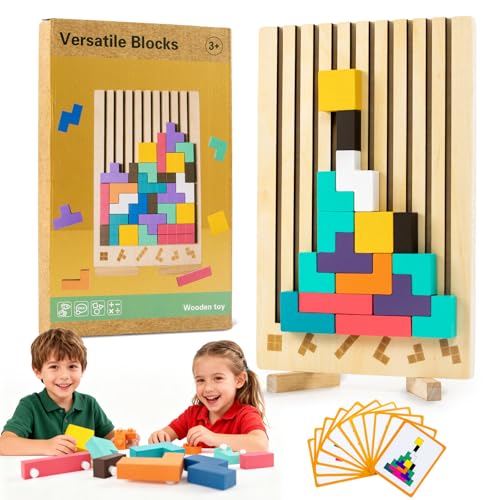
The Oppvoci wooden Russian Blocks puzzle blends classic stacking dynamics with Montessori-informed learning. The set includes 42 wooden blocks in 9 shapes and 10 double-sided cards with 20 designs to guide play. Stacking the blocks builds spatial awareness, problem-solving, and fine motor skills, while pattern cards introduce structured, guided activity. This flexibility allows for beginner builds and more complex 3D structures as a child grows, providing ongoing engagement for 6-year-olds who enjoy architectural play and creative construction.
Montessori principles are evident in the emphasis on hands-on exploration and self-directed discovery. Children can follow cards to reproduce designs or innovate their own creations, fostering creativity and independent thinking. The block shapes support color and shape recognition, as well as early geometry concepts, without overwhelming cognitive load. The set is compact and durable, making it suitable for home playrooms, classrooms, and travel scenarios where a versatile, low-tech option is preferred.
With adult supervision or instruction, this toy can extend into collaborative projects, where siblings or peers share building tasks, negotiate designs, and develop communication skills. It is well-suited for 6-year-olds who enjoy tinkering, testing hypotheses about stability, and learning through trial and error in a safe, tactile environment.
Zeewoo Montessori Board Game

The Zeewoo Montessori board game offers a four-to-eight-player format featuring a wooden tower, 40 colorful sticks, 5 balls, 1 dice, and 10 wooden stones. Inspired by classic stacking games, it emphasizes fine motor skills, spatial reasoning, and color matching. The progressive design supports various play modes—from simple color association to more intricate stacking challenges—making it suitable for 6-year-olds seeking a more complex, collaborative group activity. The wooden construction and bright finishes contribute to an appealing, durable toy that can withstand active family play.
Educational benefits include patience, turn-taking, and social interaction, alongside cognitive growth through pattern recognition and strategic planning. The multi-player aspect fosters communication and cooperation, while the in-built variability keeps games fresh. The toy’s portability suits classrooms and travel alike, and the absence of electronic elements preserves a traditional, screen-free learning environment. As children master stacking strategies, they develop confidence in problem-solving and spatial judgment.
KODATEK Wooden Snap-Together Building Toys

The KODATEK building set includes color-coded, snap-together heads, legs, arms, and bodies that let children assemble a variety of robots and creatures. The open-ended design encourages imaginative engineering, with pieces that snap together easily for small hands. The construction fosters creative thinking, logical reasoning, and problem-solving as kids mix and match components to create new shapes. The tactile, hands-on play helps develop fine motor skills and spatial awareness while supporting collaborative play when children build together or exchange ideas.
Designed for 3- to 6-year-olds, the set scales well for 6-year-olds who crave more complex constructions or challenge their peers with inventive designs. The simple snap mechanism reduces frustration and promotes perseverance, while the vibrant colors add visual appeal and aid in colorRecognition and categorization. The wooden build quality ensures durability for repeated use across play sessions, classroom centers, or after-school clubs, making it a practical long-term addition to a child’s toy collection.
Buying Guide: Key Purchase Considerations For Wooden Toys For 6 Year Olds
- Educational Value: Look for toys that promote fine motor skills, spatial reasoning, problem-solving, and critical thinking. Multi-step activities that require planning and sequencing tend to offer the broadest developmental benefits for a 6-year-old.
- Age Appropriateness: Ensure the toy is suitable for ages 5–7 to align with a 6-year-old’s cognitive and motor development. Avoid toys designed only for younger or much older children unless they advertise scalable difficulty.
- Materials And Safety: Prioritize solid wood with non-toxic finishes, burr-free edges, and smooth surfaces. Durable construction reduces breakage and prolongs use through enthusiastic play and travel.
- Open-Ended Play: Favor toys that allow multiple play modes and interpretations. Open-ended blocks, puzzles, and stacking systems encourage creativity and reduce repetitive learning patterns.
- Durability and Portability: Consider items that travel well and resist wear. Smaller sets are ideal for travel, while larger boards or stacks support longer, more involved sessions at home or in the classroom.
- Social Play Value: Group-friendly toys help develop collaboration, communication, and turn-taking. Multi-player games are especially valuable for family bonding and classroom dynamics.
- Storage And Clean-Up: Look for integrated storage solutions or simple organization schemes to foster responsibility and ease of cleanup after play.
- Future Reusability: Prefer modular or expandable designs that allow evolving challenges as a child grows, ensuring continued engagement without immediate replacement.
These considerations help compare options beyond surface appeal, focusing on whether a toy fosters reliable skill development, safe use, and lasting interest. When evaluating the listed products, consider how each addresses hand-eye coordination, spatial reasoning, color and shape recognition, and collaborative play. For families with varied interests—math-focused challenges, creative construction, or interactive group play—these picks provide balanced choices that align with a 6-year-old’s expanding educational landscape.