Best Building Kits for Teens: Engaging STEM Projects for Mindful Makers
Building kits for teens blend hands-on fun with real-world learning, helping young makers develop problem solving, engineering thinking, and creative confidence. This guide spotlights five top-rated kits that align with teens’ curiosity, covering mechanical builds, hydraulics, solar energy, and electronics. Each selection provides clear instructions, safe components, and meaningful projects to explore science, technology, engineering, and math in an approachable way.
| Product | Brand | Key Feature | Amazon Link |
|---|---|---|---|
| NATIONAL GEOGRAPHIC Da Vinci Model Kit – Catapult Kit for Kids | Blue Marble | Functional catapult, ballista, bombard, 15 projectiles | Product Link |
| Discovery Model Engine Building Kit | Discovery | 4-cylinder engine with pistons, belts, LED lights | Product Link |
| Yutin 5 Individual STEM Science Kits | Yutin | 5-in-1 wooden kits with rotating Ferris wheel and lights | Product Link |
| Teach Tech Hydrobot Arm Kit | TEACH TECH | Hydraulic powered robotic arm with 6 axes | Product Link |
| Sillbird 12-in-1 Solar Robot Building Kit | Sillbird | Solar powered robot with 190 pieces | Product Link |
NATIONAL GEOGRAPHIC Da Vinci Catapult Kit

The Da Vinci Catapult Kit from National Geographic (Blue Marble) invites teens to explore medieval engineering through hands-on construction. The set includes laser-cut wooden components, rubber bands, sandpaper, and clear instructions to assemble three machines: a Ballista, a Bombard, and a Catapult. Fully functional prototypes let students observe mechanical principles in action, including leverage, tension, and projectile motion. With 15 projectiles and 6 paper targets, this kit turns a classroom-like challenge into a tangible proof-of-concept exercise that supports STEM learning outside of school.
Discovery Model Engine Building Kit
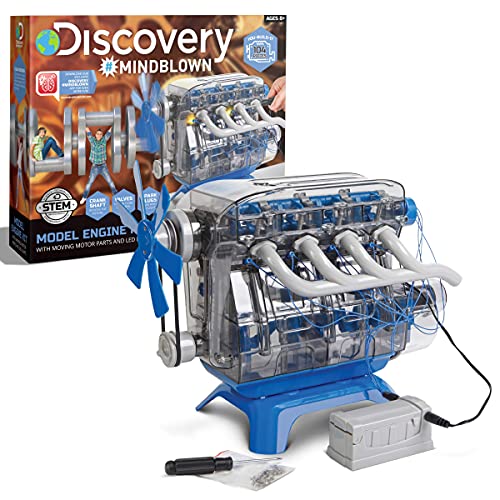
This DIY engine kit lets teens assemble a working 4-cylinder engine with pistons, valves, belts, and LED lights. The activity promotes critical thinking as learners manipulate cranks and pulleys to observe mechanical motion translating into rotational energy. The kit comes with all necessary tools and parts, enabling a cohesive build experience from start to finish. As students connect electrical components and mechanical systems, they gain an appreciation for how engines convert fuel or electrical power into motion, movement, and sound cues that reflect real-world engineering.
Yutin 5-in-1 STEM Wood Kits
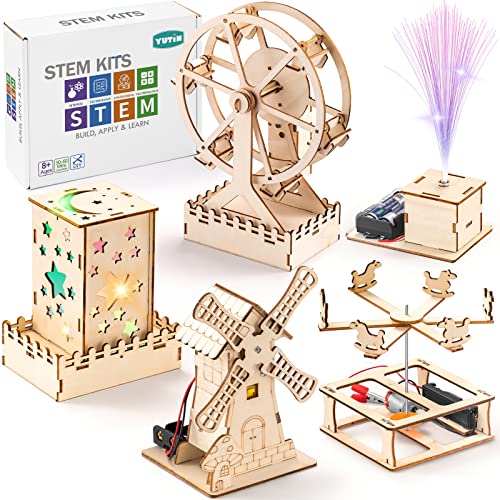
The Yutin 5-in-1 wooden STEM kits present a theme-park-inspired collection: a rotating Ferris wheel, a merry-go-round, a windmill house, a fiber optic lamp, and a star nightlight. Aimed at ages 8-14, these kits blend art and engineering, encouraging kids to assemble, paint, and customize their crafts. The activity fosters spatial reasoning, sequencing, and basic electrical concepts (battery operation for lights). While the projects are decorative, they also demonstrate how mechanical components translate to moving parts and powered outcomes, linking creativity with foundational STEM ideas.
Teach Tech Hydrobot Arm Kit

The Hydrobot Arm Kit from Teach Tech introduces hydraulics in a practical, kid-friendly format. The kit guides teens through building a working robot arm powered by water pressure, with six axes and a 270-degree rotation capability. No batteries are required, emphasizing energy principles and fluid dynamics. Learners control the gripper with levers, enabling them to open, close, and swap in suction components to pick up objects. This kit highlights engineering discipline, reliability, and problem-solving as students experiment with force transmission and control systems.
Sillbird 12-in-1 Solar Robot Kit

The Sillbird Solar Robot Kit engages teens with renewable energy concepts. This 12-in-1 Solar Robot project uses sunlight to power its movement, offering outdoor play and screen-free engagement. The kit includes 190 pieces, providing ample building opportunities and room for experimenting with solar power versus indoor lighting when sun is scarce. Students observe how solar cells convert light into electric energy and motion, then can explore alternate energy sources or substitute power under varied lighting conditions for continued experimentation.
Buying Guide for Building Kits
When selecting building kits for teens, consider several purchase factors to ensure value, safety, and lasting engagement.
- Age appropriateness and complexity: Choose kits that match the teen’s skill level, while offering room to grow with increasingly challenging builds.
- Project scope and goals: Decide whether the focus is mechanical engineering, electronics, hydraulics, or renewable energy, aligning with academic or personal interests.
- Component quality and safety: Look for durable materials, clear instructions, and non-toxic components suitable for teen handling.
- Hands-on learning value: Prefer kits that demonstrate core concepts (levers, gears, circuits, hydraulics) with observable outcomes and real-world connections.
- Expandability: Some kits integrate with supplementary modules or future projects, enabling ongoing learning and progression.
- Waste and maintenance: Consider how easy it is to replace parts, discard waste, and store components neatly after projects.
- Skill coverage: A balanced kit can cover multiple STEM areas—mechanical design, electronics, and energy—providing a well-rounded experience.
For teachers and parents, look for kits that offer teacher guides, troubleshooting tips, and safety notes to support independent teen work or guided sessions. Hands-on projects paired with supplementary resources (diagrams, online tutorials) can deepen comprehension and sustain interest. Finally, verify availability and delivery expectations to ensure timely access for classroom or at-home projects.