Best RC Car Lipo Battery Chargers for Fast, Safe Charging
Choosing the right LiPo charger can improve charging speed, enhance battery care, and help extend pack life for RC cars, drones, and other hobby devices. This guide reviews five reliable, high-performance chargers designed for 1S-6S LiPo/Li-ion/LiFe/LiHV packs, plus NiMH/NiCd and Pb options. Each product highlights new features like dual channels, smart charging, and safety protections to help you compare effectively.
The following table summarizes key details of the selected chargers to help you compare at a glance:
| Product | Max Power / Current | Cell Range | Notable Features | Brand |
|---|---|---|---|---|
| HTRC 150W Dual Channel Charger | 150W total (70-100W per channel typical) | 1S-6S LiPo/Li-ion/LiFe/LiHV; 1-15S NiMH/NiCd; Pb | AC/DC input, memory storage, smart protections | HTRC |
| Hilldow B6 Charger | 80W | 1S-6S LiPo/Li-ion/Li-Fe; 1-15S NiMH/NiCd | LCD display, multiple protections, safe parallel charging | Hilldow |
| HTRC 80W Dual RC Charger | 80W per channel, dual channels | 1S-6S LiPo/LiHV/Li-ion/LiFe; 1-15S NiCD/NiMH | Two channels, multiple modes, data storage | HTRC |
| HTRC 80W/150W Variety Charge 1-6S | Up to 150W AC input, 240W DC input (dual-channel potential) | 1S-6S LiPo/Li-ion/LiFe; 1-15S NiMH/NiCd; Pb; smart | Balance, charge, discharge, storage; memory | HTRC |
| Venom Power Pro Duo | 160W total (80W per port) | 1S-6S LiPo/LiHV/Li-Ion/LiFe; 1-15S NiMH/NiCd; Pb | Dual ports, multiple modes, 8 charge leads | Venom Power |
Product Sections
HTRC 150W RC Battery Charger – Fast, Safe Charging

This HTRC charger delivers up to 150W with dual input options (AC/DC) and a powerful circuit designed to support a wide range of cell counts from 1S to 6S for LiPo/Li-ion/LiFe/LiHV packs and up to 15S for NiMH and NiCd, plus Pb and smart batteries. It features automatic charge current limit, delta-peak detection, memory storage for up to 20 profiles, and firmware update capability. Note: do not power with both AC and DC cords at the same time. This charger is suited to RC car enthusiasts who juggle multiple battery types and need a compact, multi-mode unit.
Hilldow B6 80W Mini Lipo Balance Charger

Hilldow’s B6 charger is built with safety in mind, featuring short-circuit, overcharge, overcurrent, and overheat protections. It supports charging and discharging for LiPo/Li-ion/Li-Fe/NiMH/NiCd and Pb batteries, with an LCD display for real-time status. Its user-friendly design is ideal for hobbyists who value straightforward operation and clear feedback from the charger, especially when balancing multiple packs.
HTRC LiPo Battery Charger 80W Balance Charge
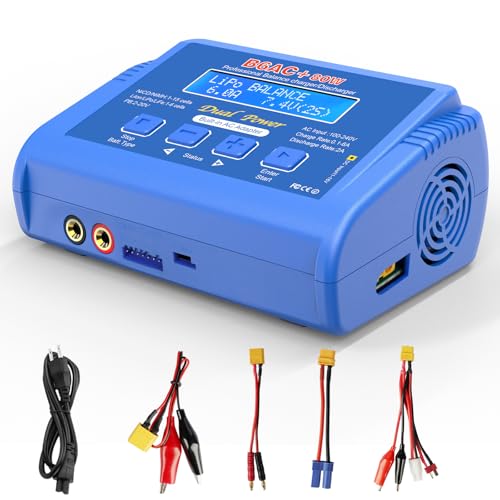
This charger supports 80W, 6A per channel, and accepts a broad range of chemistry families including LiPo, LiFe, Li-ion, NiMH, NiCd, Pb, and smart batteries. It offers charge, balance charge, discharge, and storage modes with automatic charging stop when the battery is full. The unit emphasizes safety with a fire-proof shell and clear mode controls, though users should ensure they select the correct battery type before charging.
Aorika Dual LiPo Charger – Fast Balance Charge

Aorika’s dual-channel charger supports simultaneous charging of two batteries with separate channels. It handles 1S-6S LiPo/LiHV/Li-ion/LiFe and 1S-15S NiMH/NiCd, plus Pb and smart batteries. The dual-port design allows flexible charging setups, including memory storage for up to 20 battery profiles and a balance feature to maintain cell health during discharge. Users should be mindful to charge only matching types on each channel to avoid cross-configuration issues.
Venom Power Pro Duo – Dual Port Balance Charger
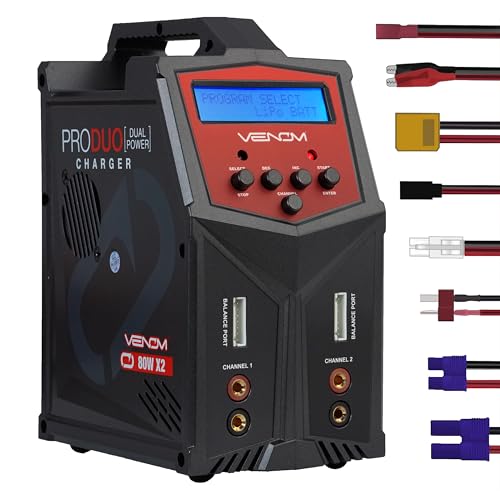
Venom Power Pro Duo combines two independent 80W circuits for a total of 160W, enabling true dual-port charging for two different batteries at once. It supports a wide array of chemistries, including LiPo, LiHV, Li-Ion, LiFe, NiMH, NiCd, and Pb, and ships with eight charging leads for compatibility with common RC setups. It features balance charge, fast charge, discharge, cycling, storage, and a battery meter, with up to five stored profiles for quick access during field use.
Buying Guide: Key Considerations When Picking an RC Car Battery Charger
- Battery compatibility: Confirm the charger supports the cell count and chemistry you use (1S-6S LiPo/LiHV/Li-ion/LiFe; NiMH/NiCd; Pb). If you switch packs frequently, prioritize wider compatibility and smart charging features.
- Power and charging speed: Higher wattage reduces charge time but requires adequate power inputs. Consider dual-channel designs if you routinely charge two packs simultaneously.
- Safety features: Look for short-circuit, overcharge, overheat protections, temperature thresholds, and a fire-proof shell. Auto-stop when full charge protects cells from overcharging.
- Charging modes: Essential modes include Charge, Balance Charge, Discharge, and Storage. Balance charging helps maintain cell health, while storage mode is useful for long-term battery maintenance.
- Display and usability: An LCD display or clear indicators helps you monitor voltage, current, and charging status. A user-friendly interface reduces setup errors.
- Memory and data management: Chargers with memory for multiple battery profiles simplify field use and enable quick setup for common packs.
- Firmware updates: Units with updatable firmware can gain new features or improved safety behavior over time.
- Physical design: Size, weight, and connector options (XT60, Deans, JST, T-Plug, etc.) influence compatibility with your RC gear and workbench.
- Power input options: AC input is convenient for home use; DC input caters to in-field charging with a car adapter or DC supply. Some units restrict simultaneous AC and DC use, which you should respect for safe operation.
These chargers provide a spectrum of capabilities from compact, single-channel models to robust dual-port systems suitable for serious RC hobbyists. When selecting a charger, map your typical battery count, pack chemistry, and the portability requirements of your setup to choose a unit that offers the right balance of power, protection, and ease of use.