Best STEM Toys for 7 Year-Olds: Top Picks for Curious Young Minds
Discover engaging, age-appropriate STEM toys that foster creativity, problem-solving, and hands-on learning for 7-year-olds. The following selections combine robotics, science experiments, engineering challenges, and anatomy exploration to support early Geniuses in science and tech. Each product emphasizes safe, interactive play and educational value, helping kids build foundational skills while having fun.
| Product | Brand | Key Benefit |
|---|---|---|
| STEM Kits for Kids Crafts | BeAndge | Multiple(robotics) projects; hands-on building |
| Gravity Maze | ThinkFun | Critical thinking through marble maze challenges |
| 50-in-1 STEM Building Kit | Veecafiodi | Wide range of engineering models; motorized play |
| National Geographic Earth Science Kit | Blue Marble | Earth science experiments; big, shareable kit |
| Dan&Darci Human Anatomy Squishy Model | Dan&Darci | Hands-on anatomy exploration with removable parts |
STEM Kits for Kids Crafts 6-8 8-12, BeAndge

The BeAndge STEM kit includes five sets: a solar powered car, a wind powered car, an obstacle avoidance robot, a transmission tank, and a glider. Designed to captivate curious 7-year-olds, these projects encourage experimentation, iterative thinking, and early robotics concepts. The kit is ideal for family STEM activities or classroom demonstrations. Note that AA batteries are required but not included. A thoughtful gift option for budding engineers, the set arrives in a gift box and supports science fair-worthy projects at home or school.
ThinkFun Gravity Maze – Falling Marble Logic Game

Gravity Maze blends puzzle play with basic engineering concepts. Players arrange towers and create a marble flight path to reach a target, stimulating critical thinking, planning, and spatial reasoning. With multiple levels of challenge, Gravity Maze keeps children engaged as they experiment with different routes and structures. It is suitable for individual play or classroom use, and helps develop perseverance and problem-solving skills while remaining accessible to 7-year-olds.
KLUTZ Lego Race Cars STEM Activity Kit

This book-and-supplies kit guides kids to build 10 LEGO race cars and a racetrack. It promotes spatial reasoning, logical thinking, creativity, and hands-on STEM skills through step-by-step instructions. The combination of reading and building makes it well-suited for independent play or parent-guided projects, offering a structured yet imaginative pathway into engineering and design.
Blue Marble National Geographic Magic Chemistry Set
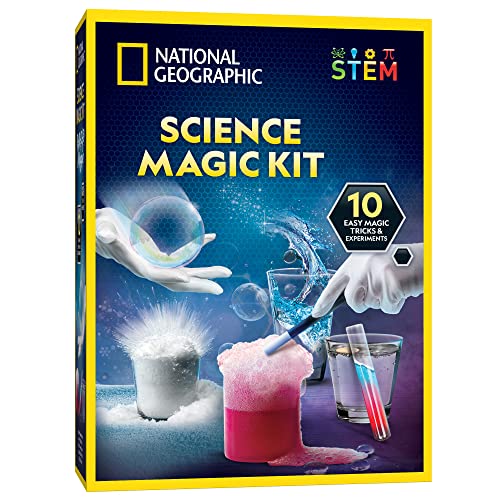
Blue Marble’s Magic Chemistry Set blends science experiments with magic-inspired tricks. Kids can perform 10 brain-tingling experiments, including color-changing water and floating coins, enhanced by a kid-friendly guide. Aimed at 8- to 12-year-olds, the kit makes science approachable and entertaining through visual demonstrations, magical presentation, and approachable explanations of the science behind the tricks.
Veecafiodi 50 in 1 STEM Building Kit

The Veecafiodi kit offers 50-in-1 building possibilities with 107 durable pieces and a motorized option requiring three AAA batteries. Models include unmanned jets, radar vehicles, attack robots, Ferris wheels, and more, encouraging engineering exploration and problem-solving. The included instruction manual simplifies assembly and storage, making it a versatile option for extended STEM play and creative construction sessions for 7-year-olds.
Dan&Darci Human Anatomy Squishy Model

Dan&Darci’s squishy body model invites hands-on anatomy exploration. With 30 removable parts including organs, bones, and a flexible spine, kids can disassemble, examine, and reassemble the human body. The accompanying guide presents engaging facts, interactive activities, and challenges that reinforce biology concepts, measurement, and observation—ideal for curious 7-year-olds who enjoy tactile learning and scientific storytelling.
Buying Guide: Key Purchase Considerations
Choosing STEM toys for 7-year-olds involves balancing challenge with accessibility. Consider:
- Skill progression: Look for sets that offer expandable challenges to grow with the child.
- Type of learning: Robotics, chemistry, Earth science, and anatomy provide diverse experiences—rotate through topics to maintain engagement.
- Safety and age suitability: Ensure small parts and batteries are age-appropriate; supervise accordingly.
- Durability and storage: Durable components and organized storage help families manage active play.
- Educational value: Prefer kits with clear explanations, real-world applications, and opportunities for family involvement.
When evaluating options, assess how each toy aligns with your child’s interests—engineering challenges, scientific experiments, or anatomy exploration—and consider a mix to cover a broad STEM spectrum. Cross-check for included manuals, assembly difficulty, and whether batteries are required but not included. A balanced mix of hands-on building, problem-solving, and science communication tends to yield sustained engagement and skill growth for early elementary learners.