Best Interactive Toys for 3-Year-Olds: Engaging Learning Play
Interactive toys for 3-year-olds blend pretend play, early literacy, and fine motor skills. This guide highlights five engaging options designed to support language development, problem solving, and playful exploration. Each pick features hands-on activities, age-appropriate challenges, and safe, kid-friendly designs that suit curious toddlers and preschoolers alike.
Summary of chosen products:
| Product | Brand | Key Benefit | Link |
|---|---|---|---|
| LeapFrog 2-in-1 LeapTop Touch, Green | LeapFrog | Flexible laptop/tablet play with name spelling | Amazon |
| Airbition Talking Flash Cards | Airbition | Vocabulary building with 224 words | Amazon |
| HopeRock Whack A Frog | HopeRock | Fine motor and coordination with multi-mode play | Amazon |
| Magnetic Wooden Fishing Game | NASHRIO | Color, letter, and number recognition through fishing | Amazon |
| LeapFrog Prep for Preschool Activity Book | LeapFrog | Six touch-responsive pages for school readiness | Amazon |
LeapFrog 2-in-1 LeapTop Touch

The LeapFrog 2-in-1 LeapTop Touch mixes computer-style play with tablet-like activities. In keyboard mode, children tap letters A-Z and numbers 1-10 to practice early literacy and numeracy. The screen can flip to tablet mode for swiping and pretend email-style interactions. Role-play options let kids imagine emailing Scout, while parents can customize features to reinforce spelling of the child’s own name. This toy supports letter recognition, basic word-building, and imaginative play, all in a compact, kid-friendly design.
Airbition Talking Flash Cards

This talking flash card set includes 224 illustrations and sounds to support vocabulary growth across categories like animals, vehicles, foods, fruits, and vegetables. Designed with Montessori-inspired learning in mind, the device helps with speech therapy and autism-related learning through a sound-image pairing. A standard American accent reinforces clear pronunciation, and a repeat button allows kids to practice challenging words. Volume control and simple operation keep playtime accessible for toddlers and preschoolers.
HopeRock Whack A Frog Game

This interactive frog game uses five modes and 45 levels to develop motor skills, timing, and coordination. Modes include Pass, Competitive, Memory, Play, and Piano, which keeps children engaged as they master increasing difficulty. An upgraded spray feature adds visual excitement and encourages repeated play. The game asks children to tap light-up frogs to score points, building finger strength and precision while fostering focus and rhythm through music and lights.
Magnetic Wooden Fishing Game
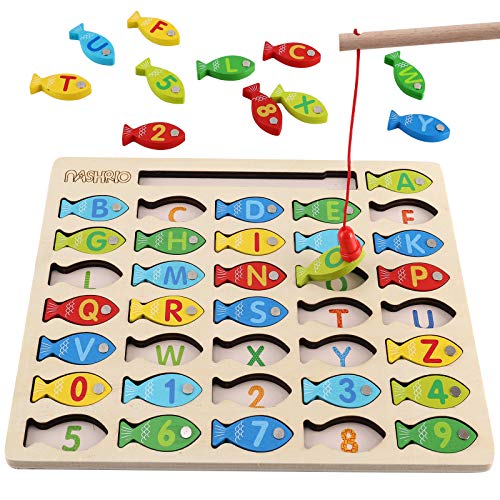
This wooden fishing puzzle combines color, letter, and number recognition with motor skill development. A corkscrew-style pole catches fishing pieces from a board painted with non-toxic, water-based dyes. The natural wood construction emphasizes safety, smooth edges, and durability. Toddlers practice hand-eye coordination while identifying letters and numbers, making it a gentle introduction to early literacy and basic math concepts in a tactile, hands-on format.
LeapFrog Prep for Preschool Activity Book

This activity book helps preschoolers prepare for school with six touch-sensitive pages featuring counting, colors, shapes, alphabet, and early words. Additional marker pages with an erasable pen allow practice with letter writing, number matching, shape tracing, and line drawing. A “Dress for the Weather” page encourages kids to choose appropriate clothing and draw the outfit, supporting independent decision-making and daily living skills while reinforcing readiness concepts.
Buying Guide: Key Purchase Considerations
- Educational goals: Choose toys that align with literacy, numeracy, motor skills, or social play. Consider whether the toy encourages active thinking, problem solving, or creative storytelling.
- Age appropriateness: Confirm the manufacturer’s recommended age range and assess whether the child can handle fine motor tasks, small parts, or increased complexity.
- Durability and safety: Prioritize sturdy materials, rounded edges, and non-toxic finishes. Look for certifications and age-appropriate restrictions on small parts.
- Screen time balance: For tech toys, balance digital play with hands-on activities to support a well-rounded development.
- Social and language benefits: Toys that encourage cooperative play, turn-taking, or verbal interaction can support language development and social skills.
- Portability and storage: Consider size, weight, and whether the toy can be easily stored or transported for travel or playdates.
- Maintenance and batteries: Check if batteries are required, how long they last, and whether the product is easy to clean and maintain.
- Value and longevity: Look for toys that evolve with a child’s skills, offer replay value, or provide multiple modes of play to extend use beyond a single activity.
- Learning style fit: Visual, auditory, or tactile learners may benefit from different formats; a mix of sound, sight, and touch often yields the best results.
These considerations help parents compare options across brands, ensuring a balanced mix of entertainment and education. The selected products emphasize interactive play that fosters motor development, language growth, and cognitive skills while remaining appropriate for three-year-olds.