Best Telescope Finder Scopes for Quick Targeting
Finding objects in the night sky starts with a reliable finder scope. The following picks emphasize ease of use, image orientation, and bright views to help you locate stars, planets, and DSOs more efficiently. Each product is designed to complement a variety of telescopes, from beginner setups to more advanced rigs. The list below focuses on popular finder scopes that balance performance with value, so you can choose the best fit for your observing sessions.
| Product | Brand | Key Benefit |
|---|---|---|
| Telrad Finder Sight | TELRAD | Non-magnified, sky-centered aiming |
| Celestron 51630 Star Telescope Finderscope | Celestron | Right-side-up views with adjustable brightness |
| SVBONY SV208 Finder Scope | SVBONY | 8×50 with corrected image and illuminated reticle |
| Astromania Finder Scope 9×50 | Astromania | Bright 9×50 optics with 90-degree angle |
| SVBONY Finder Scope 5×24 | SVBONY | Compact 5×24 with crosshair and bracket |
Overview: This article covers five finder scopes that align with common telescope setups, offering different magnifications, imaging orientations, and mounting options. Each entry includes a brief image and feature snapshot to help you compare at a glance, followed by practical guidance on choosing the best finder scope for your needs.
Telrad Finder Sight

The Telrad Finder Sight is a non-magnifying finder designed to provide a wide, true-sky field. It is mounted in front of the main telescope, allowing you to aim quickly without adjusting for magnification. The viewer’s experience remains faithful to the sky’s orientation, easing target acquisition for beginners and seasoned observers alike. This model emphasizes intuitive alignment and rapid targeting, making it a popular choice for those who value straightforward operation.
Celestron 51630 Star Telescope Finderscope

The Celestron StarPointer finderscope adds a bright red dot for quick pointing, enabling a “point and look” workflow with most telescopes. Its right-side-up views align with natural human vision, reducing confusion when locating objects. The adjustable red dot brightness helps balance night vision with daytime usability, making this finder versatile for both starry nights and terrestrial viewing during daylight outings.
SVBONY SV182 Finderscope
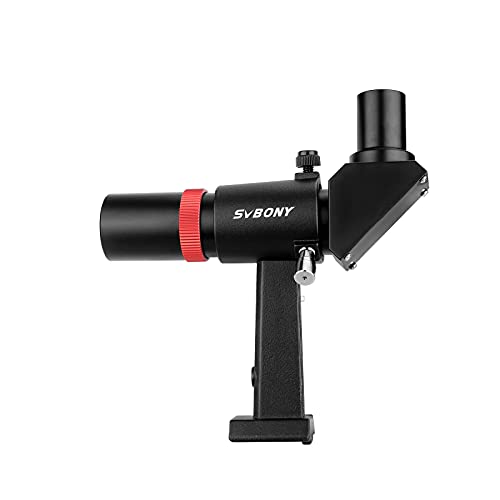
The SV182 provides a 6×30 sight with a crosshair and bracket, enhancing alignment accuracy while keeping a compact footprint. Its objective and optical design aim to improve light gathering for faint objects, with a comfortable 90-degree viewing angle that reduces neck strain during extended sessions. The combination of crosshair precision and stable mounting supports steady targeting, especially for beginners learning star-hopping techniques.
Astromania Finder Scope, 9×50
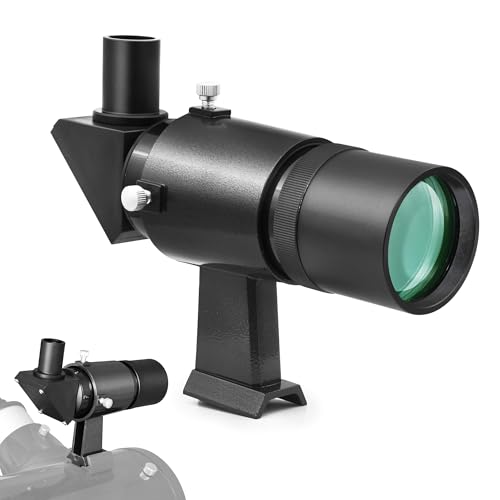
The Astromania 9×50 finder uses a 50mm objective and a 9x magnification to provide brighter star fields, expanding the number of visible guide stars. Its 90-degree angle simplifies viewing when locating objects near the zenith, improving comfort and usability. A crosshair reticle and robust bracket help with precise alignment, making it a practical choice for users who want a straightforward, reliable finder with clearer targets in a wide sky field.
SVBONY 5×24 Finder Scope

The compact SVBONY 5×24 is designed as a lightweight secondary scope to help locate objects with precision. It includes mounting hardware and a crosshair reticle, and its 5x magnification is ideal for quick, broad searches before switching to a higher-power eyepiece. The kit’s flexibility makes it suitable for travel or smaller telescope tubes, offering dependable performance without bulk.
Buying Guide
Key considerations when choosing a finder scope include field of view, optical orientation, mounting compatibility, and illumination options. A wide, true-sky view (non-magnified or low magnification) helps you locate stars quickly, while right-side-up views reduce orientation errors when comparing with star charts. Choose a finder with a sturdy bracket and an easy alignment method to minimize setup time before observing.
- Field of view vs. magnification: Non-magnified finders provide the broadest view for initial locating; higher magnification finders help refine alignment once a target is centered.
- Image orientation: Right-side-up finders reduce confusion, especially for beginners following sky maps or star charts.
- Illumination: Red-dot or illuminated reticles are helpful for dim skies, but may affect night vision. Dim, adjustable brightness is ideal.
- Mounting compatibility: Ensure the bracket or dovetail fit works with your telescope’s tube diameter and mounting system.
- Durability and alignment: A solid tube and secure screws keep the finder aligned through travel and use. Quick-collimation or easy alignment features save time during setup.
Choosing between a traditional crosshair finder, a red-dot aimer, or a combination depends on your observing goals and comfort level. For beginners, a right-side-up red-dot style (like the Celestron StarPointer) can speed up initial target acquisition. For more experienced observers, a larger, bright finder with a clear crosshair (such as the SV182 or Astromania 9×50) provides precise initial pointing with comfortable viewing angles.