Best Balance Scales for Kids: Top Educational Scales for STEM Learning
Balance scales offer hands-on math and science experiences for children, helping them grasp concepts like weight, mass, volume, and comparison. This guide highlights five engaging balance scales designed for kids, detailing how each supports early math and scientific thinking. Read on to discover practical picks that blend play with learning and fit various classrooms, homes, and learning styles.
| Product | Brand | Key Benefit | Ideal For |
|---|---|---|---|
| Blue Nestable Bucket Balance | hand2mind | Clear buckets for viewing contents; space-saving base | Early measurement & volume exploration |
| Primary Bucket Balance | Learning Resources | Calibrated buckets; solids and liquids exploration | Preschool classrooms, hands-on measurement |
| Blue Nestable Pan Balance | hand2mind | Clear double pans for comparing weights | Science and math comparisons |
| Numberblocks Blockzee Balance Set | hand2mind | MathLink Cubes with themed balance play | Numbers up to ten; early arithmetic concepts |
| Penguin Balance Scale | BAKAM | Engaging penguin design with multi-level challenges | Preschool to early elementary learning |
Each choice emphasizes hands-on learning with visual feedback, aiming to build confidence in measurement, comparison, and early arithmetic. The selections span bucket-style scales, pan balances, and themed manipulatives, providing varied approaches to accommodate different teaching goals and home learning environments.
Note: All five products listed below are designed to support curiosity, observation, and critical thinking as children interact with weights, volumes, and numerical concepts. The sections present objective features to help educators and parents compare options without personal opinions.
Blue Nestable Bucket Balance (Hand2mind)
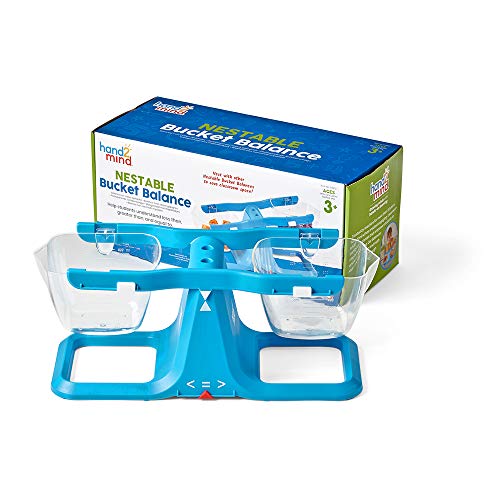
The Blue Nestable Bucket Balance by hand2mind is designed to help kids explore weight differences using clear plastic buckets. This setup supports measurement activities such as comparing the mass of manipulatives, counting bears, or other math counters. Students can observe how objects of different weights influence balance and estimate outcomes before measurement, reinforcing inequalities and mass concepts in a tangible way.
Key features include a durable, transparent design that enables students to see inside the buckets, and a compact, nestable base that saves space in classrooms or at home. The scale is well-suited for activities involving liquids and solids, promoting hands-on inquiry into volume and weight. It serves as a practical entry point for early science experiments and math lessons on balance and estimation.
Primary Bucket Balance Teaching Scale

The Primary Bucket Balance Teaching Scale from Learning Resources offers calibrated buckets with lids, providing a clear view of contents and enabling precise comparison of solids and liquids. This setup supports measuring volume and mass, encouraging students to estimate and then verify results. The removable lids make it easy to switch between activities involving dry goods and liquids, supporting classroom flexibility.
With a focus on observation and estimation, this scale helps children understand mass measurement and volume concepts through hands-on exploration. The sturdy construction is designed for frequent classroom use, making it a reliable option for early grade science and math centers that emphasize measurement and data collection.
Blue Nestable Pan Balance (Hand2mind)

The Blue Nestable Pan Balance from hand2mind provides double pans for comparing weights of varied materials. Children can place manipulatives, liquids, or solids on each pan, then observe the balance point as a reflection of their relative weights. This design supports conceptual learning around inequalities and balance, helping students connect mathematical relationships to tangible objects.
Features emphasize easy assembly and space-saving storage, making it suitable for classroom setups or home learning stations. The clear construction allows for straightforward observation of contents, volume approximations, and weight distribution, fostering inquiry-based exploration of physical properties and measurement concepts.
Numberblocks Blockzee Balance Activity Set

This activity set features a balance scale paired with 61 MathLink Cubes and Numberblocks-themed content. Students place cubes on the balance to visualize greater than, less than, and equal to relationships. The design supports exploring numbers up to ten, encourages pattern recognition, and reinforces foundational arithmetic through tangible, visual feedback.
The included number blocks and balance provide a multisensory approach to early math learning, aiding in construction of number sense, comparisons, and basic operations. The Numberblocks storyline adds a familiar context that can motivate sustained engagement during math centers or guided instruction.
Penguin Balance Scale

The Penguin Balance Scale by BAKAM brings a playful design to balance activities, featuring four levels of difficulty that challenge children to balance two plates with number blocks. The penguin-themed toy makes math exploration engaging for preschool and early elementary learners, promoting counting, comparing, and problem-solving skills as students adjust weights to achieve balance.
Made from child-friendly materials, this scale emphasizes safe play and durability. It is well-suited for teacher-led lessons, group activities, or independent practice, and supports the development of fine motor skills through manipulation of blocks and components in a friendly, approachable format.
Buying Guide: Key Purchase Considerations and Comparisons
When choosing a balance scale for kids, consider the following factors to ensure an effective learning experience:
- Age and developmental level: Choose scales that align with the child’s cognitive and motor skills; younger children benefit from clear visuals and larger manipulatives, while older kids can handle more complex weight comparisons.
- Materials and durability: Look for sturdy, non-toxic materials and safe designs that withstand frequent handling in classrooms or homes.
- Viewable contents: Clear buckets or pans help children observe material movement, which enhances estimation and measurement skills.
- Learning targets: Some scales emphasize mass and volume, others focus on inequality or arithmetic through balancing activities—match the product to your curriculum goals.
- Storage and space: Nestable or compact bases save room in small classrooms and home learning spaces, facilitating easy setup and cleanup.
- Expansion options: Consider sets that integrate with number blocks, cubes, or other manipulatives to enable multi-skill exploration (counting, addition, subtraction, pattern recognition).
- Instructional support: Some products include cards, activities, or guided prompts that help teachers structure lessons and track progress.
For educators, combining different formats—bucket scales for volume work, pan balances for weight comparisons, and themed sets for engagement—can create a robust balance-focused STEM center. For parents, selecting a mix of at-home friendly scales with clear visuals and simple activities helps sustain long-term interest and consistent practice.
Across these options, the emphasis remains on experiential learning: letting children hypothesize, test, and observe how changing weights, volumes, and numbers affects balance, and then recording outcomes to build a foundation in measurement literacy.