Best Activity Centers for Babies That Grow With Your Little One
Finding the right activity center can support early development, fine motor skills, and sensory exploration. The following selections combine engaging toys, safe materials, and multi-stage use to grow with your baby—from tummy time to toddler table play. Each option emphasizes age-appropriate activities, durable construction, and developmental benefits.
| Product | Brand | Type / Key Benefit |
|---|---|---|
| Bigjigs Early Learning Activity Centre | Bigjigs Toys | Wooden, 5 activities in 1; shapes, color recognition, counting |
| Skip Hop Baby Activity Center | Skip Hop | Grow-with-me, 3 stages, 25+ developmental activities |
| Move2Play 4-in-1 Activity Centre | Move2Play | Montessori-inspired, 8 toys, tummy time to toddler table |
| Baby Einstein Neighborhood Symphony Activity Center | Baby Einstein | Musical lights and melodies with adjustable height |
| TOWO 5-in-1 Wooden Activity Centre Triangle | Toys of Wood Oxford | Alphabet blocks, abacus, clock, multiple sides for varied play |
Bigjigs Early Learning Activity Centre

Bigjigs Toys offers a compact wooden activity centre designed to entertain and educate infants aged 12 months and up. This 26 cm by 23 cm by 27 cm structure packs in five activities in one, including counting and animal-themed sorting boards, an abacus, ABC picture blocks, and a chalkboard. The design emphasizes high-quality, responsibly sourced wood and aims to support shape and color recognition as well as early fine motor skills. With no detachable pieces, it remains a safer, consolidated learning hub for little hands exploring cause and effect and basic problem solving.
Features focus on multisensory and cognitive development: shape matching, color differentiation, counting, and early literacy blocks help build hand-eye coordination and dexterity. The compact footprint makes it suitable for small play spaces, yet it offers enough activities to hold a baby’s attention for extended play sessions. The chalkboard adds a creative outlet for drawing connections between colors and forms while fostering early writing readiness. This center is best for supervised play sessions and steady exposure to varied manipulatives.
Skip Hop Baby Activity Center
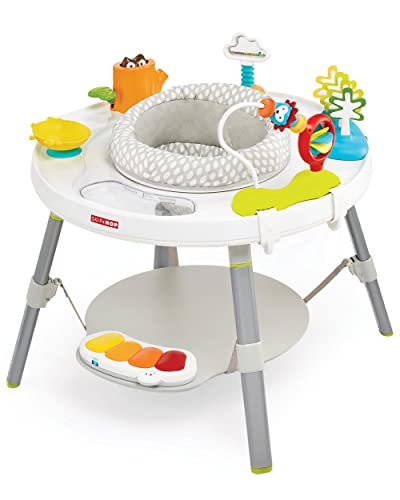
Skip Hop’s Explore & More activity center grows with your child through three stages: Sit, Swivel, and Bounce & Play, transitioning into a toddler-friendly play table. The setup includes a musical, light-up piano with multiple modes, a peek-a-boo owl, and clip-on toys that can be repositioned to suit your baby’s abilities. With 25+ developmental activities, the center supports early motor skills, rhythm and auditory development, and engagement through interactive play. It’s designed for babies from around 4 months up to weights around 25 pounds, ensuring prolonged use as your child grows.
Developmental highlights include gross motor practice during bouncing, fine motor work with grasping and reaching for toys, and sensory exploration through music, light, and action-reaction toys. The modular layout helps caregivers tailor play by age and skill level. While the unit is larger than some compact wooden centers, its durability and immersive features make it a strong choice for families seeking a versatile, camera-ready play space that can entertain for years.
Move2Play 4-in-1 Activity Centre

This Montessori-inspired, 4-in-1 center supports long-term use from infancy through toddler years. It grows with baby from tummy time to a toddler table, featuring eight Montessori toys that are easy to remove. Toys target motor control, tactile exploration, self-awareness, and problem-solving. The interactive piano offers more than 30 phrases, sounds, and songs to keep little ones engaged, with batteries included to start exploration immediately.
Key benefits include a strong emphasis on independent play and skill-building through modular toys. The design facilitates multi-sensory exploration—music, color, shapes, and textures—while encouraging curiosity and cognitive development. Parents can rearrange toys to focus on different milestones, such as hand-eye coordination and sequencing, making this a flexible, long-term learning station for busy households.
Baby Einstein Neighborhood Symphony Activity Center

Baby Einstein’s Neighborhood Symphony Activity Center blends music and movement to inspire early musical expression. This infant-entertainment hub uses adjustable height to grow with the baby and includes light and sound features alongside interactive toys that encourage exploration. The layout promotes auditory discrimination, rhythm recognition, and cause-and-effect learning as babies reach for buttons and observe the responses. The four height adjustments help keep the activity engaging through different stages of development.
With a focus on early creativity, the center provides a stimulating environment for sensory processing and language anticipation. Its musical emphasis supports brain development in sound processing, while the accompanying toys help develop hand motor skills and coordination. As a learning toy, it offers continuous novelty through rotating toys and varied textures, suitable for households prioritizing musical play as a core component of early education.
TOWO 5-in-1 Wooden Activity Centre Triangle
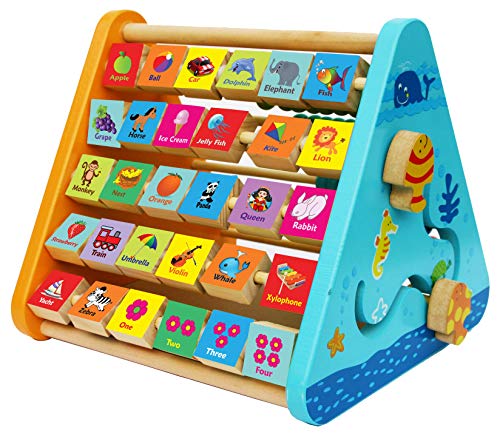
The TOWO wooden activity triangle features five integrated play surfaces, including alphabet blocks, an abacus, a clock, a zig-zag sliding fish, and a whiteboard. This compact 25 x 23 x 29 cm center is designed for home use and durability, with all-in-one functionality to minimize missing pieces. The toy set fosters hand-eye coordination, letter and number recognition, early reading and counting, and imaginative play. The wooden construction promotes tactile and visual learning through multiple faces and activities in one unit.
Designed for long-term engagement, it helps children practice cognitive skills such as sequencing and time-telling, while encouraging fine motor development through manipulating blocks and abacus beads. The multi-sided approach offers varied experiences to prevent boredom and promote curiosity about letters, numbers, colors, and object recognition. This is a sturdy, space-efficient option for parents seeking a traditional wooden center with diverse play modalities.
Buying Guide: Key Purchase Considerations
Choosing the right activity center involves assessing a few core factors to match your child’s age, space, and developmental goals. The following considerations help compare options objectively.
- Age range and growth potential: Look for centers that transition from infant play to toddler activities to maximize usefulness and value.
- Durability and materials: Wooden centers tend to offer lasting durability; plastic options may be lighter and multi-piece friendly but check for safe finishes and non-toxic paints.
- Teacher- or caregiver-friendly setup: Consider how easy it is to assemble, rotate toys, and store components when not in use.
- Number and variety of activities: More toys can boost engagement, but ensure the setup remains uncluttered and safe for small hands.
- Portability and footprint: If living space is limited, prefer compact designs with fold-away or easily storable parts.
- Educational focus: Some centers emphasize fine motor skills; others highlight language, music, or cognitive development. Align with your goals for early learning.
- Safety features: Check for rounded edges, secure toy attachments, and age-appropriate weight limits to minimize hazards during play.
- Care and maintenance: Wooden centers may require occasional wiping and conditioning; fabric elements should be washable or easy to sanitize.
Comparison Snapshot
- Wooden centers (Bigjigs, TOWO): Durable, traditional feel, good for shape, color, and letter recognition; great for small spaces.
- Grow-with-me (Skip Hop, Move2Play): Longer usability across stages; richer in interactive features and cognitive stimulation.
- Musical and sensory focus (Baby Einstein): Strong auditory and visual engagement; height-adjustable for evolving needs.
- Montessori-inspired (Move2Play): Emphasizes independent play, practical life skills, and multi-sensory exploration.
When evaluating options, balance your child’s current interests with potential for future growth. Read safety reviews, verify toy detachability if applicable, and ensure the product suits your living space. Most importantly, rotate a few key activities to keep exploration fresh while maintaining a predictable routine that supports early learning milestones.