Best Beginner Reflector Telescopes for Stargazing
Embarking on astronomy as a beginner means finding a reliable reflector telescope that’s easy to set up and provides clear views of the Moon, planets, and deep-sky objects. This guide highlights five accessible options with solid optics, sturdy mounts, and beginner-friendly features. Each pick is evaluated for ease of use, maintainability, and potential for growth as skills improve. Use the buying guide at the end to compare key factors like aperture, mount type, and accessories.
| Product | Brand | Aperture | Key Benefit |
|---|---|---|---|
| Celestron StarSense Explorer LT 114AZ | Celestron | 114mm | App-assisted star-hunting with smartphone dock |
| MEEZAA 150EQ Newtonian Reflector | MEEZAA | 150mm | Stable equatorial mount and strong light gathering |
| Celestron PowerSeeker 127EQ | Celestron | 127mm | Manual, beginner-friendly German equatorial mount |
| Dianfan 150EQ Telescope | Dianfan | 150mm | Equatorial setup with manual tracking and included accessories |
| HEXEUM 80mm Aperture 600mm AZ | HEXEUM | 80mm | Compact, portable with phone adapter for quick captures |
Celestron StarSense Explorer LT 114AZ
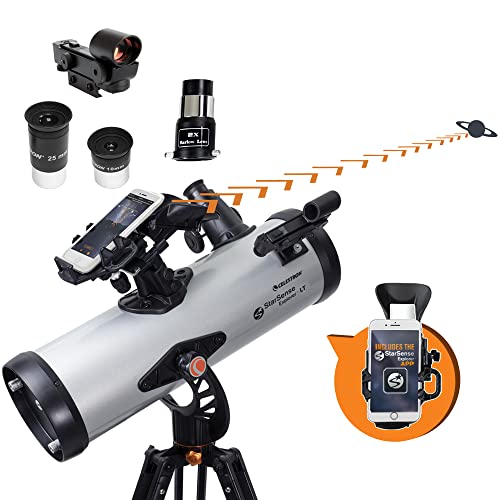
The StarSense Explorer LT 114AZ uses a smartphone-powered sky tour to simplify star-gazing. Users dock a phone, launch the StarSense Explorer app, and follow guided arrows to locate celestial objects. This approach makes locating planets, nebulae, and star clusters feasible for beginners, even in light-polluted areas. The patented StarSense technology analyzes star patterns overhead to determine the telescope’s position, enabling quick alignment. The app also offers a curated list of targets based on time and location, enhancing urban stargazing capabilities.
MEEZAA 150EQ Newtonian Reflector
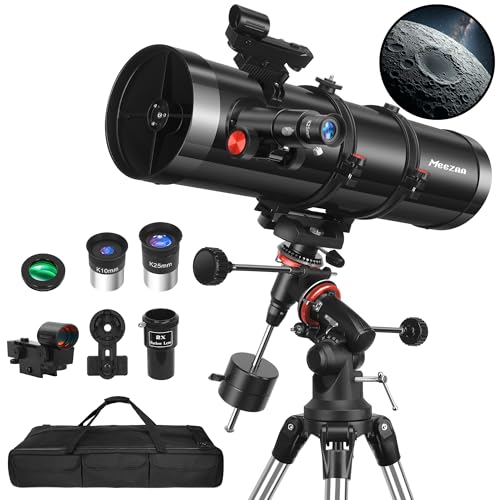
This 150mm aperture telescope delivers bright, detailed views with a 650mm focal length. It includes two eyepieces (25mm and 10mm) and a 2X Barlow lens, offering magnification from 26x to 130x. A red dot finderscope helps with fast targeting, and a moon filter reduces glare for comfortable lunar observing. The upgraded German Equatorial Mount provides smooth pointing and slow-motion control for precise tracking, making it well-suited for beginners who want consistent results as they practice alignment and observing techniques.
Dianfan 150EQ Telescope
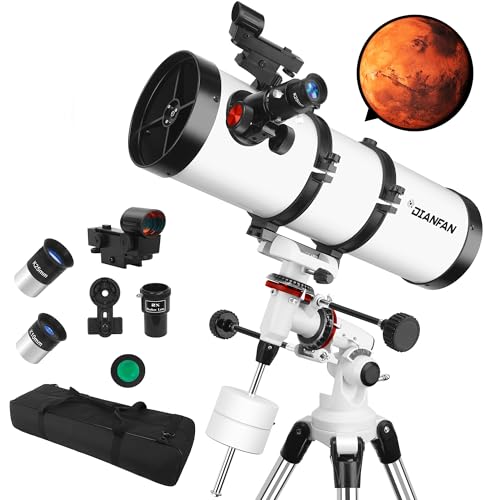
The Dianfan 150EQ is built around a 150mm aperture and a 650mm focal length. It delivers sharp, bright images suitable for both lunar details and deep-sky objects. Included accessories cover essential viewing needs, such as multiple eyepieces and a 2x Barlow lens for flexible magnification. The pre-assembled equatorial mount supports smooth tracking, and the package emphasizes ease-of-setup, with most users able to assemble in about 20 minutes. It is a solid choice for families or beginner enthusiasts seeking reliable performance with a robust mount.
Celestron PowerSeeker 127EQ

The PowerSeeker 127EQ offers an accessible entry into practical astronomy with a 127mm Newtonian reflector. Its manual German Equatorial Mount features a slow-motion altitude rod, easing object tracking as objects drift across the night sky. The telescope is compact and portable, making it suitable for backyard use or trips to darker observing sites. It supports learning basic star-hopping and manual targeting while providing sufficient light gathering for planetary and lunar detail and some bright deep-sky objects.
HEXEUM 80mm Aperture 600mm AZ

HEXEUM’s 80mm reflector offers a compact, portable option with a simple AZ mount and phone adapter for quick imaging. Although smaller in aperture, it supports beginner-friendly use with easy setup and straightforward alignment. The telescope includes a carrying bag and wireless control features, making it a good starter option for travelers or casual night sky viewers who want a lightweight instrument that still delivers crisp lunar and bright planetary views.
Buying Guide: Key Purchase Considerations
- Aperture and light-gathering: Larger apertures (120–150mm) collect more starlight, revealing fainter objects. Beginners often balance affordability with practical brightness for lunar, planetary, and some deep-sky targets.
- Mount type: Equatorial mounts enable smoother tracking at higher magnifications, but they require some setup and skill. Alt-az mounts are typically easier for quick views and beginners.
- Tracking and stability: Smooth slow-motion controls reduce field drift. Sturdy tripods and well-balanced tubes improve image steadiness during observation.
- Optical quality and coatings: Fully coated optics improve light transmission and contrast. Check for multi-coated elements, especially on entry-level models.
- Ease of use: App-assisted options and pre-aligned systems can shorten learning curves for beginners, particularly in urban light pollution.
- Accessories: Included eyepieces, a moon filter, a red-dot finder, and a carrying bag add value. Consider whether you’ll want additional eyepieces or a Barlow lens for higher magnification.
- Portability and storage: If you plan to travel to darker sites, weight and compactness matter. A telescope that fits in a car trunk and a manageable setup time pays off.
- Future growth: Begin with a model that supports upgrades—new eyepieces, better mounts, or computerized guidance—so your investment remains useful as skills advance.
Choosing a beginner reflector often comes down to balancing ease of use with potential for growth. Those prioritizing guided targeting and quick results may favor app-enabled models, while those seeking deep-sky potential may opt for larger apertures and robust equatorial mounts. Consider your typical observing environment, such as urban light pollution, and your willingness to invest time in setup versus quick sky views.