Best Beginner Telescopes for Deep Space Observations
New to stargazing and eager to explore deep space? The following beginner-friendly telescopes offer bright views, easy setup, and reliable mounts. Each option is suited for learning the night sky, tracking planets, and peeking at distant deep-sky objects with steadily improving skills. Below, five models stand out for accessible performance, portability, and useful accessories that help new astronomers grow their understanding of how the cosmos looks through a telescope.
| Product | Key Benefits | Audit Snapshot |
|---|---|---|
| MEEZAA Telescope, 150EQ Newtonian Reflector | Large aperture for deep space viewing; stable equatorial mount; multiple eyepieces and a moon filter | 150mm aperture, 650mm focal length, 26X–130X mag |
| Dianfan Telescope, 90mm Aperture | Bright optics with 800mm focal length; portable; includes tripod and phone adapter | 90mm aperture, 800mm focal length |
| SVBONY SV48P Telescope | Wide field, easy focus, rotatable OTA; great for beginner astrophotography | 102mm aperture, f/6.5 |
| HEXEUM Telescope, 80mm Aperture | Multi-coated optics; versatile for day and night; complete accessory kit | 80mm aperture, 600mm focal length |
| HUGERSTAR Telescope, 80mm | Portable travel design; high power range; includes tripod and phone adapter | 80mm aperture, 500mm focal length |
Note: The table highlights core strengths to help you compare how each model supports beginner-friendly deep space viewing and hands-on learning.
MEEZAA 150EQ Newtonian Reflector For Beginners
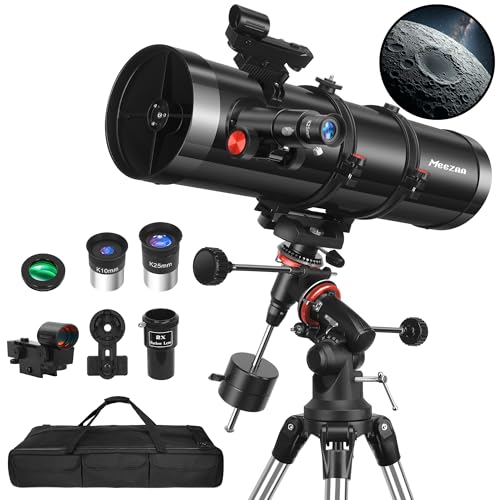
The MEEZAA 150EQ combines a sizable 150mm aperture with a practical equatorial mount, designed for users who want to explore deep space beyond the Moon. A 650mm focal length delivers bright, detailed images of nebulae and galaxies when paired with the included eyepieces (25mm and 10mm) and a 2X Barlow lens. The red dot finder aids targeting, while the Moon filter reduces glare for lunar observing. The German Equatorial Mount offers slow-motion control for smoother tracking, which is helpful as new observers learn to locate faint deep-sky objects. This kit also includes a robust tripod and a phone adapter for easy astrophotography of brighter targets.
Best used from a steady observing site, the MEEZAA setup emphasizes learning the mechanics of mounting, balancing, and manual tracking—valuable skills for progressing beyond beginner targets. While the aperture is generous, users should temper expectations for very faint deep-sky objects until they gain experience with sky conditions and exposure techniques.
Gskyer 70mm Refractor With Travel Setup

The Gskyer refractor offers a compact, portable entry into astronomy with a 70mm aperture and 400mm focal length. Its fully coated optics provide bright, high-contrast images of the Moon, planets, and brighter deep-sky targets. The kit includes two eyepieces and a 3X Barlow lens, which expands magnification from 3x to higher ranges when combined with the eyepieces. A 5×24 finder scope simplifies object locating, and the wireless remote and phone adapter enable easy capture of lunar and planetary details. This model is ideal for family observing nights and travel where size and weight matter.
Because it is lighter and shorter, it’s particularly friendly for absolute beginners who want straightforward setup and quick wins in the sky. It may perform best once you settle on a stable observing spot and practice star-hopping with the finder scope.
Dianfan 90mm Aperture Portable Refractor

The Dianfan telescope pairs a 90mm objective with 800mm focal length for bright, detailed views of the Moon and planets, and it’s designed with beginners in mind. It includes a stainless stand and a phone adapter, which helps new stargazers share discoveries with friends and family. The 45-degree zenith mirror ensures upright orientation for terrestrial viewing as well, broadening its use beyond astronomy. The optics are described as high-transmission, contributing to clear color contrast and sharpness across targets.
Setup is approachable, with assembly typically requiring about 15 minutes. The longer focal length helps with lunar details and planetary features, while the larger aperture improves visibility of brighter deep-sky objects under dark skies with proper patience and sky conditions.
NASA Lunar Telescope For Kids (Blue Marble)
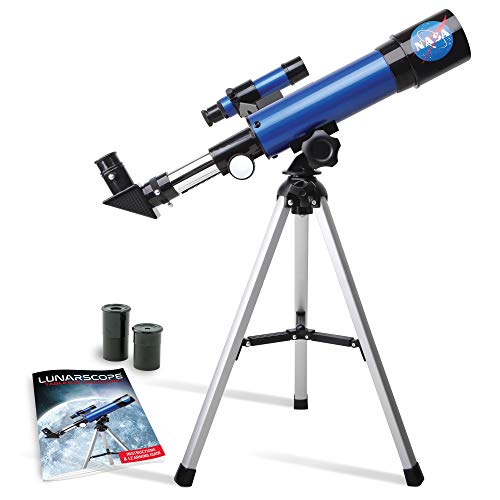
The NASA Lunar Telescope focuses on lunar details and serves as an engaging introductory tool for children and beginners. It comes with two eyepieces, a finder scope, and a tabletop tripod for stable viewing. The design emphasizes easy targeting of the Moon’s features and a straightforward viewing experience. While its primary appeal is educational and kid-friendly, it helps new observers understand basic telescope operation, scale, and the value of proper alignment and focus. The included NASA-branded theme adds an exciting storytelling element to early stargazing sessions.
As a learning instrument, this model prioritizes simplicity and reliability. It’s well-suited for tabletop use, making it easy to demonstrate constellations, lunar maria, and other bright targets in a family setting.
ToyerBee 70mm Refractor For Beginners

The ToyerBee telescope emphasizes accessibility with a 70mm aperture and a 15X–150X magnification range achieved via two eyepieces and a 3X Barlow lens. The 300mm focal length supports bright, wide-field views that are excellent for beginner exploration of star clusters and the Moon’s brighter features. The kit includes a phone adapter and a wireless remote for capturing images, which helps new observers transition from visual to digital observing. Its portable build makes it a strong option for beginners who want to stargaze on road trips or backyard sessions.
HUGERSTAR 80mm Refractor Travel Telescope

The HUGERSTAR 80mm refractor delivers bright, crisp images with fully multi-coated optics and a 600mm focal length. Aimed at both adults and kids, it offers a wide magnification range (20X to 150X) via two eyepieces and a 3X Barlow lens. A 5×24 finder helps locate objects quickly, while the 45° diagonal provides upright viewing for terrestrial targets in daylight. The included phone adapter and portable backpack kit make it convenient for educational settings, camping trips, or backyard sessions. The tripod is adjustable, supporting comfortable viewing heights for different users and locations.
Buying Guide: How to Choose a Beginner Telescope For Deep Space
When selecting a beginner telescope for deep space, consider these factors to balance ease of use with future growth:
- : Larger apertures gather more light, revealing fainter deep-sky objects. For beginners, 70–90mm refractors and 100–150mm reflectors hit a practical balance between ease of use and potential. While bigger is brighter, it also adds weight and setup complexity.
- : Refractors are low-maintenance and easy to use, great for beginners. Reflectors deliver more aperture per dollar for deep-space views but require occasional alignment (collimation). Compound (Maksutov- or Schmidt-) designs sit between, with good optical quality and modest maintenance.
- : An equatorial mount helps learn sky navigation and tracking, but a stable alt-az mount is simpler for quick observing. For deep space, slow-motion controls on an equatorial mount reduce target drift during longer observations.
- : A versatile setup includes a low-power eyepiece for wide fields and a high-power eyepiece for detail. A Barlow lens expands magnification but can degrade brightness if the optics aren’t bright enough.
- : A good finder scope, a sturdy tripod, a phone adapter, and a moon or light pollution filter can improve the experience. A carry bag aids portability for star parties or camping.
- : For beginners, a lightweight, quick-to-assemble package encourages regular use. Consider the weight, balance, and storage needs for your observing location.
- : Light pollution, humidity, and atmospheric stability influence what you’ll see. Beginners should start with the Moon, planets, and brighter deep-sky objects, then progress to fainter targets as skills grow.
Comparing the options above, beginners should weigh aperture against portability, consider whether they want to learn manual tracking with an equatorial mount, and factor in whether they value built-in smartphone capture for sharing discoveries. A kit with starter eyepieces, a stable mount, and a straightforward finder is typically the most dependable starting point for exploring deep space without overwhelming new observers.