Best Brain Toys for Kids to Boost Critical Thinking and Problem Solving
Growing minds thrive on play that challenges thinking, builds memory, and strengthens fine motor skills. The following brain-boosting toys are designed for kids and families, offering varied puzzles, logic challenges, and STEM-friendly play. From tangrams to marble mazes and memory games, these selections promote spatial reasoning, planning, and persistence while keeping kids engaged and entertained.
| Product | Brand | Key Benefit |
|---|---|---|
| Learning Resources STEM Explorers Brainometry | Learning Resources | Pattern blocks and double-sided cards for progressive, hands-on math and logic practice |
| Educational Insights Kanoodle | Educational Insights | Portable 3D brain teasers with hundreds of puzzles for spatial reasoning |
| KINGOU Hexagon Tangram Puzzle | KINGOU | Timber tangram with multiple assembly methods to spark pattern creation |
| ThinkFun Gravity Maze | ThinkFun | Marble-based logic challenges that build planning and engineering thinking |
| Educational Insights BrainBolt | Educational Insights | Light-and-sound memory game for sequence recall and concentration |
Learning Resources STEM Explorers Brainometry

The Brainometry set blends tactile blocks with pattern matching to boost critical thinking and early math skills. Designed for ages 5 and up, it emphasizes hands-on exploration and fine motor development through colorful, pattern-based activities. Ten double-sided English activity cards provide a structured progression, allowing children to tackle easier tasks before advancing to more challenging puzzles. This toy supports independent discovery as well as guided learning, making it suitable for home use and classroom activities.
Educational Insights Kanoodle

Kanoodle offers a compact, brain-bending challenge in a self-contained case, ideal for travel and on-the-go play. With more than 200 puzzles that vary from beginner to expert, players arrange 2D and 3D configurations to complete each challenge. The game is suitable for solo play or for quick, cooperative challenges, encouraging strategic thinking and spatial visualization without external distractions.
KINGOU Hexagon Tangram Puzzle
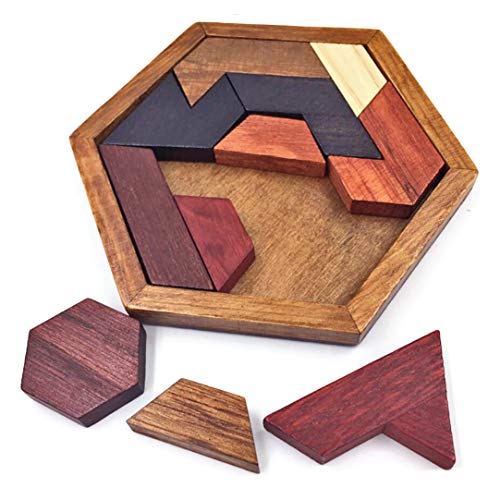
This timber tangram features 11 blocks and a hexagonal frame, offering numerous assembly patterns to challenge both kids and adults. With water-based paint and a smooth finish, it provides a tactile, durable puzzle experience. The set invites experimentation with different methods to fill the box, promoting creativity, pattern recognition, and problem-solving through hands-on manipulation and endless pattern possibilities.
ThinkFun Gravity Maze

Gravity Maze combines marble mazes with engineering challenges to foster critical thinking. The game includes nine towers, three marbles, a grid, and a target piece, creating a versatile set of challenges that require planning, spatial reasoning, and strategic sequencing. It is well-suited for kids ages 8–12 and can be used in classrooms or at home to strengthen logical thinking and problem-solving abilities.
Educational Insights BrainBolt

BrainBolt offers a handheld, screen-free memory challenge with light and sound cues. Players remember sequences and reproduce patterns, either solo or in a two-player mode for competitive play. Its compact design makes it ideal for travel, waiting rooms, or quick brain-boosting sessions. The game supports memory, attention, and sequential thinking, providing a quick, engaging cognitive workout for kids and adults alike.
Buying Guide: Key Purchase Considerations
- Age and skill level: Choose toys with appropriate difficulty progression to maintain engagement without frustration.
- Learning goals: Consider whether you want to focus on math concepts, spatial reasoning, memory, or engineering thinking.
- Portability: For travel or waiting rooms, compact, self-contained puzzles (like Kanoodle) are advantageous.
- Durability and materials: Wooden or high-quality plastics with safe finishes are preferable for long-term use.
- Versatility: Puzzles offering multiple methods to solve (like tangrams or block patterns) provide extended play value.
- Single-player vs. group play: Some games support solitary challenges, while others encourage collaboration or head-to-head play.
- Maintenance: Look for pieces that are easy to clean and maintain, especially for younger children.
- Educational alignment: If you’re integrating with schooling, select options that align with math, science, or problem-solving curricula.
Across these selections, common strengths include tangible manipulation, progressive difficulty, and portability. Parents and educators can use them to foster resilience, attention to detail, and systematic thinking—critical abilities for future success in STEM and everyday problem solving.