Best Budget Telescope Eyepieces for Clearer Nights Under the Stars
The right eyepieces can transform a modest telescope into a versatile stargazing setup without breaking the bank. This guide highlights five affordable options that balance performance, compatibility, and value for American hobbyists. From versatile zooms to multi‑piece kits, these budget-friendly eyepieces help you explore the Moon, planets, star clusters, and distant nebulas with improved clarity and ease.
| Product | Brand | Key Benefit |
|---|---|---|
| Acxico 3Pcs/Set Universal Eyepiece | Acxico | Wide range of focal lengths; 0.965″ compatibility |
| Celestron Zoom Eyepiece | Celestron | Single piece 8–24 mm zoom; versatile |
| SVBONY SV135 Zoom Eyepiece | SVBONY | 7–21 mm zoom; 6‑element design |
| CelticBird 1.25″ Accessory Kit | CELTICBIRD | 5 Plossl eyepieces + 2X Barlow |
| Starboosa 1.25″ Eyepiece Set | starboosa | Soft eyecups; 4/10/20 mm trio |
Acxico 3Pcs/Set Universal Eyepiece

The Acxico set includes three eyepieces designed for 0.965″ or 24.5 mm telescope objectives. It covers a range of focal lengths (20 mm, 12.5 mm, and 4 mm equivalents) for low to high magnification, enabling quick adjustments during observation sessions. The eyepieces are multi-coated to improve light transmission and contrast, and they are compatible with reflectors and refractors alike. With a 35° apparent field of view and a robust optical glass plus metal construction, this kit supports observing star clusters, nebulae, the Moon, and planets, making it a practical entry point for astronomy beginners and hobbyists looking for budget flexibility.
Key features include: multi-coating for improved brightness, a compact 24.5 mm/0.965 inch format, and varying focal lengths to switch magnifications without swapping components. The kit aims to deliver a wider viewing field and crisp edges, suitable for exploring both bright and faint targets during midnight sessions.
Celestron Zoom Eyepiece

The Celestron Zoom Eyepiece provides a continuous focal-length range from 8 mm to 24 mm, allowing quick transitions between wide-field scanning and high magnification. This eliminates the need to own multiple fixed focal-length eyepieces and reduces setup time, so observers can spend more time stargazing. It works with any telescope that accepts 1.25″ eyepieces and is threaded to accommodate 1.25″ filters, offering flexibility for planetary, lunar, and deep-sky viewing. The design emphasizes practical usability and broad compatibility, making it a staple for budget-conscious enthusiasts seeking versatility.
SVBONY SV135 Zoom Eyepiece
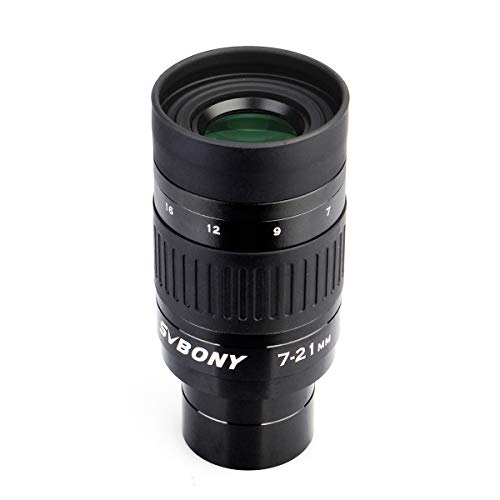
The SV135 Zoom Eyepiece ranges from 7 mm to 21 mm, matching a broad spectrum of observing targets—from lunar craters to distant galaxies. Its 18 mm to 16.3 mm eye relief is comfortable for eyeglass wearers, and the six-element, four-group design aims to deliver sharp edge-to-edge clarity. Fully multi-coated elements improve light transmission and contrast, reducing internal reflections for clearer planetary and deep-sky views. This eyepiece is positioned as an adaptable choice for users who want a single piece that covers multiple focal lengths without swapping components.
CelticBird 1.25″ Accessory Kit

This CelticBird kit bundles value-oriented 1.25″ eyepieces with a 2X Barlow and a set of seven filters. Included are five Plossl eyepieces across a range of powers (40 mm, 20 mm, 12.5 mm, 8 mm, 6 mm), plus two filters and a polarizing option. The 2X Barlow doubles magnification when used with any 1.25″ eyepiece, and there are T-adapter capabilities for attaching a DSLR. This makes the kit a practical all-in-one solution for beginners seeking versatility in planetary, lunar, and DS targets without purchasing individual pieces at a higher price.
Starboosa Multi-Coated Eyepiece Set

The Starboosa eyepiece trio includes 4 mm, 10 mm, and 20 mm focal lengths designed for 1.25″ telescopes. The 1.25″ diameter is standard for many consumer scopes, making these eyepieces widely compatible. With soft eyecups, these eyepieces emphasize comfortable viewing for extended sessions. The focal lengths provide a mix of high and mid-range magnifications for observing lunar detail, planetary features, star clusters, and nebular targets. The optics are described as upgraded for better imaging, with balanced chromatic performance and improved edge sharpness across the field of view.
Buying Guide: Key Purchase Considerations For Budget Eyepieces
- Compatibility: Check your telescope’s eyepiece diameter (1.25″ vs 0.965″/24.5 mm) and the mount type. Many budget sets offer multi-diameter adapters or are designed to fit common formats, but always confirm compatibility before purchase.
- Focal Length Range: Sets that cover a broad range (short, mid, and long focal lengths or a zoom) allow flexibility for planets, the Moon, star clusters, and DS targets. Zoom eyepieces reduce the need to swap multiple fixed focal-length pieces.
- Optical Design: Multi-coated lenses improve light transmission and contrast, while more complex designs (e.g., 6-element/4-group) can deliver sharper images but may come at a slightly higher price. Balance cost with performance expectations.
- Comfort: Eyecups and eye relief matter, especially for eyeglass wearers. Budget sets with soft eye cups can reduce eye strain during longer sessions.
- Accessories: Many bundles include Barlow lenses, filters, or T-adapters. Such additions expand capabilities for lunar, planetary, and astrophotography activities, increasing overall value.
- Durability and Build: Metal barrels and robust construction withstand regular use. Plastic housings may be lighter but can degrade with heavy handling.
- Use Case: Beginners may prioritize versatility and value, while intermediate users might seek sharper optics and higher contrast. Define your goals to pick the right mix of focal lengths and features.
- Brand and Support: Reputable brands often provide better quality control and compatibility notes. Look for warranty or return policies when buying budget kits online.
In summary, budget eyepiece sets can cover a broad range of observing needs—from quick lunar glances to extended starfield exploration. Users should weigh diameter compatibility, focal length variety, and added accessories to choose the setup that best fits their telescope and observing style.