Best Budget Telescopes for Planet Viewing
Looking to explore planets without breaking the bank? This guide highlights affordable telescopes that are well suited for observing the Moon, planets, and other celestial details. Each pick combines ease of use, solid optics, and practical accessories, helping beginners and casual observers get meaningful views without a steep learning curve.
Summary Of Chosen Products
| Product | Aperture / Focal Length | Best For | Key Accessory Highlights |
|---|---|---|---|
| NACATIN Astronomy Telescope | 90mm / 800mm | Beginner Moon & Planets, portability | Phone adapter, easy setup, crosshair finder |
| HETEKAN Telescope for Adults | 90mm / 900mm | Planetary observing, family use | Phone adapter, stargazing mount, finder scope |
| FAMIROSA Telescope for Adults | 90mm / 900mm | Planet details and versatility | Phone adapter, carrying bag, three eyepieces |
| Slokey Discover The World Telescope | 20x-250x | Flexible magnification, portable setup | Three eyepieces, 3x Barlow, sturdy tripod |
| National Geographic Sky View 70mm | 70mm / 400mm | Affordable entry, smartphone photography | Two eyepieces, 3x Barlow lens, smartphone adapter |
NACATIN Astronomy Telescope For Beginners

The NACATIN telescope is designed for adults and beginners seeking bright lunar and planetary views. Its 90mm aperture gathers ample light to reveal craters on the Moon and cloud bands on Jupiter. Included are two eyepieces, a 3x Barlow, a 5×24 finder, and a smartphone adapter to capture discoveries. The design supports straightforward setup, making it suitable for home use or quick field sessions.
Optical quality centers on fully multi-coated optics and reliable focus mechanics, promoting crisp, high-contrast images. With a focal length of 800mm, users can explore a range of magnifications when paired with the provided eyepieces. This setup is appropriate for beginners who want tangible planetary details without complexity.
HETEKAN High Powered 90mm Telescope

The HETEKAN telescope targets observers who want sharper planetary views with practical aids. A 90mm aperture provides solid light gathering, while a 900mm focal length supports a wide range of viewing scenarios from lunar details to Jovian cloud patterns. Three eyepieces plus a 3x Barlow lens deliver magnifications from 36x to 450x, catering to both wide-field scanning and close-up planetary scrutiny. A finder scope, phone adapter, and a stable mount complete the setup for home or classroom use.
FAMIROSA 90mm Refractor Telescope
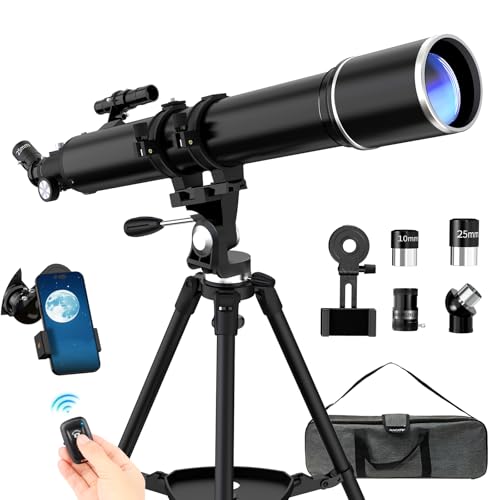
The FAMIROSA refractor emphasizes bright, clear images with fully coated optics and a 900mm focal length. Its 90mm aperture captures more light than smaller models, improving detail in planetary views and lunar textures. The kit includes two eyepieces (H10mm and H25mm) and a 3x Barlow, yielding 36x to 270x magnification. A dedicated phone adapter supports quick image capture, and a compact carry bag aids portability for field observations or classroom use.
Celestron Zoom Eyepiece for Telescopes

The Celestron Zoom Eyepiece offers flexible focal length without swapping eyepieces. Variable magnification from 8mm to 24mm lets observers smoothly adjust power to match target and seeing conditions. It works with any 1.25″ eyepiece-compatible telescope, reducing the need for multiple fixed focal length optics. This accessory is particularly useful for beginners who want quick transitions between wide views of star fields and close-ups of planetary details.
Bushnell Refractor 600x50mm Telescope

Bushnell’s refractor offers a budget-friendly entry into space viewing with a 50mm objective and a 600x magnification capability, suited for planets and brighter deep-sky objects. While compact, the telescope provides practical optics for beginners seeking stable performance and straightforward operation. Its lightweight design makes it an accessible option for youth observers or quick backyard sessions.
National Geographic Sky View 70mm Refractor
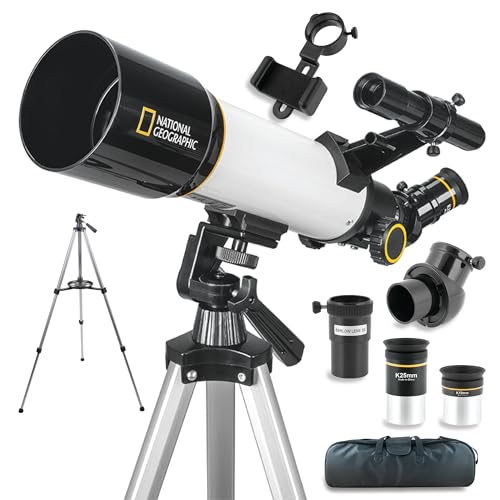
The National Geographic Sky View focuses on beginner-friendly astronomy with a 70mm aperture and a 400mm focal length. Magnification options include 16x, 40x, 48x, and 120x through interchangeable eyepieces and a 3x Barlow lens. The included smartphone adapter enables simple astrophotography, letting observers capture images of the Moon, planets, or bright deep-sky targets without complex setup.
Buying Guide: Key Purchase Considerations
- Purpose and skill level: For beginners, prioritize ease of setup, stable mounts, and clear optics. For planetary observing, a 90mm class aperture balances light collection and portability.
- Aperture vs. portability: Larger apertures gather more light but can be heavier and less convenient for travel. If you mainly observe from a backyard, 90mm models are a strong balance.
- Optics quality: Fully multi-coated optics improve brightness and contrast. Look for refractor designs with high-transmission coatings for steady planetary views.
- Magnification range: Planets require higher magnification, but higher power also reduces brightness and clarity if seeing is not ideal. A versatile kit with multiple eyepieces and a Barlow lens is advantageous.
- Accessories: A finder scope helps locating objects, while a smartphone adapter enables easy sharing and astrophotography. A sturdy tripod or mount minimizes vibrations during viewing.
- Ease of use: Quick setup, intuitive controls, and clear instructions save time and encourage consistent use. Consider a model with a simple alignment process for planets.
- Durability and support: Look for well-made builds and reliable customer support. Lightweight tripods should still feel stable on solid ground.
- Budget alignment: Entry-level refractors with 70–90mm apertures typically offer the best value for planet-focused observing without excessive cost or complexity.