Best Catapult Kit for Kids: Hands-on STEM Kits to Inspire Engineering
Catapult kits combine history, physics, and hands-on building into engaging STEM learning adventures for curious kids. From early siege engines to modern mechanical models, these kits help young engineers explore force, trajectory, and motion while staying within safe and approachable project levels. Below are five top picks that balance realism, instructional clarity, and age-appropriate challenge for American families seeking educational, screen-free play.
Summary Of Featured Kits
| Product | Brand | Notable Feature |
|---|---|---|
| NATIONAL GEOGRAPHIC Da Vinci Model Kit | Blue Marble | Three functional machines: ballista, bombard, and catapult |
| Thames & Kosmos Catapult Engineering | Thames & Kosmos | Six models with comprehensive physics experiments |
| Pathfinders Leonardo da Vinci Catapult | Pathfinders | Working catapult inspired by da Vinci’s sketches |
| Pathfinders Medieval Catapult STEM Kit | Pathfinders | Historical siege device with careful mechanical design |
| Pathfinders Roman Catapult | Pathfinders | Real working catapult with long-launch testing |
NATIONAL GEOGRAPHIC Da Vinci Catapult Kit

The Da Vinci Catapult Kit from National Geographic blends a wood-building experience with classic medieval machines. Builders get three distinct models—ballista, bombard, and a catapult—each fully functional and designed to reinforce core STEM concepts. The kit ships with 15 projectiles and six targets for practical testing, turning play into measurable experiments. Assembly is described as doable within 1-3 hours, using laser-cut wood pieces, rubber bands, sandpaper, and clear instructions—no special tools required. This makes it accessible for families and classrooms seeking a structured yet creative build.
What makes it stand out
Three machines in one kit offer a layered learning curve: observe how different contraptions store and release energy, then compare range and accuracy. The included targets enable simple experiments on trajectory and angle adjustment. The build time is reasonable for younger builders with supervision, while older kids can optimize launches and discuss engineering tradeoffs. The kit’s wood construction provides tactile feedback and durable outcomes, supporting sustained exploration beyond a single project.
Thames & Kosmos Catapult Engineering

This kit from Thames & Kosmos invites builders to construct six distinct siege devices: a crossbow, reverse-draw crossbow, onager, catapult, trebuchet, and ballista. Each model is designed to be both functional and educational, illustrating principles of force, energy, motion, and trajectory through a robust, illustrated manual. The kit includes safe foam balls and soft-tipped projectiles to keep experiments kid-friendly while preserving a sense of authentic engineering challenges. With its six-model scope, it provides long-term engagement and opportunities for cross-model comparisons.
What makes it stand out
The comprehensive 32-page color manual supports guided learning and independent exploration. Students can observe how different mechanisms store energy and how geometry influences reach and accuracy. Because the set features multiple devices, it accommodates group activities, classroom demonstrations, and family STEM nights. It’s a solid choice for curious minds who enjoy deeper dives into engineering history and mechanics.
Pathfinders Leonardo Da Vinci Catapult

Inspired by Leonardo da Vinci’s engineering sketches, this Pathfinders kit challenges kids to build a working catapult with an emphasis on tension, balance, and release. In about an hour, builders witness real launching action, making the project both educational and entertaining. The kit uses straightforward, kid-friendly components to demonstrate core physics concepts such as energy transfer, projectile motion, and leverage. It’s especially well-suited for school projects, science fairs, or family STEM sessions centered on history-linked innovation.
What makes it stand out
By tying a historic figure to a functional model, the kit offers a narrative that enhances motivation and retention. The real-launch capability provides experiential learning—students can hypothesize launch angles and then test outcomes, reinforcing empirical thinking. Because it’s based on da Vinci’s designs, the model also serves as a gateway to broader discussions about Renaissance engineering and its influence on modern mechanics.
Pathfinders Medieval Catapult STEM Kit

This Pathfinders kit brings a historical siege engine to life with quality wooden pieces and a clear, guided build. The project is designed for exploration of mechanical design and historical warfare concepts while maintaining a practical, kid-friendly approach. Builders assemble the catapult, then use included projectiles to conduct distance tests. The focus on practical construction helps children develop fine motor skills, planning, and measurement accuracy as they adjust aim and tension to achieve desired results.
What makes it stand out
With a historical context, this kit bridges science and social studies—students learn about the era’s engineering challenges while observing cause-and-effect in real launches. The hands-on process supports persistence and problem-solving as kids iterate designs to improve range and stability. It’s a strong option for classrooms or family use where collaborative playing and learning are valued.
Pathfinders Roman Catapult
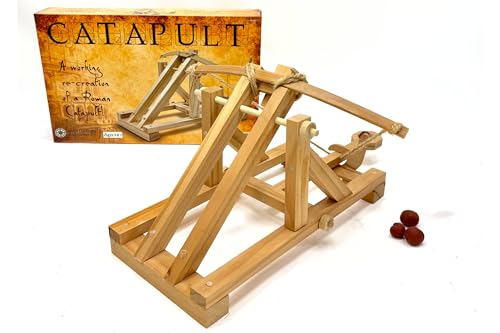
Inspired by ancient Roman siege technology, this Pathfinders kit lets kids build a real working catapult capable of launching projectiles beyond 15 feet. The experience blends history with practical science—learners explore physics concepts such as force, energy, and motion while assembling a model that functions much like its historical counterpart. The kit comes with all necessary parts including eco-friendly wood pieces, elastic bands, and illustrated instructions, with no tools required for assembly. It’s well suited for curious minds 8+ and older who enjoy historical engineering narratives paired with tangible results.
What makes it stand out
The Roman catapult kit emphasizes testing and measurement, encouraging kids to experiment with launch distances and angles. The historical angle deepens engagement, and the fully functional mechanism provides a clear demonstration of how early engineers solved practical problems. As a standalone project or group activity, it supports strategy development, teamwork, and iterative thinking.
Buying Guide: How to Choose a Catapult Kit For Kids
Choosing the right catapult kit involves balancing age, complexity, safety, and educational goals. The following considerations help compare options and select the best fit for home, school, or after-school programs.
- Age and safety: Look for kits with simple instructions, non-sharp parts, and kid-friendly project scopes for younger builders. Older kids may enjoy more complex mechanisms and historic contexts.
- Hands-on learning vs. demonstration: Some kits emphasize building and launching experiments, while others focus on historical context and design principles. Decide whether you want more active testing or more theoretical exploration.
- Number of models and variety: A multi-model kit (catapult, ballista, trebuchet, etc.) offers broader practice with different mechanisms, ideal for extended learning or classroom use.
- Materials and durability: Wood construction provides tactile feedback and sturdiness, whereas plastic kits may be lighter but less durable. Consider storage and handling for frequent use.
- Included materials: Check if the kit includes projectiles, targets, glue, or sandpaper. Some kits require no extra tools, while others may benefit from basic supplies.
- Instruction quality: Clear, illustrated manuals or step-by-step videos reduce frustration and improve learning outcomes. Look for kits that explain the physics concepts behind launches.
- Historical vs. modern design: If the goal is to connect history with science, select kits that tie to historical siege engines or prominent figures like Leonardo da Vinci or Roman engineering.
- Educational alignment: Some kits align with STEM standards and classroom activities, which can be helpful for teachers and homeschooling families.
Comparative Summary
All five kits provide a blend of construction, launching tests, and educational context. The National Geographic Da Vinci kit emphasizes a trilogy of machines for varied experience, while Thames & Kosmos offers a curated six-model set with a strong physics focus. Pathfinders Leonardo and Medieval Catapult kits highlight historical connections with functional models, and Pathfinders Roman Catapult provides a robust launch experience grounded in ancient engineering. Depending on age, interest in history, and desire for hands-on experimentation, any of these choices can support a rich, inquiry-based learning journey.
Note: This article presents objective information about product features and educational value. Prices and availability may vary by retailer and over time.