Best Coding Toys for Toddlers and Early Learners
Discover engaging, screen-free coding toys that build foundational STEM skills for toddlers and preschoolers. This guide highlights five hands-on options that encourage problem solving, logical thinking, and creativity without screens. Each toy introduces core programming concepts through interactive play, making early coding approachable for young minds.
| Product | Age Range | Key Benefit |
|---|---|---|
| Learning Resources Switcheroo Coding Crew | 4+ | Three-in-one rescue robot for varied coding missions |
| Learning Resources Code & Go Robot Mouse Activity Set | 4-8 | Screen-free introductory coding with maze-based challenges |
| Learning Resources Code & Go Robot Mouse | 4+ | Hands-on keypad and route planning for beginner programmers |
| Learning Resources Coding Critters Bopper | 4+ | Interactive storytelling and 22-piece pet playset for coding play |
| Botley The Coding Robot 2.0 Activity Set | 5+ | Expanded coding styles with music, lights, and movements |
Learning Resources Switcheroo Coding Crew

Switcheroo Coding Crew introduces early coding concepts through a three-in-one rescue robot. Suitable for ages 4 and up, the hands-on play eliminates screens while building foundational logic and sequencing skills. The toy supports flexible play as the robot can transform into a police car, fire truck, or construction vehicle, enabling multiple mission-based challenges. Children experiment with simple directional inputs to navigate the robot through a 9-piece town map, fostering spatial awareness and problem-solving abilities. The modular design ensures continued engagement as kids grow more confident with basic programming logic.
From a developmental perspective, the product emphasizes problem-solving development and planning. caregivers can observe how children plan routes, adjust approaches, and adapt to new tasks. The three-mode play also encourages cooperative play and communication as kids explain their strategies. Since the kit uses tactile puzzle elements, it aligns well with Montessori-inspired learning styles, reinforcing hands-on comprehension of cause and effect in a controlled, age-appropriate setting.
Learning Resources Code & Go Robot Mouse Activity Set
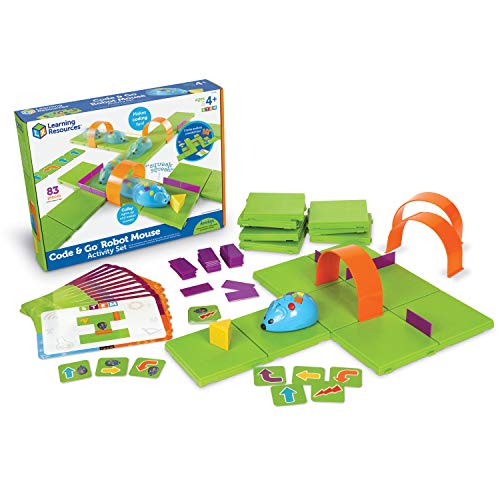
This screen-free coding kit offers an approachable doorway into programming for children aged 4 to 8. Through hands-on maze navigation, kids learn sequence planning, debugging, and logical thinking without relying on digital screens. The activity set includes a programmable mouse and a series of challenges that progressively increase in difficulty, helping children build confidence as they master essential STEM concepts. The kit’s tactile components support diverse learning styles, including visual, kinesthetic, and auditory learners, while providing a structured path from simple steps to more complex command sequences.
The product emphasizes problem-solving: children must anticipate outcomes, adjust plans when a route fails, and iterate toward a successful solution. This iterative process mirrors real-world debugging and algorithmic thinking in a developmentally appropriate format. Batteries are required, which introduces a small maintenance aspect that mirrors real devices and keeps the play experience tangible and repeatable.
Learning Resources Code & Go Robot Mouse
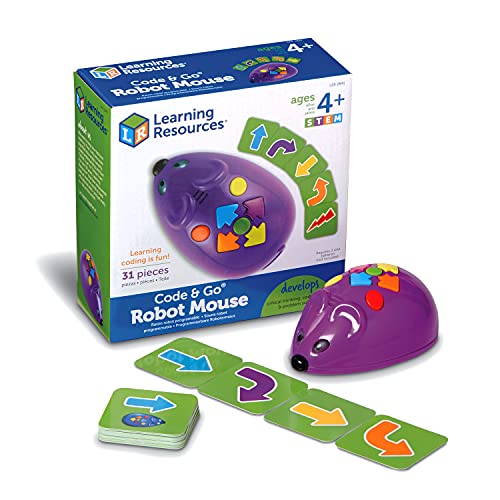
Code & Go Robot Mouse offers an approachable entry into coding with a focus on planning and sequencing. Children program a friendly mouse to navigate a path to its destination, learning how to set and adjust commands to reach a goal. The design engages multiple learning modalities through color-coded buttons, directional cards, and accompanying sounds, supporting visual, tactile, and auditory learners. The screen-free setup reinforces the idea that programming is a problem-solving activity driven by logic rather than a digital experience.
Educational value centers on early STEM concepts such as spatial reasoning, sequence building, and cause-and-effect relationships. As kids plan routes and test outcomes, they develop foundational computational thinking that translates to more advanced coding later. The interactive elements are crafted to sustain curiosity while providing clear feedback through prompts and responses from the robot, helping young learners stay motivated and engaged.
Learning Resources Coding Critters Bopper

Coding Critters Bopper introduces early coding through a 22-piece pet playset and a screen-free storybook adventure. Kids code along with Bopper and friends, engaging in basic sequencing and directional thinking within a playful narrative. The pet-themed setup promotes imaginative play while teaching core programming concepts such as order, repetition, and conditional actions in a kid-friendly context. The combination of storytelling and tangible components helps reinforce memory and comprehension as children practice coding steps in a familiar, accessible format.
The playset design supports design-your-own challenges, enabling children to create endless coding scenarios. This versatility makes it suitable for varied attention spans and developmental paces. By integrating a physical story experience with interactive tasks, learners can translate storytelling into procedural thinking, a key component of early computer literacy.
Botley The Coding Robot 2.0 Activity Set

Botley 2.0 extends screen-free coding into a broader creative toolkit with 78 pieces and expanded coding styles. Children can code Botley to perform sequences, movements, and even music and lights, offering a deeper dive into computational thinking while keeping play intuitive. The 16 interactive activities encourage learners to explore different coding approaches, such as changing order or adding repeats, which reinforces algorithmic thinking and planning without relying on screens. Botley’s accessible design makes it suitable for independent play or guided activities with a caregiver or teacher.
The kit supports early programming education by introducing multiple coding paradigms in a single set. This diversity helps address varying learning preferences, whether a child gravitates toward problem-solving, storytelling, or creative expression. Because Botley is open-ended, it provides a stable foundation for future, more complex coding concepts as children progress to higher levels of STEM learning.
Buying Guide: Key Purchase Considerations And Comparisons
When selecting coding toys for toddlers and early learners, consider these factors to ensure age-appropriate challenge, safe play, and meaningful skill development.
- Age suitability and developmental fit: Choose items labeled for 4–5+ years with activities that scale in difficulty. Some products provide simpler entry points for younger children, while others offer more complex sequences for growing minds.
- Screen-free emphasis: Prioritize toys that teach programming concepts through hands-on play without screens. This approach supports tactile learning and reduces screen time for toddlers.
- Core programming concepts: Look for units that introduce sequencing, loops, cause-and-effect reasoning, and basic debugging. A well-rounded set should expose kids to different coding paradigms (directional commands, maps, story-driven tasks, and simple conditional actions).
- Open-ended vs. structured play: Open-ended sets foster creativity and flexible thinking, while structured activities build confidence with guided tasks. A balanced mix helps children adapt to varied challenges.
- Learning styles compatibility: Visual, auditory, and kinesthetic learners benefit from color cues, sound feedback, and hands-on components. Toys that integrate multiple senses tend to sustain engagement.
- Durability and maintenance: Durable components and safe materials are important for toddlers. Some sets require batteries or include recording features; consider maintenance and replacement needs.
- Progression potential: Choose products that offer escalating levels of challenge or multiple missions so the same toy can grow with a child’s skills over time.
- Montessori-aligned elements: If you prefer hands-on, self-directed exploration, consider toys with modular pieces and puzzle-like maps that encourage independent problem solving.
- Family and caregiver involvement: Some toys work best with guided play or collaborative challenges. Look for options that support joint learning and conversation about strategies.
In sum, the right mix of toys provides a sturdy foundation in computational thinking while remaining engaging and age-appropriate. Screen-free options that combine story, puzzle, and mission-based play tend to support steady development of planning, sequencing, and logical reasoning in young children.