Best Counting Toys for Toddlers: Big Math Skills From Small Hands
Finding engaging, educational toys that support early math skills is essential for toddlers. This guide highlights five top counting and sorting toys that promote number recognition, counting, color sorting, and fine motor development. Each option pairs classroom-friendly concepts with playful activities to keep little learners engaged at home, in preschool, or during therapy sessions.
Summary of selected products:
- Oomloid Counting Animals Montessori Toys for Ages 3-5
- Melissa & Doug Counting Caterpillar – Classic Wooden Toy
- Melissa & Doug Abacus – 100 Beads
- Aigybobo Farm Animals Montessori Counting Set
- Learning Resources Smart Counting Cookies
Oomloid Counting Animals Montessori Toys

The Oomloid Counting Animals set includes 36 colorful animal pieces, six rainbow sorting bowls, and two tweezers. Designed for toddlers and early elementary children (ages 3-5 and 4-8), these toys help develop counting, sorting by color, and basic arithmetic concepts. The Montessori approach encourages independent exploration as children group animals by type and color, then count and compare quantities. This activity supports hand-eye coordination and fine motor precision as kids manipulate tweezers to place animals into the matching bowls.
Key features support early math learning through hands-on activities: animal categorization, number counting, and color matching. The set also serves as a versatile classroom resource for teachers and a home-learning kit for parents seeking structured playtime that promotes cognitive development and number sense.
Melissa & Doug Counting Caterpillar

This classic wooden counting toy features 10 numbered segments, each painted a different color and marked with dots to support counting practice. Children can arrange the segments in numerical order, connect the dots to practice one-to-one correspondence, or explore simple math problems. Crafted from durable wood, the Caterpillar is designed for long-lasting play with smooth edges for safe exploration. It helps develop number sense, color recognition, fine motor skills, and hand-eye coordination while fostering imaginative play as children line up the segments to form the caterpillar.
Melissa & Doug Abacus

The Melissa & Doug Abacus offers a classic wooden counting frame with 100 beads arranged on 10 wires. Its sturdy hardwood construction and smooth finish ensure safe, durable use for years. The abacus supports a wide range of early math activities, including counting, basic addition and subtraction, and pattern recognition. Teachers and parents can guide kids through structured exercises or let children freely explore bead counts to build foundational arithmetic skills and logical thinking as they manipulate the beads along the wires.
Aigybobo Farm Animals Montessori Counting
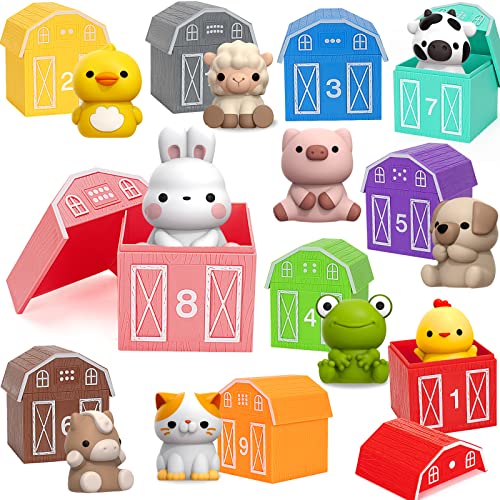
This 20-piece farm animal set presents 10 animals and 10 barns, designed to boost counting, sorting, and fine motor skills. Each animal can function as a finger puppet, with holes that accommodate toddler fingers for easy on/off play. The barns are labeled with numbers 1–10, and the animals feature dots that correspond to those numbers, supporting early number identification and one-to-one correspondence. This kit doubles as a language and cognitive development tool, encouraging kids to describe, compare, and categorize while engaging in pretend play around farm scenes.
Learning Resources Smart Counting Cookies

The Smart Counting Cookies set includes 11 cookies representing numbers 0–10, each with a unique number of chocolate chips to visualize quantities. This pretend-play tool blends math practice with kitchen-themed imaginative play, encouraging children to count, compare, and identify number patterns while sorting and stacking cookies. The integrated use with play kitchens or tea-time scenarios helps build fine motor control as kids pick up, place, and maneuver the cookies, reinforcing hand strength and dexterity alongside numerical understanding.
Buying Guide
Key purchase considerations when selecting counting and sorting toys for toddlers:
- Age appropriateness and safety: Look for rounded edges, non-toxic materials, and age-appropriate pieces that avoid small parts for younger children.
- Core math skills targeted: Determine whether you want focus on counting, number recognition, sorting by color, or early addition/subtraction. Some sets blend several skills for a broader learning experience.
- Materials and durability: Wooden options tend to last longer and withstand rough play, while rubber or plastic pieces can be washable and versatile for sensory activities.
- Fine motor development: Consider tools that promote pincer grip, tweezers, or nesting/bagging activities to strengthen hand muscles and coordination.
- Versatility and room to grow: Toys that support multiple activities (sorting, counting, matching, pretend play) provide ongoing engagement as a child’s skills advance.
- Home and classroom use: If you’ll use toys in a classroom setting, select items with clear, repeatable activities and potential for group work or guided lessons.
Performance comparisons across the featured items emphasize a balance between traditional wooden toys (durability and tactile feedback) and modern sensory sets (color sorting, multi-piece assemblies). Parents and educators may choose based on preferred learning style—concrete counting with physical pieces, or light, portable options that integrate easily into daily routines and travel. Each product listed here aligns with early math development goals while offering engaging play experiences that support cognitive and motor growth.