Best Educational Gadgets for Students: Top STEM Tools for Learning
Exploring science and math becomes engaging when students have the right hands-on tools. This guide highlights educational gadgets that support classroom learning and at-home exploration, from pocket microscopes to compact multi-tools. Each pick emphasizes accuracy, portability, or practical reference knowledge to bolster curiosity and understanding.
| Product | Brand | Key Benefit |
|---|---|---|
| Carson MicroBrite Plus 60x-120x Accurate LED Lighted Pocket Microscope | Carson | Portable magnification for field and lab exploration |
| The Pocket Physicist | Genius Lab Gear | Compact physics reference tool with constants and conversions |
| Microscope For Kids, 1000X 1080P | Uarzt | High-resolution handheld digital microscope |
| Microscope For Kids Beginners 40X-1000X | Emarth | Beginner-friendly with dual illumination |
| BEBANG Pocket Microscope | BEBANG | Portable, easy-to-use beginner microscope |
The following selections focus on accessible, reliable educational gadgets that support STEM curiosity, measurement skills, and hands-on science practice for students of various ages.
Carson MicroBrite Plus Pocket Microscope

The Carson MicroBrite Plus delivers true magnification in a compact, LED-illuminated package. Designed for classroom use and field study, it offers up to 120x optical zoom with reliable performance. Its small size makes it ideal for students who want to examine everyday samples, from leaves to fabric fibers, without bulky equipment. This pocket microscope supports hands-on exploration and fosters a practical understanding of microscopic structures.
The Pocket Physicist – Metal Physics Daily Tools

This compact metal card provides essential physics references in a portable format. Equipped with rulers, a protractor, and a compass, it serves as a handy aid for physics students and STEM enthusiasts who need quick access to equations, constants, and unit conversions. Its metric and imperial measurements, along with embedded references, support efficient problem-solving and calculations during labs and homework.
Microscope For Kids, 1000X 1080P (Uarzt)

This upgraded digital microscope sustains learning with 100X–1000X zoom on a 1080P display. The built-in screen allows students to view specimens clearly without external displays, and the kit includes a set of slides for immediate experimentation. Its user-friendly design supports extended exploration of hair, leaves, coins, and other everyday items, helping students build confidence in microscopic observation and documentation.
Microscope For Kids Beginners (Emarth)
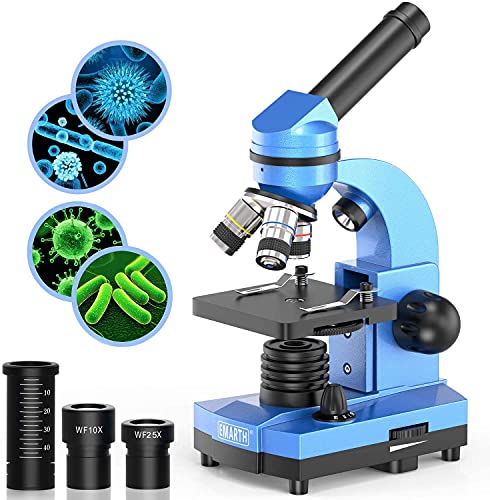
Emarth’s beginner microscope offers six magnification levels from 40x to 1000x, with WF10x and WF25x eyepieces for clearer viewing. Dual illumination supports both opaque and translucent specimens, while rotating color filters enhance contrast and learning engagement. It’s designed to be approachable for younger students while still providing solid optics for foundational lab work.
BEBANG Pocket Microscope

The BEBANG Pocket Microscope emphasizes portability and ease of use, with a 60x-120x magnification range and built-in LED illumination. It is well-suited for quick field observations, classroom demonstrations, and on-the-go science exploration. Its compact size makes it an approachable tool for students who want to carry a microscope in a pocket or bag for spontaneous study sessions.
The Pocket Scientist – Metal Science Ruler

Genius Lab Gear’s Pocket Scientist offers a compact set of measurement tools with embedded references. It includes a straight-edge ruler, protractor, and compass, all in a metal card form factor. The embedded equations and constants support quick, in-text calculations and sketches during geometry, physics, or engineering assignments, making it a handy field-ready reference for students and educators alike.
Buying Guide
Key purchase considerations for educational gadgets for students include:
- Purpose and age suitability: Choose tools aligned with current curriculum goals and the student’s age to maximize engagement and safety.
- Magnification and optics quality: For microscopes, higher optical magnification with good lighting yields clearer images; for measurement tools, precision and durability matter.
- Portability and ease of use: Pocket or handheld designs support flexible learning whether at home, school, or in the field.
- Educational value: Tools with built-in references, manuals, or color aids can enhance learning without excessive external resource searching.
- Durability and safety: Stainless steel or robust plastics improve longevity in classroom environments; safety-focused features reduce risk during use.
- Compatibility and extension: Consider whether the gadget integrates with other kits or supports data capture (photos, videos, or notes) for assignments and labs.
When evaluating options, compare optical quality, illumination options, ease of cleaning, and included accessories. For a classroom setting, a mix of a few high-utility items (like a durable pocket microscope and a compact physics reference tool) alongside beginner-friendly kits can provide broad coverage of core STEM topics while accommodating varying student interests.