Best Forensic Science Kits for High School Students
This guide highlights top forensic science kits suited for high school learners. Each kit offers hands-on activities in fingerprints, blood analysis, hair and fiber examination, handwriting, and crime scene investigation. The selections balance realism with classroom safety, helping students build critical thinking and scientific reasoning through structured, evidence-based experiments. Explore five compelling options with detailed features to compare what best fits your curriculum, lab setup, and learning objectives.
| Product | Brand | Key Focus |
|---|---|---|
| Mark Twain Forensic Investigations Workbook | Mark Twain Media | Deductive reasoning, handwriting, fingerprinting |
| Crime Scene Forensic Science Kit: Solve The Missy Hammond Murder | Crime Scene | Actual forensic tests, latent print, evidence analysis |
| ALDON Innovating Science Forensic Case Study: Murder at Eagle Nest Harbor | ALDON | Evidence analysis, multiple forensic methods |
| Forensic Chemistry of Blood Typing | ALDON | Blood typing, chemical analysis in forensics |
| Forensic Chemistry of Hair Analysis Experiment Kit | ALDON | Hair and fiber analysis, observational skills |
Mark Twain Forensic Investigations Workbook

Features a student-centered approach to crime solving, with scenarios that encourage multiple plausible outcomes. Activities include interpretive handwriting, body language cues, fingerprinting, and more, fostering deductive-reasoning skills in a structured classroom or homeschool setting. The workbook format supports collaborative projects and individual practice.
Crime Scene Forensic Science Kit: Solve The Missy Hammond Murder
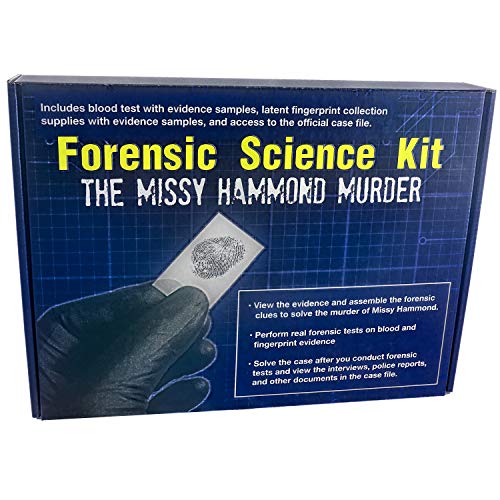
This kit uses authentic forensic tests to analyze provided evidence, including latent fingerprints and fabric samples with synthetic blood. Students access a police case file (internet required) and perform hands-on investigations to draw conclusions about the crime. It’s well-suited for aspiring detectives and cooperative lab work.
ALDON Innovating Science Forensic Case Study: Murder at Eagle Nest Harbor

In this classroom activity, students analyze a variety of evidence—fingerprints, hair, blood, fiber, and handwriting—to identify the most likely suspect. The kit emphasizes methodical data collection, hypothesis testing, and evidence-based reasoning, aligning with standard high school science objectives.
Forensic Chemistry of Blood Typing

This distance-learning kit introduces chemical forensic testing methods to determine blood types and the role of blood evidence in investigations. The demonstration highlights the scientist’s role in a case and challenges students to assess suspect involvement using learned concepts, supporting remote or hybrid learning formats.
Forensic Chemistry of Hair Analysis

This kit explores how hair and fiber evidence contributes to solving crimes. It includes observational and comparative exercises, plus hair samples from various sources. Students practice analytical skills, linking microscopy results to investigative conclusions in a safe, hands-on format.
Buying Guide
Key purchase considerations for high school forensic kits include scope and alignment with curriculum, safety and age-appropriateness, access to teacher resources, and the level of hands-on engagement. Consider the following perspectives:
- Curriculum alignment: Choose kits that map to biology, chemistry, and scientific inquiry standards, with clear lab activities and assessment ideas.
- Safety and materials: Look for kits using non-toxic, classroom-safe materials. Check for required PPE, handling guidelines, and supervision needs.
- Hands-on depth: High school learners benefit from multi-step investigations, data collection, and evidence interpretation rather than single-skill activities.
- Evidence realism vs. accessibility: Some kits provide authentic crime-scene components; others offer simulated evidence. Balance realism with safety and cost.
- Digital integration: Some packages include online case files or supplementary videos. Evaluate whether digital resources improve engagement and understanding.
- Group work potential: For classrooms, assess whether kits support collaborative investigations, role assignments, and peer review.
- Assessment support: Look for built-in rubrics, lab sheets, and answer keys to streamline grading and track progress.
Compared to purely theoretical lessons, these kits provide tangible evidence handling, data analysis, and problem-solving experiences. When selecting, consider your students’ prior experience, the available lab space, and the time allotted for a module or unit. Some kits pair well with cross-disciplinary topics such as ethics in forensics, statistics in evidence evaluation, and writing assignments that require documenting investigative steps and conclusions.