Best Indoor RC Helicopters for Fun and Learning
Discover top indoor RC helicopters that combine stability, durability, and beginner-friendly controls. This guide highlights five highly rated models, detailing features like altitude hold, gyro stabilization, LED lighting, and extended flight times. Ideal for kids, teens, and adults, these helicopters are designed for safe indoor use while delivering engaging, hands-on learning about flight dynamics and remote control basics.
| Product | Brand | Key Feature | Flight Time |
|---|---|---|---|
| BUSSGO RC Helicopter | BUSSGO | 7 LED light modes, altitude hold, dual batteries for longer play | 30-34 minutes with two batteries |
| SYMA S100 Mini RC Helicopter | SYMA | Small desk-friendly design, one-key take-off/landing, altitude hold | 5-7 minutes |
| Cheerwing S107/S107G Blue | Cheerwing | 3-channel, gyro-based stability, two frequencies | Varies by model |
| RC Helicopter Toy for Kids | jikuva | 30+ minutes with two modular batteries, LED lights | Up to 30 minutes |
| SIMREX RC Helicopter | SIMREX | Altitude hold, dual speeds, 2 batteries included | Up to 30 minutes |
BUSSGO Indoor RC Helicopter With LED Modes

The BUSSGO RC Helicopter uses an upgraded gyro system to deliver stable hover performance in indoor environments. Its 7 LED light modes create an engaging night-time display, with demo mode features that automatically perform auto-rotation or circle flights to spark curiosity. This model emphasizes simple operation, allowing basic ascent, descent, and directional control, along with speed settings for various skill levels. The build includes a sturdy PVC body, protective landing gear, and an alloy-encased control board to minimize damage from gentle crashes. A modular battery setup supports extended play in two-battery mode.
SYMA S100 Mini RC Helicopter With Gyro Stabilizer

The SYMA S100 is a compact desk-friendly helicopter featuring a gyro stabilizer, altitude hold, and a 3.5-channel design. Its small footprint makes it ideal for quick indoor flights or display purposes when not in use. Easy one-key take-off and landing plus intuitive joystick controls support first-time flyers, offering a gentle introduction to RC aerial maneuvers. Despite its tiny size, this model delivers stable flight and quick responsiveness, making it a popular starter option for households and classrooms.
Cheerwing S107 Phantom 3CH Blue
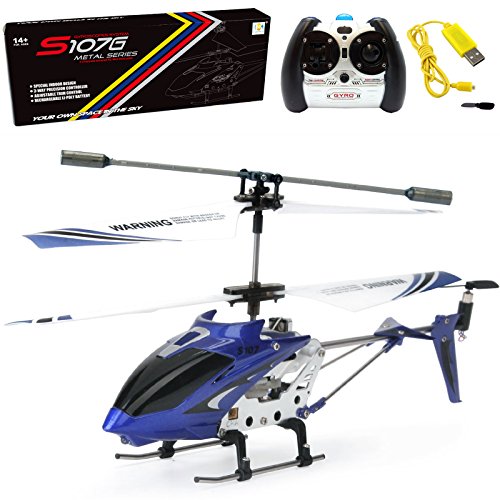
The Cheerwing S107 series offers a 3-channel control system with a gyro-driven stabilization platform and selectable frequencies for interference-free operation. The Blue variant emphasizes reliable indoor flight performance in compact spaces. With straightforward controls and durable build, it provides predictable hover behavior and smooth transitions between ascent, descent, and turns, making it suitable for beginners who want a low-stress learning curve and dependable performance.
RC Helicopter Toy for Kids by Jikuva
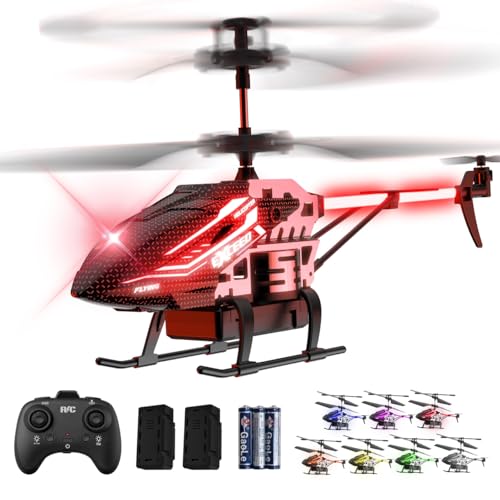
The Jikuva RC Helicopter focuses on beginner-friendly operation with altitude hold and one-key takeoff/landing. Two removable modular batteries extend playtime beyond typical beginner models, enabling up to about 30 minutes per session. Safe indoor use is supported by a durable shell and LED indicators for orientation in low light. The kit is positioned as a family-friendly option, with simple controls that help new pilots gain confidence quickly while maintaining safety during flights.
SIMREX RC Helicopter Toy For Kids

The SIMREX model blends altitude hold with two-speed options and a dual-battery setup for longer sessions. Its latest gyroscope technology supports stable aerial performance, especially for beginners who are still mastering hover control. The 2.4 GHz remote control helps maintain a solid connection with minimal interference, while a straightforward take-off and landing workflow minimizes complexity for new pilots. The overall design prioritizes consistent, approachable flight dynamics in indoor settings.
Buying Guide: Key Purchase Considerations
When choosing an indoor RC helicopter, consider stability, control simplicity, and durability as top factors. Look for a robust gyro system and altitude-hold capability to prevent constant drifting, especially in smaller rooms. Battery life and the option for extra batteries extend playtime and reduce downtime between flights. A modular battery design is convenient for quick swaps and easier charging. Light-emitting features can improve orientation in dim environments, but ensure they do not overcomplicate handling for beginners. Weight, size, and protective gear such as landing skids or a shell guard influence crash resilience and room suitability.
Beginner-friendly controls, including one-key takeoff/landing and trim adjustments, help new pilots build confidence before advancing to more complex maneuvers. Frequency options matter in multi-ship environments to avoid radio interference; dual-frequency or digital systems reduce skip and jitter. For younger flyers, choosing a model with safety-focused design, soft plastics, and clear indicators is prudent. Finally, assess the learning curve: some models offer multiple speed modes or programmable settings to grow with the user, ensuring continued engagement as skills improve.