Best Light-Up Keyboard Pianos for Beginners and Enthusiasts
If you’re exploring entry points into piano playing or want a kid-friendly practice companion, a light-up keyboard piano can accelerate learning. These instruments combine illuminated keys with built-in lessons, rhythms, and teaching modes to help players develop proper finger placement and timing. Below, five popular models are highlighted, focusing on light-up keys, learning aids, and beginner-friendly features. Each product section includes a quick overview, key specs, and how its teaching tools may support progress.
| Product | Key Feature | What It Offers |
|---|---|---|
| JIKADA 61 Key Portable Keyboard | Lighted learning keys, 3 teaching modes | LCD status display, 255 tones/ rhythms, built-in speakers, practice with mic and headphones |
| MUSTAR 61 Key With Light-Up Keys | Smart learning system, 3-step modes | Light guidance, 4 memory settings, 255 tones/ rhythms, recording and dual-keyboard play |
| RockJam 61 Key Kit | Lighted keys, teaching features | LED panel, 200 rhythms/tones, recording, USB/aux options |
| MUSTAR 61 Key With Stand (Black) | Lighted keys, learning modes | Large LCD, 2 built-in speakers, 255 tones/ rhythms, stand and stool options |
| SFESGRER 61 Key Keyboard | Light-Up keys, LED display | ABS construction, 60 demo songs, percussion kit option, microphone input |
Choosing a light-up keyboard involves balancing playability, learning aids, and portability. The following product sections present five models that emphasize guided learning, interactive features, and compact design suitable for homes, classrooms, or travel. Each entry provides a concise look at what stands out and how the teaching features can support ongoing improvement.
JIKADA 61 Key Portable Keyboard Piano

The JIKADA 61-key keyboard combines full-size keys with a bright LCD display that clearly shows active functions. It includes audio input/output and a microphone jack, enabling late-night practice without disturbing others. It delivers 255 tones and 255 rhythms, along with 50 demo songs and 61 keyboard percussion types, for a broad sonic palette. A three-teaching mode system guides learners through steps and integrates piano note stickers to help with note positions and theory. The two built-in speakers produce a balanced sound for personal practice or small-group sessions.
MUSTAR 61 Key Light-Up Keyboard
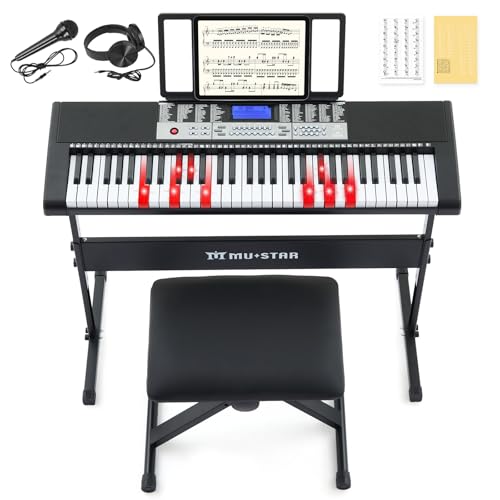
The MUSTAR keyboard for beginners emphasizes a smart 3-step learning system: Single Key, Follow, and Ensemble modes, which simplifies progression as skills grow. Lighted keys guide finger placement, and 255 tones, 255 rhythms, plus 50 demo songs provide extensive practice material. A 4-memory setting feature lets students save fast-lookup configurations for quick transitions during practice or performance. It includes a built-in recording capability and the option for dual-keyboard play, expanding learning opportunities beyond solo practice.
RockJam 61 Key Keyboard Kit

The RockJam 61-key kit blends portability with teaching-focused features. A LED panel displays rhythms and tones, while 200 rhythms and 200 tones offer a broad sonic range. The kit’s teaching function and 30 demo songs support structured practice, and the built-in recorder allows layering of performances for self-review. A versatile setup enables mains power or battery operation, and there’s an auxiliary input to play along with favorite tracks, which can accelerate learning by providing musical context for timing and phrasing.
MUSTAR 61 Key Keyboard With Stand

This MUSTAR model also targets beginners with light-up keys and a comprehensive learning setup. It features a clear LCD screen, two built-in stereo speakers, and a selection of 255 tones/255 rhythms plus 50 demo songs. Three intelligent teaching modes help beginners progress from simple note recognition to more complex ensemble playing. A bundled stand and stool option makes it a ready-to-practice package, supporting proper posture during longer sessions and reducing setup friction for new players.
SFESGRER 61 Key Light-Up Keyboard

SFESGRER’s 61-key keyboard emphasizes brightness and playability with 61 illuminated keys and an LED display to track settings. It includes a robust set of features for both beginners and more experienced players, such as 200 tones, 200 rhythms, and 60 demo songs. The instrument supports an optional 8-piece percussion kit and provides audio input/output plus a microphone jack, enabling a full practice setup for singing and playing. The durable ABS construction makes it well-suited for frequent handling and transport in educational contexts.
Buying Guide: Key Purchase Considerations
When selecting a light-up keyboard piano, consider the following factors to match your goals and environment:
- Learning features: Look for light-up keys, step-by-step modes, and memory settings that support progressive learning. A 3-step system (Single Key, Follow, Ensemble) or equivalent is useful for building confidence and technique.
- Sound and voices: A broad palette—255 tones and 200+ rhythms—gives flexibility for practice across musical styles. Built-in demo songs can guide timing and phrasing.
- Teaching aids: Piano note stickers, LCD displays, and a dedicated practice microphone input help with reading music and rhythm retention, especially for beginners and children.
- Connectivity: Audio input/output and headphone jacks enable private practice. An aux input allows playing along with tracks, while USB or MIDI options suit more advanced users.
- Portability and setup: If you’ll travel or practice in multiple rooms, aim for a compact design with a lightweight stand and stool option. Ensure power options are convenient (mains or battery).
- Durability and materials: ABS plastics keep costs down and weight reasonable, but ensure keys have a good tactile feel and sufficient rebound for accurate finger positioning.
- Upgrade path: As skills improve, you may want a model with recording capabilities, multi-voice layering, and the ability to save configurations for quick recall during performances.
- Price-to-feature balance: Decide which teaching features you truly need versus extras. Beginners often benefit most from guided learning modes and clear visual cues.
Bottom line: for beginners, prioritize light-up keys, clear instructional modes, and reliable sound output. For more advanced practice, consider models with recording capabilities, diverse tones, and versatile connectivity. Assess your space, typical practice times, and whether you’ll use the instrument for solo lessons or collaborative play with others.