Best Math Toys for 6 Year Olds: Engaging Tools to Boost Early Math Mastery
Finding the right math toys for 6-year-olds can turn everyday play into meaningful skill-building. The items below cover a range of learning styles—from electronic tutors and board games to hands-on STEM sets—designed to reinforce addition, subtraction, multiplication, and number recognition. Each product encourages interactive learning, quick feedback, and family-friendly play to keep kids motivated. Explore options that blend fun with fundamental math practice to support confident, curious learners.
| Product | Brand | Why It Stands Out |
|---|---|---|
| alilo Math Games | alilo Store | 19 interactive games with 5 modes, including speed challenges and rewards |
| Number Hunter Math Board Game | Clever Fox Play Store | Turn-based addition and subtraction with hands-on dice play |
| Brainometry | Learning Resources Store | 3D puzzle and pattern-based logic for spatial thinking |
| Montessori Wooden Board Game | — | Classic counting sticks and color balls for hands-on math play |
| Math Whiz | Educational Insights Store | Electronic math practice with multiple modes and difficulty levels |
alilo Math Games for Kids Ages 5-12
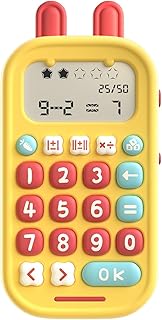
The alilo math toy provides 19 interactive games designed to build logic and core math skills. It includes four logic-based activities (number memory, size comparison, pattern recognition, and number guessing) plus 10 arithmetic games covering addition, subtraction, multiplication, and division. A set of math fact patterns and a timed challenge mode (5 or 10 seconds) helps improve speed and accuracy, while instant voice feedback supports comprehension and engagement. An error-check feature lets children revisit mistakes for targeted practice and long-term improvement, making it a well-rounded tool for mixed-ability classrooms or family learning sessions.
Number Hunter Math Board Game
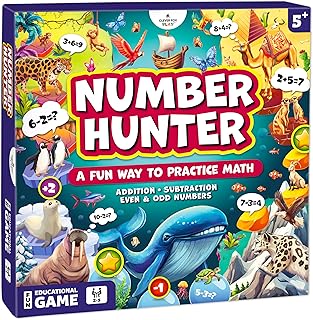
Number Hunter transforms math practice into an adventure. Designed for kids in kindergarten through third grade, the game focuses on addition and subtraction skills through a race-based, turn-taking format. Rolling dice and solving math challenges advances players along a track, promoting number recognition, rapid calculation, and strategic thinking. Its classroom- and homeschool-friendly design supports cooperative play, motivating learners to tackle problems in a light-hearted, social setting while reinforcing essential arithmetic concepts.
Learning Resources STEM Explorers Brainometry

Brainometry combines 3D puzzle play with math-oriented brainteasers to develop critical thinking and spatial reasoning. The tactile blocks and pattern-matching activities invite hands-on exploration, improving fine motor skills while introducing early math concepts through pattern recognition and logical sequencing. With double-sided activity cards offering escalating difficulty, this set grows with a child’s abilities, providing a versatile resource for independent play, guided learning, or small-group challenges.
Montessori Wooden Board Games for Kids

This Montessori-inspired wooden board game blends counting sticks and color balls into a classic, multi-game framework. Crafted from beech wood with non-toxic finishes, it supports a range of activities—from pick-up sticks to Mikado and math-based challenges. The setup helps early learners sort, count, and develop strategic thinking while building hand-eye coordination. Suitable for group play or solo exploration, it offers durable, kid-friendly design and repeatable mathematical practice in a tangible format.
Educational Insights Math Whiz

Math Whiz offers electronic math practice with three modes of play to suit different learning needs. Drill Mode delivers progressively challenging problems, Challenge Mode adds a numbers elimination twist, and Calculator Mode provides a straightforward arithmetic tool. With eight levels of difficulty per skill, this handheld device scales with a child’s growing math abilities, supporting independent practice, classroom stations, or travel-friendly learning on the go.
Buying Guide: Key Considerations for Math Toys
- Learning goals: Align the toy with current math priorities such as addition fluency, subtraction accuracy, number sense, and early multiplication concepts.
- Age and ability range: Choose options that offer scalable difficulty, so the toy remains engaging as skills advance.
- Learning style: Balance screen-free activities (board games, manipulatives) with any electronic tools to diversify practice modalities.
- Engagement and motivation: Look for features like feedback, rewards, or competitive elements that sustain interest without creating pressure.
- Durability and safety: Prioritize sturdy construction and non-toxic materials for long-term use in households or classrooms.
- Portability: For travel or small-group activities, consider compact designs or portable kits that are easy to store and carry.
- Teacher and parent resources: Some toys include activity cards, guided challenges, or progression charts that help adults facilitate learning.
- Assessment potential: Toys with built-in feedback or tracking can help monitor progress and tailor future practice sessions.
- Price range and value: Compare the number of activities, durability, and potential for repeated use to determine overall value.
- Inclusivity and pace: Ensure the toy supports collaborative play or solo practice without overstimulation or frustration.
In selecting math toys for six-year-olds, aim for a balanced mix of cognitive challenges, hands-on manipulation, and opportunities for social interaction. The products listed here offer varied approaches—from structured board games and tactile manipulatives to electronic practice—each contributing to a well-rounded early math toolkit. When used together, they can reinforce core skills and foster a positive attitude toward math that endures beyond early elementary grades.