Best Microscope for a Five-Year-Old: Safe, Educational Picks for Little Scientists
Choosing a beginner-friendly microscope for a five-year-old involves balancing safety, simplicity, and curiosity. The right model introduces basic scientific concepts, supports motor skills, and keeps kids engaged without frustration. This guide highlights five top kid-friendly digital and handheld microscopes that are well-suited for young learners, offering clear images, child-safe features, and durable designs suitable for at-home exploration or classroom activities. Read on to compare magnification ranges, display options, and ease of use, so you can pick a microscope that nurtures early STEM confidence.
Summary of chosen products:
- Oripira Kids Microscope Handheld, Autofocus 500X with 1080P display
- WINWEND Kids Microscope Pocket 1000X with 2” digital screen
- coobest Pocket Kids Microscope Over 3 Years Old, 1000X
- Nisumkey Digital Microscope with 1000X and 2.0″ IPS screen
- USCAMEL Kids Microscope Science Kit, 1200X with carrying box
Oripira Auto-Focus 500X Kids Microscope

The Oripira handheld microscope is designed with early learners in mind, combining a compact pocket form with a straightforward autofocus system. Magnification ranges from 100X to 500X, enabling kids to observe details in leaves, insects, and everyday objects clearly. It features a 2MP 1080P camera and a built-in 2.0-inch display, so children can view specimens without an external screen. Eight adjustable LED lights illuminate subjects for better visibility in varied lighting, while a rechargeable battery supports outdoor use. The included lanyard makes it easy to carry during outdoor science adventures.
Key features: 100X–500X magnification, 1080P display, eight LEDs, rechargeable battery, portable design, beginner-friendly controls. This model is a strong option for parents seeking a single-device kit that combines viewing and recording in a kid-safe package.
WINWEND Pocket Microscope 1000X with 2” Screen

The WINWEND digital microscope stands out with a 2” built-in display and a broad 100X to 1000X magnification range, making it easy for young learners to explore a variety of specimens without needing a separate computer. A dedicated storage feature allows capturing up to 400 photos, and expandable memory via a TF card means videos can be saved for later review. Eight LED lights with six brightness levels help ensure clear imaging in different environments, from sunlit windowsills to dim drawers of specimens.
Key features: 100X–1000X magnification, 2” display, built-in storage, USB export, eight LEDs with adjustable brightness. This model suits families who want frequent photo-documentation of discoveries and easy sharing for school projects.
coobest Pocket Microscope For Kids Over 3
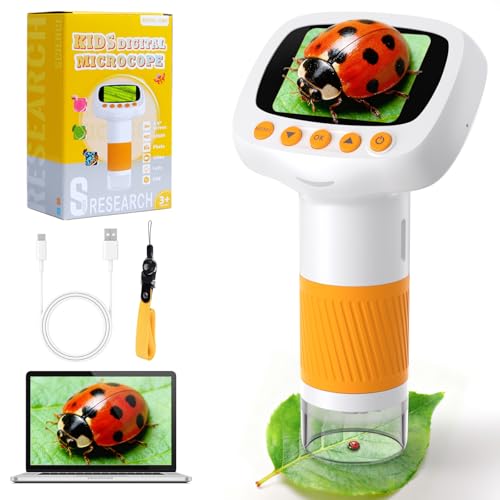
The coobest handheld microscope is designed as a palm-sized learning tool with a simple three-step operation: turn on, adjust focus, and observe. It delivers up to 1000X magnification on a 2.0-inch IPS screen, enabling kids to view plant cells, insect details, and textures up close. The anti-lost lanyard provides a convenient carrying option, and the compact form factor makes it a good gift choice for holidays or birthdays. The device encourages independent exploration and can be a family science starter kit.
Key features: 1000X magnification, 2” IPS screen, simple three-step use, lanyard included, portable design. This option prioritizes ease of use and on-table or on-the-go discovery for young scientists.
Nisumkey Digital Microscope Essentials for Ages 5-12

The Nisumkey digital microscope line offers two variants with a 2.0-inch IPS display and up to 1000X magnification, crafted for kids ages 5 and up. The models emphasize ease of use, enabling children to capture photos and videos directly on the device and export them via USB. Eight LED lights with adjustable brightness support clear imaging in various conditions, supporting outdoor science sessions and classroom demonstrations alike.
Key features: 1000X magnification, 2.0″ IPS display, photo/video capture, USB export, eight adjustable LEDs. This family-friendly option balances robustness with a straightforward interface for budding scientists.
USCAMEL 1200X Kids Microscope Kit

The USCAMEL kit raises the magnification ceiling to 1200X and includes a kid-friendly educational focus. Its intuitive controls are paired with a durable frame and a carry case for easy transport, making it suitable for science-rich activities at home, school, or in the field. The kit supports self-guided experiments and family learning, reinforcing observation skills and scientific curiosity in younger children.
Key features: 1200X magnification, portable kit with case, intuitive controls, educational activities. This model targets families seeking a more robust, higher-mortem magnification option while staying child-appropriate.
Buying Guide: Key Purchase Considerations For Young Learners
- Ease of use: Simple controls, quick startup, and minimal setup help maintain engagement for five-year-olds. Look for models with straightforward on/off actions and clear focus knobs or autofocus.
- Display versus device pairing: Handheld or pocket microscopes with built-in screens reduce reliance on smartphones or computers, promoting independent exploration. If a device links to a computer or tablet, ensure a user-friendly software interface.
- Magnification range: For young kids, 100X–1000X provides enough detail to examine diverse subjects without overwhelming the learner. Adjustable focus helps accommodate different specimen types.
- Lighting: Built-in LED illumination improves visibility. Variable brightness enhances image clarity in dim or bright environments, which is helpful for classroom and outdoor use.
- Durability and safety: Plastic housings with rounded edges and shatter-resistant components minimize risk during play. A lanyard or carry case can reduce accidental drops or misplacement.
- Storage and sharing: Devices with internal storage and easy photo/video export support documentation of discoveries for school projects or family photo albums.
- Learning resources: Some kits include guided activities or worksheets that align with early STEM curricula, helping caregivers integrate microscopy into playtime.
- Portability: Lightweight, pocket-sized designs encourage exploration in various settings, from living rooms to parks, fostering ongoing curiosity.
- Future-proofing: If your child shows sustained interest, a model with higher magnification and robust build can extend learning without frequent replacements.
Additional Perspectives And Comparisons
When evaluating options, consider whether you prefer a device with a built-in display or one that requires a connected screen. Built-in displays simplify first-time use and reduce dependency on external devices, while screen-connected models may provide higher resolution images and easier data transfer for school reports. Durability is also a factor for younger children who may drop or mishandle equipment. Look for models with protective casing and straightforward, big knobs for focusing. Finally, assess whether the included accessories (carrying case, lanyard, or prepared slides) align with your child’s interests, such as insects, leaves, or coins.
In terms of scope, the five highlighted models offer a spectrum: from ultra-portable, easy-to-operate handheld devices to more feature-rich kits with expanded magnification ranges. Each aims to transform curious play into early scientific reasoning, supporting foundational skills in observation, documentation, and critical thinking.