Best Microscope Kits for Students: Top Picks for Learning at Home or in the Classroom
Choosing the right microscope kit helps students explore biology with hands-on confidence. This guide highlights five reliable options that balance magnification, build quality, and engaging accessories. Each product is suitable for different ages and educational goals, from early curiosity to more advanced lab work. Use this overview to compare features, lenses, lighting, and included slides so you can pick a kit that matches your curriculum and budget.
Summary table of chosen products:
- PalliPartners Compound Microscope — 100X-2000X, dual LED illumination, metal frame, slides set, phone adapter
- Uarzt 58-Piece Kids Microscope Kit — 100X-1200X, metal body, LED light, carrying box
- AmScope M162C-2L-PB10-WM — 40X-1000X, all-metal, top & bottom LED, curriculum book
- AmScope M30 Series 52-Piece STEM Kit — 120X-1200X, monocular, LED, color filter wheel
- National Geographic Dual LED Kids Microscope — 50+ accessories, two lighting modes
PalliPartners Compound Microscope: Serious Power For Students

The PalliPartners compound microscope is designed for both classroom labs and home education. It features six magnification levels from 100X to 2000X using a WF25X eyepiece with 4X/10X/40X objectives. A dual control focus system with coarse and fine adjustment (0.1mm precision) helps students lock in sharp images of slides and prepared samples. It also includes lab-grade illumination with top and bottom LEDs and a 0.65 NA condenser, delivering strong contrast for plant cells, insect structures, and other specimens. The metal frame provides sturdy support for longer study sessions and more accurate observations. A slides set and a phone adapter are included to document findings, supporting both written lab notes and digital portfolios.
Uarzt 58-Piece Kids Microscope Kit: Entry-Level Exploration

This 58-piece kit is aimed at younger scientists, offering 100X, 400X, and 1200X magnifications to view a variety of specimens. The metal body and LED illumination create a durable, easy-to-use platform suitable for family science nights and school projects. With 44 additional pieces, including blank slides and specimens, children can observe a wide range of biology concepts—from cells to histology. The carrying box makes it practical for classrooms and learning-at-home setups, while the accessible design encourages hands-on experimentation and ongoing curiosity.
AmScope M162C-2L-PB10-WM: Award-Winning Classroom Grade
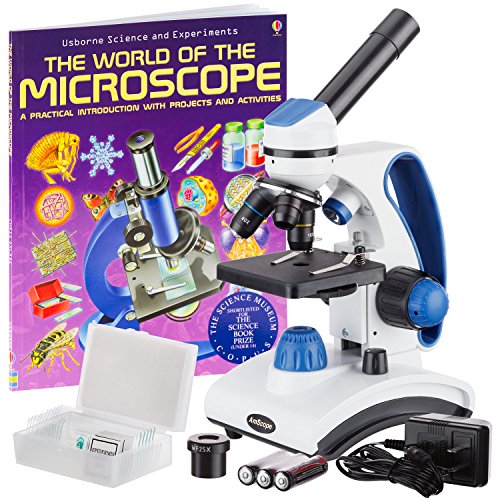
This all-metal, monocular microscope delivers strong performance for upper elementary through high school projects. It provides 40X-1000X magnification across five wide-field settings and includes top and bottom LED lights for flexible illumination. The coaxial coarse and fine focusing helps students acquire precise focusing skills, a core competency in biology labs. The kit often arrives with slides and a basic lab book to guide experiments, making it a reliable choice for structured curricula or independent study.
AmScope M30 Series 52-Piece STEM Microscope Kit: Kid-Driven Inquiry

The AmScope M30 kit is designed for kids and young students exploring microscopy as a STEM activity. It features six magnification settings from 120X to 1200X and a monocular viewing head with LED illumination. A rotating color filter wheel adds a fun, educational element while simplifying specimen observation. The 52-piece kit includes plastic slides and a variety of accessories to encourage experimentation, making it an entry-level option for classrooms and homeschool curricula that emphasize hands-on discovery.
National Geographic Dual LED Kids Microscope: Comprehensive Starter Kit

The National Geographic Dual LED kit is a well-rounded entry point for young scientists. It offers two lighting modes—useful for observing both small slides and three-dimensional specimens with the upper LED. The kit includes more than 50 accessories, such as prepared slides, blank slides, tweezers, and an eye-dropper, plus a mini geode. This breadth makes it a strong classroom option for introducing biology, geology, and general science. The combination of approachable features and a sturdy build supports frequent use in learning environments and homes alike.
Buying Guide: Key Purchase Considerations For Student Microscope Kits
- Magnification range and optics: Consider what subjects students will study. Entry-level kits often offer 40X-1000X, while higher-end models reach 2000X. Look for quality lenses and clear optics to minimize visual fatigue during longer sessions.
- Illumination: LED lighting is standard on most educational kits. Dual illumination (top and bottom) improves contrast for both transparent and opaque specimens. Adjustable brightness helps accommodate varying slide materials.
- Build quality and stability: A metal frame generally lasts longer and resists wobble during use. A sturdy arm and stage help maintain precise viewing, which is important for accurate measurements and documenting findings.
- Ease of use: For younger students, monocular heads, intuitive focus controls, and simple slide handling reduce frustration. For older students, options with advanced controls suit more complex experiments.
- Included accessories: Look for slides (prepared and blank), covers, tweezers, labels, and a storage case. Additional items like phials, lenses, or a student workbook add value for structured lessons.
- Documentation and curriculum alignment: Some kits include beginner guides or teacher resources. Consider whether the kit aligns with your science standards or classroom objectives.
- Expansion potential: If you expect ongoing use, verify compatibility with extra slides, additional lens sets, or digital capture accessories such as phone adapters or USB cameras for later projects.
- Maintenance and safety: Check assembly requirements, ease of cleaning slides, and whether the kit avoids hazardous materials. A wipe-clean surface and simple disassembly can save classroom time.
- Digital integration: If students will share findings, a microscope with a phone adapter or built-in digital capture simplifies documenting and presenting results.
In choosing a kit, balance immediate classroom needs with long-term learning goals. For younger learners, kits with colorful features, robust durability, and plenty of accessories encourage exploration. For older students, look for higher magnification, precise focusing, and more advanced illumination options to support lab projects and research assignments. The five kits above offer varied entry points while keeping a consistent emphasis on educational value and reliability.