Best Planet Models for Kids: Fun Space Kits for Learning
Explore engaging, educational planet models that inspire curiosity about the solar system. This guide highlights five kid-friendly kits with interactive features such as glow effects, projectors, and movable parts. Each option is designed to support STEM learning, spark imagination, and fit various ages and interests.
| Product | Brand |
|---|---|
| National Geographic Glow-in-The-Dark Solar System Model Kit for Kids | Blue Marble |
| Science Can Solar System for Kids | Science Can |
| 4M Solar System Planetarium | 4M |
| BONNYCO Solar System for Kids Toys | BONNYCO |
| Wooden Solar System Model Board | Xylolin |
National Geographic Glow-in-The-Dark Solar System Kit

This kit offers a hands-on solar system display with glow-in-the-dark features. Kids can customize all eight planets and the sun, creating a bright, 3D model that lights up in the dark. It supports space-themed room decor while teaching planetary positions and scale.
Included are six vibrant paints, glow accents, a brush, a palette, decals, and a poster with solar system facts. Easy-to-follow, kid-friendly instructions simplify assembly, making it suitable for group projects or solo explorations.
Movable arms enhance playtime as children adjust planet positions to reflect orbit ideas or personal displays. The design encourages experimentation with scale and arrangement, reinforcing concepts of astronomy and spatial reasoning.
Science Can Solar System for Kids

This interactive solar system model doubles as a planetarium projector, projecting the eight planets onto a surface. It transforms a ceiling or wall into an educational space scene, supporting visual learners and classroom activities alike.
The device features English and Spanish language options, making it versatile for bilingual households or classrooms. A projector base activates educational facts about each planet, encouraging inquiry and discussion about space science.
The kit includes 24 full-color space images via three disks, expanding learning opportunities with planet, spaceship, astronaut, and other space-themed visuals. It’s a compelling option for ages 5 and up who enjoy interactive storytelling with science facts.
4M Solar System Planetarium
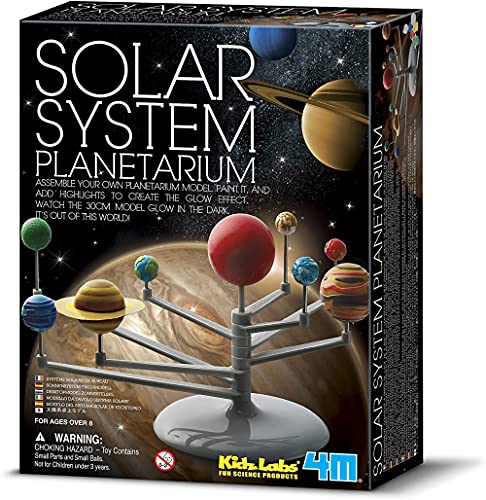
This DIY glow-in-the-dark planet model set invites children to assemble and paint their own solar system. It includes stencils, glow paint, rods, string, and a wall chart with quizzes to reinforce learning, making it an all-in-one STEM activity.
Designed to foster hands-on understanding of planetary positions and orbits, the kit combines art with science. Complete assembly instructions support independent learning and guided group projects, suitable for home use or school activities.
BONNYCO Solar System for Kids Toys

This felt board set uses 61 felt figures to represent the solar system, including the Sun, Moon, 13 planets, dwarf planets, and numerous space objects. It doubles as a storytelling tool and classroom resource for hands-on learning and imaginative play.
Includes adhesive hangers for wall display and a variety of space-themed figures that support Montessori-inspired teaching. The kit emphasizes labeling and recognition of planetary names, aiding early readers and visual learners.
Wooden Solar System Model Board

The wooden model board provides a tactile, durable approach to learning the solar system. Eight wooden planet spheres and accompanying flashcards help children associate planets with facts, while a three-piece puzzle forms a cartoon-style solar system display.
Made with smooth, safe materials and no sharp edges, the kit is suited for younger children and classroom activities. The sturdy design supports repeated handling and long-term display in a playroom or study space.
Buying Guide: Key Purchase Considerations
- Age appropriateness: Choose a kit aligned with a child’s developmental level, whether they prefer hands-on assembly, storytelling, or projector-based exploration.
- Learning objectives: Consider whether the kit emphasizes facts, spatial reasoning, science vocabulary, or creative display as primary goals.
- Interactivity: Glow features, movable arms, projectors, and felt boards offer different engagement styles. Determine which method most motivates ongoing learning.
- Durability and materials: Wooden or sturdy plastic components recommend longevity for frequent handling and travel-friendly use.
- Storage and setup: Some kits include storage aids or wall displays; others rely on compact components. Assess space and ease of setup.
- Language and accessibility: Bilingual options or clear, kid-friendly instructions help broader audiences and diverse classrooms.
- Educational value vs. decor: If the aim is room decor, glow-in-the-dark features and attractive visuals may be prioritized; for classroom use, robust educational content is key.
- Maintenance: Some kits require paints or brushes; others provide pre-painted pieces. Consider whether ongoing supplies are needed for future projects.
- Expansion potential: If a child enjoys astronomy, look for kits that complement future topics like moons, comets, or orbital mechanics.