Best Portable Telescopes for Deep Space Viewing
For stargazers who crave deep-space glimpses without hauling heavy equipment, portable telescopes offer a balance of lightness, setup speed, and capability. The following selections emphasize travel-friendly designs, reliable optics, and smart features that help you locate and capture distant galaxies, nebulae, and star clusters—even on weekend getaways or urban-dark-sky trips. Each option prioritizes portability, ease of use, and solid image quality for deep-space observation.
Summary of Chosen Products
| Product | Brand | Lightweight / Portability | Key Deep-Space Capability |
|---|---|---|---|
| DWARFLAB Dwarf 3 Smart Telescope | DWARFLAB | Ultra-light 3 lb | 4K Auto-Tracking and dual imaging for deep-space targets |
| ZWO Seestar S30 All-in-One | ZWO | About 3.6 lb (1.65 kg) | Automatic star-finding and dual-lens system for wide and telephoto deep-space views |
| HEXEUM Telescope 80mm | HEXEUM | Compact refractor with included tripod | Bright, wide-field views with high transmission coatings |
| Dianfan 90mm Aperture | Dianfan | Portable refractor with bag | High magnification with multi-coated optics for lunar and deep-sky targets |
| Celestron NexStar 130SLT | Celestron | Portable computerized setup | Extensive database and computerized object locating |
DWARFLAB Dwarf 3 Smart Telescope

The DWARFLAB Dwarf 3 combines ultra-light portability with smart features designed for on-the-go astronomy. Weighing roughly 3 lb, it is pitched as the world’s most portable smart telescope. The dual imaging system supports day and night use, enabling wildlife, landscape, and celestial captures with a single setup. Four-kay and cloud-based processing enhance imaging clarity, while the auto-tracking capability keeps celestial objects in frame for extended sessions. This model suits explorers who want quick setup, mobility, and reliable tracking for deep-space targets such as star clusters and brighter galaxies.
Key features include an ultra-light design that slips into a standard backpack, a dual-lens system for daytime and nighttime use, and a professional-grade 4K auto-tracking engine. The combination of a lightweight build, portability, and automatic tracking makes it a compelling option for weekend stargazers and travelers who value speed and consistency when chasing deep-space sights.
ZWO Seestar S30 All-in-One

The Seestar S30 is designed as a compact, travel-ready smart telescope with built-in camera capabilities. Its light frame weighs about 3.6 lb (1.65 kg), making it easy to carry in a backpack or messenger bag. The integrated Seestar App provides automatic star-finding, precise tracking, and one-tap shooting, turning complex astrophotography into a user-friendly experience. The dual-lens arrangement (telephoto and wide-angle) supports both deep-space framing and terrestrial landscapes, enabling flexible sessions that can include Milky Way arcs, star clusters, and nearby planets.
Three shooting modes—Stargazing, Scenery, and Solar System—expand the telescope’s versatility beyond deep-space observing. The S30 balances portability with automated functionality, offering a modern solution for travelers who want accessible, on-demand deep-space imaging without the need for extensive setup or computer control on-site.
HEXEUM 80mm Aperture Refractor
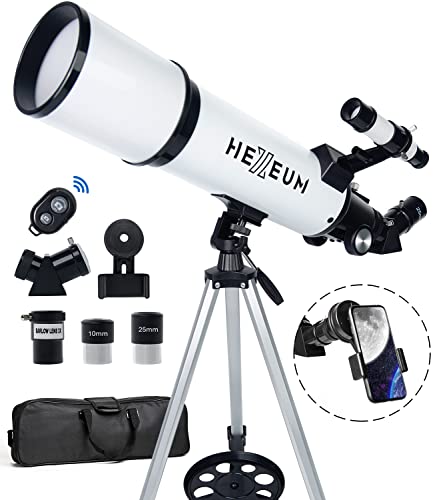
The HEXEUM 80mm refractor emphasizes portability with a compact 80mm objective and a fully multi-coated optical path. The arrangement supports 24X to 60X magnification via included eyepieces (25mm and 10mm) and a 3x Barlow lens that triples magnification for higher-detail lunar and planetary views. The design optimizes light transmission to deliver brighter images, and it includes a phone adapter and wireless control options for quick capture. A compact tripod and carrying bag complete the package, making it a practical choice for travel and family outings where space is a premium.
With a 600mm focal length and robust coatings, it presents a reliable option for observing brighter deep-space targets such as star clusters and the Moon’s surface. While not a specialized deep-space imager, its portability and sturdy build make it a versatile all-around performer for beginner to intermediate observers who value mobility without sacrificing optical quality.
Dianfan 90mm Aperture Refractor

The Dianfan telescope features a 90mm aperture and 800mm focal length, combining bright light-gathering with flexible magnification. The 90mm aperture enhances light collection for brighter planetary and deep-space views, while fully coated optics improve contrast and color fidelity. The 3× Barlow lens expands magnification, enabling lunar detail and closer glimpses at brighter deep-space targets. The kit includes a sturdy tripod and a phone adapter, supporting simple alignment and quick captures for both beginners and more experienced observers who want a portable setup for field observations.
The telescope’s quick setup and beginner-friendly instructions help new users become productive rapidly. The upright image orientation via the zenith mirror is another practical feature for terrestrial viewing, which complements astronomy sessions. This instrument is well-suited for travelers seeking a balance of portability, ease, and respectable deep-space capability.
ToyerBee 90mm Refractor Telescope

The ToyerBee 90mm refractor excels as a family-friendly beginners telescope. It provides 15X to 150X magnification via a 3× Barlow lens and two eyepieces, enabling wide lunar views and tighter planetary details. The 70mm aperture supports brighter daytime views and modest deep-space glimpses, and the wireless remote adds convenience for group observations or guided demonstrations. The included phone adapter and lightweight tripod enhance portability for travel or camping trips, making it a practical pick for learning the night sky while on the go.
Buying Guide: Key Purchase Considerations
- Portability vs. aperture: Lighter models are easier to transport, but larger apertures collect more light for fainter deep-space objects. Determine your balance based on typical travel plans and observing targets.
- Optical design: Refractors are generally low-maintenance and resistant to misalignment, ideal for beginners and travelers. Reflectors offer more aperture for the price but may require occasional collimation in portable setups.
- Smart features and automation: Devices with automatic star-finding, tracking, and image capture simplify field use and improve success rates when locating deep-space targets, especially in light-polluted areas.
- Mount type and stability: A sturdy, adjustable tripod with smooth tracking enhances viewing comfort and reduces fatigue during longer sessions, particularly at higher magnifications.
- Accessories: A good starter kit should include eyepieces with different focal lengths, a Barlow lens for higher magnification, a finder scope, a smartphone adapter, and a carry bag to keep everything organized.
- Target compatibility: If deep-space viewing is the primary goal, ensure the telescope can handle faint objects beyond the Moon and planets. Telescopes with wider fields of view help locate nebulae and star clusters more easily.
- Ease of use: For new observers, features like one-button launch, app-based guidance, and simple alignment routines reduce setup time and increase observing opportunities.
- Durability and weather resistance: Consider materials and coatings that withstand outdoor use and varying temperatures, especially if you plan outdoor field trips or camping.
When selecting a portable telescope for deep-space viewing, it helps to compare how each model handles common real-world scenarios: quick setup at a dark-sky site, backpack-friendly transport, reliable object location in light-polluted environments, and the ability to capture manageable images without complex configurations. The options above provide a mix of lightweight designs, digital automation, and versatile optics to suit different traveler types—from casual stargazers to enthusiasts seeking more serious deep-space imagery on the go.