Best Pretend Cash Register Toys for Kids
Parents and educators alike seek engaging, educational toys that blend playtime with early math skills. Pretend cash registers are a popular choice, helping children practice counting, basic addition and money recognition while they role-play shopping experiences. This guide highlights five top options, each designed to spark imagination and reinforce foundational numeracy in a safe, interactive way.
| Product | Brand | Key Feature |
|---|---|---|
| Learning Resources Pretend & Play Calculator Cash Register Toy – Pink | Learning Resources | Solar powered calculator and authentic cash drawer sounds |
| Learning Resources Pretend & Play Calculator Cash Register Toy | Learning Resources | 73-piece set with play money and credit card |
| lalalark Cash Register Toy for Kids | lalalark | Detachable write & erase pad and voice-assisted calculator |
| BAODLON 103 Pcs Toy Cash Register | BAODLON | Comprehensive grocery store set with microphone and banking features |
| FS Pretend Play Calculator Cash Register Toy | FS | Built-in calculator, scanner and pretend credit card |
Across these options, you’ll find a range of features—from solar-powered calculators to lightning-fast “cha-ching” drawers and multiple play money pieces. The right pick depends on your child’s age, how they like to play, and whether you want a straightforward cash register or a richer grocery-store setup that includes accessories and pretend shopping items.
Learning Resources Pretend & Play Calculator Cash Register Toy – Pink

This pink pretend cash register centers on simple, accessible math play. The set includes 73 pieces to mimic a real-store experience, supporting early counting, addition and money recognition. A solar-powered calculator eliminates the need for batteries, making ongoing play less disruptive. The cash drawer emits an authentic “ka-ching” sound, adding a tactile, auditory cue that reinforces learning through action. A pretend credit card and receipts pad complete the shopping narrative, enabling kids to role-play everyday transactions in a playful, educational context.
Designed for preschool-aged children, this option balances durability with engaging features. The solar calculator ensures accessible operation without replacing batteries, while the included play money—bills and coins—helps children connect numerical concepts to tangible currency. The setup also encourages role-play communication as kids practice speaking and negotiating during “payments.”
JOVA Lalalark Cash Register Toy – Detachable Write & Erase Pad
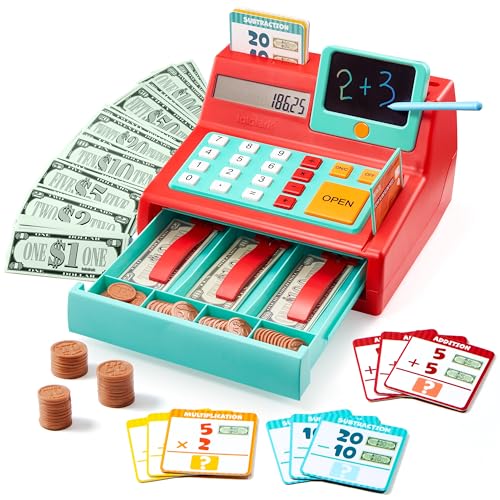
The lalalark model focuses on interactive learning with a detachable write & erase pad that can be used during standalone play or alongside the cash register. A voice-assisted calculator provides guided arithmetic, which supports early math confidence as kids simulate real-world store practices. The kit includes 49 US bills, 42 coins, a credit card, and 10 flashcards, enriching role-play with variety and challenge. The pad’s removability allows independent play, offering flexibility for children who enjoy both hands-on cash handling and writing/answering math prompts.
Key advantages of this design include engaging sound effects and a responsive calculator that provide feedback as kids swipe cards and tally totals. While batteries are required for the voice feature, the set aims to keep play accessible and educational as children explore money values, change, and price comparisons. The included flashcards introduce quick calculation prompts that help maintain momentum during play sessions.
BAODLON 103 Pcs Toy Cash Register – Silver Store Set

This BAODLON kit emphasizes a robust, multi-piece grocery store experience. It features a working cash register with a microphone, a credit card card, and 40 plastic coins alongside 60 paper bills. The drawer opens with a satisfying cha-ching, mirroring real-life cash handling. The set includes a microphone and a full array of groceries, shopping bags and coupons to extend role-play beyond simple checkout interactions. The real calculator inside the unit supports basic arithmetic and enhances math fluency in practical contexts. Suitable for children who enjoy extended play scenarios and storytelling around a mini-store environment.
With a higher piece count, this option supports extended play and imaginative scenarios, coordinating math practice with language and social interaction. The design aims to mimic a real retail experience, encouraging kids to sequence tasks, manage pretend money, and engage in multi-step exchanges. It’s a strong choice for families seeking a comprehensive, durable set that grows with a child’s counting and counting-based problem solving over time.
FS Pretend Play Calculator Cash Register Toy

The FS model emphasizes a well-rounded pretend play experience with a built-in calculator and a pretend scanner. The design supports classic shopping role-play while emphasizing counting, money handling and basic arithmetic. A microphone and decorative “food” items help create a full-store atmosphere, encouraging kids to engage in conversations, price checks and payment simulations. This option is practical for younger children who benefit from straightforward, tactile interactions and simple prompts to guide math practice during play.
Durability and safety considerations are important for FS, as the toy targets early childhood ages. The included features are crafted to facilitate hand-eye coordination, number recognition and pretend shopping dialogue. The balance of sound effects and physical play elements makes it a versatile choice for classrooms or home use when nurturing early math literacy.
Buying Guide: Key Purchase Considerations
- Age and developmental stage: For younger children (ages 3–5), simpler interfaces with large buttons, bright sounds and clear feedback work best. Older preschoolers may enjoy more complex sets with more pieces and realistic sounds.
- Interactivity vs. simplicity: Some models rely on a solar calculator and a few sounds, while others include multiple accessories and a complete grocery-store setup. Choose based on how your child likes to play—quick role-play or extended, imaginative scenarios.
- Learning features: Look for real-world money handling with coins and bills, basic arithmetic prompts, and a functional calculator. Toys that offer text-free prompts and visual cues support early numeracy without overwhelming language demands.
- Dramatic play accessories: Credit cards, receipts, a microphone, and grocery items can heighten realism and encourage narrative play, which supports vocabulary development and social skills.
- Durability and safety: Check for sturdy construction, rounded edges, and washable components where possible. Ensure small parts are age-appropriate to prevent choking hazards for younger children.
- Power source considerations: Solar-powered calculators reduce battery replacements and extend play readiness. Battery-powered features should be assessed for safety and ease of replacement.
- Storage and portability: Sets with organized compartments or carry cases help keep pieces together and encourage independent clean-up after playtime.
- Educational balance: While all toys support math practice, the best option combines counting, money recognition and language-based interaction to create a holistic learning experience.