Best Robot Arm Kit Ideas for Building Skills in Robotics and Engineering
Explore top robot arm kits that teach electronics, mechanics, and programming through hands-on building. This guide highlights five standout kits suitable for ages 8 and up, including teens and adults. Each selection emphasizes clear educational value, practical assembly, and engaging experimentation to spark interest in STEM.
Summary of chosen products:
| Product | Brand | Key Focus |
|---|---|---|
| Robot Arm Kits Robotics for Kids | ANNISOKA | Intro to circuits, wooden build, 6 AA batteries required |
| ACEBOTT Robot Arm Expansion Pack | ACEBOTT | 5 DOF, Arduino/ESP32 open platform, graphical programming |
| Giggleway 360° Rotating Robot Arm Kit | Giggleway | 360° rotation, easy operation, DIY STEM project |
| LewanSoul Hiwonder-xArm1S | LewanSoul | 6 DOF, high torque servos, PC/App control |
| Thames & Kosmos Bionic Robotic Arm | Thames & Kosmos | No motors required, nylon cable control, joystick operated |
ANNISOKA Robot Arm Kit For Beginners

Intro to robotics: This kit provides motors, PCB microcontroller boards, and wiring, enabling beginners to build and operate a robotic arm. It introduces electronic circuits and mechanical movement through hands-on assembly. It blends 3D puzzle elements with electrical engineering to engage ages 8–14 and beyond. Note: requires 6 AA batteries, not included. The kit aims to spark interest in engineering while offering a satisfying, educational building experience.
ACEBOTT Robot Arm Expansion Pack

Flexible 5 DOF robotic arm: Includes high-quality metal gear servos enabling 5 DOF motion. The clamp opens 260°, wrist and elbow rotate up to 180°, and the base turns 180°, offering versatile object manipulation. Graphical programming supports car functions and stimulates creativity, built on an Arduino open-source platform with ESP32 control for easier programming and DIY assembly. The kit emphasizes hands-on learning and concentration development through practical coding and construction.
LK COKOINO Robot Arm For Arduino

Arduino-based learning: This kit includes a 4DF robotic arm design with a 260° gripper opening and 180° rotation for the wrist, elbow, and base. It provides step-by-step assembly and programming tutorials, along with responsive after-sales support. Aimed at beginners and teens, it blends electronics with math and science concepts to reinforce hands-on problem solving and programming fundamentals.
Giggleway 360° Rotating Robot Arm Kit

360° rotation and easy operation: This wooden-based STEM kit enables full multi-directional movement with a gripper for grabbing and releasing objects. It is designed as a DIY learning experience for kids aged 12–14 and older, promoting hand-eye coordination and practical understanding of robotics. The included components encourage hands-on construction and iterative problem solving through assembly and testing.
LewanSoul Hiwonder-xArm1S
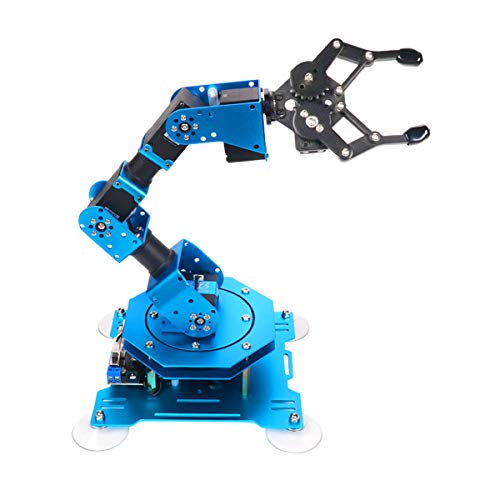
6-axis robotic arm with metal construction: The Hiwonder-xArm1S offers six high-precision servos with position, voltage, and temperature feedback. It supports remote control and programming for interactive projects, capable of grasping up to 500g. The design emphasizes stability and strong torque, making it suitable for more advanced experiments and demonstrations in classrooms or home labs.
Thames & Kosmos Bionic Robotic Arm

Mechanical arm with no motors: This STEM kit uses nylon cable systems controlled by joysticks to manipulate a bionic arm. It builds a working robotic arm from nearly 300 pieces, emphasizing intuitive control without electricity. Joysticks operate the arm and claw, challenging players to grab, move, and release objects through precise cable mechanics and manual coordination.
Buying Guide
- Age and skill level: Match complexity to the user’s experience. Some kits are beginner-friendly with step-by-step tutorials, while others support more advanced programming and hardware tinkering.
- Power and components: Consider whether the kit uses batteries, USB power, or computer interfaces. Some sets rely on motors and servos; others use hydraulic or purely manual control.
- Programming and open platforms: Kits built on Arduino or ESP32 offer broad learning ecosystems and future expandability. Look for graphical programming options if coding is new.
- Materials and durability: Metal gear servos and aluminum frames tend to be more durable for serious exploration, while wooden or plastic builds suit casual experimentation.
- Educational value: Assess whether the kit covers mechanical design, electronics, programming, and problem-solving through guided projects or open-ended play.
- Expansion potential: Some kits support add-ons or expansions (extra servos, grippers, or compatible software) to grow with the learner.
- Instruction clarity: Clear manuals, online tutorials, and quick-start guides reduce setup time and improve learning outcomes.
- Safety considerations: Ensure age-appropriateness and supervision needs, especially for kits with small parts or tools.
These robot arm kits offer diverse approaches to learning: from electronics-first setups with batteries to cable-driven mechanical systems that rely on manual control. Each selection provides hands-on opportunities to study robotics concepts, develop fine motor skills, and experiment with programming and mechanical design in a structured, safe environment.