Best Robot for 9 Year Olds: Fun STEM Toys for Learning and Play
Finding engaging, educational toys for a nine-year-old can be challenging. The following robots combine hands-on building, beginner-friendly coding, and interactive play to support curiosity and problem-solving. Each option below is suitable for kids around age 9, promoting STEM skills while keeping playtime exciting.
| Product | Type | Key Benefit | Approx. Suitability |
|---|---|---|---|
| Ruko 1088 Smart Robots for Kids | Large programmable robot | Voice and app control; expressive movement | 9 years |
| Henoda Robot Toys | Modular STEM building kit | Complex builds; multiple control modes | 8+ years |
| KingsDragon Robots Toy | Gesture-sensing and remote robot | Gesture control plus programming | 6+ years |
| ELEGOO UNO R3 Smart Robot Car Kit | Arduino-based robot car | Hands-on electronics and coding | 8-12 years |
| SONOMO Intelligent Programmable Robot | RC gesture and remote robot | Gesture sensing; programmable actions | 6+ years |
Below you’ll find concise overviews of five standout options, each aligned with learning goals typical for a nine-year-old explorer.
Ruko 1088 Smart Robots For Kids

Ruko’s 1088 model stands out with a tall, engaging design and a suite of control options. It is up to 15.8 inches tall and supports APP control in addition to voice commands. Its 10 expressions and 9 flexible joints enable lifelike, dynamic movement that invites kids to experiment with sequencing and cause-and-effect. With 10 songs and diverse activities like gymnastics, storytelling, and dancing, the robot doubles as a creative companion, helping develop motor coordination and early programming logic through guided, age-appropriate play. The combination of physical presence and programmable features makes it a strong fit for curious nine-year-olds who enjoy interactive play and lightweight encoding tasks.
Henoda Robot Toys
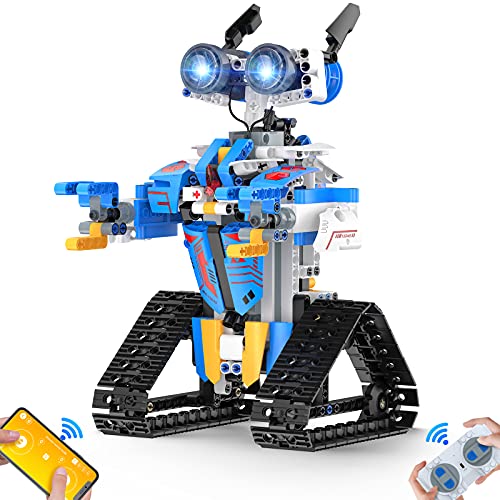
Henoda’s kit blends a robust 468+ brick-style build set with programmable features and remote control. The emphasis on STEM learning is clear: kids assemble blocks to form a functioning robot, then switch between modes—path, gravity sensor, voice control, and the 2.4 GHz remote—to guide its actions. The product’s 20-meter remote range expands play space, while glowing eyes and rotating joints introduce a tactile, interactive element. This multi-modal approach supports developing spatial reasoning, hand-eye coordination, and problem-solving as kids plan builds and test different control schemes.
KingsDragon Robots Toy

KingsDragon emphasizes gesture sensing for intuitive control that kids can master quickly. The toy supports both gesture-based and remote control operation, with obstacle detection to prevent collisions. Its programmable aspect lets children record up to 50 moves, turning play into a small coding project as kids sequence actions like turning, sliding, or stopping. The robot also sings and dances, integrating music and motion into a cohesive, engaging experience. This option suits children who enjoy a rhythmic, performative element to their play, alongside basic programming practice.
ELEGOO UNO R3 Smart Robot Car Kit V4

ELEGOO’s UNO R3-based kit focuses on hands-on electronics and programming. It includes 24 module parts for obstacle avoidance, line-tracing, and remote control, with compatibility for Android and iOS devices. The kit supports learning from Scratch to Arduino, offering a gentle progression from simple block-based coding to more advanced programming concepts. Assembly is designed to be approachable, with standardized ports to minimize errors, making it an attractive option for a nine-year-old ready to dive into more engineering depth while still enjoying guided projects.
SONOMO Intelligent Programmable Robot
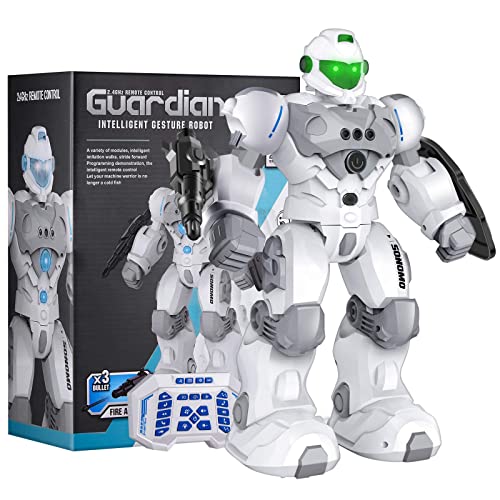
SONOMO’s robot blends 2.4 GHz remote control with gesture sensing and programmable actions. It enables kids to create sequences of motions—turns, slides, and other directional moves—using the remote as a basis for early programming concepts. In addition to remote and gesture control, the robot supports basic programming workflows that encourage planning and experimentation. This combination of tactile control with a programmable layer makes it suitable for kids who enjoy both hands-on play and constructing action routines.
Buying Guide: Key Considerations For Selecting A Robot For 9-Year-Olds
- Learning progression: Look for toys that offer both guided activities and opportunities to create independent projects. A smooth path from basic control to simple programming is ideal for a nine-year-old.
- Control options: Devices that support multiple control modes (remote, app, gesture, voice) help sustain interest and adapt to different learning styles.
- Durability and safety: Check build quality, age-appropriate materials, and rounded edges. Non-toxic materials and tested safety standards are essential for younger users.
- Social and collaborative play: Some kits enable group projects, coding with peers, or family participation, which can enhance motivation and learning outcomes.
- Gender-neutral and inclusive design: Choose robots with universal appeal and features that encourage imagination across activities like storytelling, music, and problem solving.
- Future learning potential: Kits that can be upgraded or expanded with additional modules or programming projects offer extended value as skills grow.
- Resource availability: Access to tutorials, coding cards, and software updates supports sustained learning and reduces frustration during exploration.
These considerations help balance immediate engagement with long-term skill development. When choosing, consider the child’s interests—whether they prefer storytelling, construction, music and dance, or hands-on coding—as well as the level of support available to guide learning milestones.