Best Science Toys for 7 Year Olds That Ignite Curiosity and Learning
Discover engaging science toys that align with 7-year-olds’ curiosity and budding problem-solving skills. This guide highlights hands-on kits and activities designed to inspire exploration, curiosity, and critical thinking while staying safe and age-appropriate. Each pick combines fun with foundational science concepts in chemistry, physics, earth science, and engineering.
Below is a quick summary of the five featured products. The table provides a snapshot of each kit’s focus, the primary science area, and what kids can explore through play.
| Product | Main Focus | ||
|---|---|---|---|
| Blue Marble National Geographic Magic Chemistry Set | Chemistry Experiments & Magic Tricks | Observation, Hypothesis, Basic Reactions | Perform 10 magic-style experiments and learn underlying science |
| UNGLINGA 70 Lab Experiments Science Kit | Comprehensive STEM Experiments | Critical thinking, Problem solving, Data gathering | Explore volcanoes, crystals, circuits, and reactions |
| National Geographic Gross Science Kit | Gross Science & Safe Horrible-Fun Experiments | Observation, Hypothesis, Safety | Gross-out experiments and science explanations |
| Bottleboom 13-in-1 Solar Power Robots | Solar Power & Robotic Engineering | Engineering design, Energy concepts | Build 13 robot types powered by solar energy |
| National Geographic Light Up Terrarium Kit | Earth Science & Mini Ecosystems | Botany, ecosystems, observation | Grow a tiny indoor garden and illuminate the habitat |
Blue Marble Magic Chemistry Set
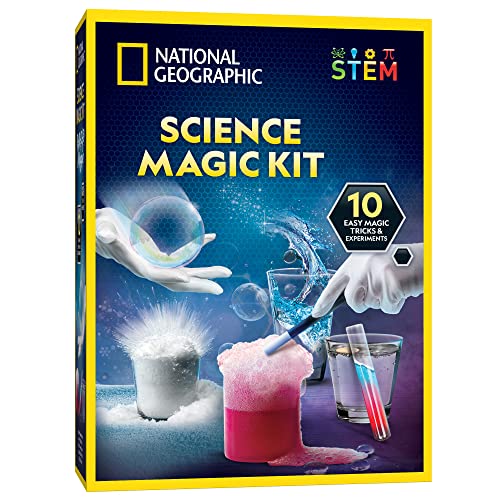
The Blue Marble National Geographic Magic Chemistry Set offers ten science experiments presented as magic tricks. Kids can perform effects like making a coin float and turning water colors, with a wand and gloves to enhance the show. The included instruction guide explains the science in kid-friendly terms and connects techniques to real-world scientists, encouraging curiosity and foundational chemistry concepts.
Key features focus on engaging presentation and approachable explanations. The kit emphasizes observation, cause-and-effect reasoning, and the wonder of discovery while introducing basic chemical ideas behind everyday phenomena. This set suits curious kids who enjoy dramatic demonstrations and storytelling around science.
UNGLINGA 70 Lab Experiments Kit

UNGLINGA’s 70-experiment set provides a broad spectrum of activities—from erupting volcanoes to fruit circuits and crystal growing. It encourages children to think like scientists, solve problems, and apply math skills as they document observations. The manual includes clear illustrations and explanations of the chemical reactions and physical processes at work.
Designed for extended play, this kit supports repeated experimentation, hypothesis testing, and the integration of science with everyday materials. It’s well-suited for independent play or family science sessions, helping kids develop persistence and curiosity through iterative experimentation.
National Geographic Gross Science Kit

The Gross Science Kit leans into the “wow” factor with 15 gross-but-safe experiments plus a 30-extension option using household items. Kids explore playful yet informative activities like making “test tube vomit” and glowing worms, which makes science memorable through vivid sensory experiences. The guide provides kid-friendly steps and concise science explanations to ground the fun in learning.
Beyond entertainment, the kit reinforces sequencing, prediction, and safe handling of materials. It’s a practical choice for social play with siblings or friends, helping children articulate what they observe, infer causes, and relate results to real-world science concepts.
Bottleboom 13-in-1 Solar Robots

The Bottleboom Solar Power Robots kit gives 13 different build-and-play options powered by solar energy. Kids learn about energy conversion, gear systems, and mechanical design as they assemble and switch between robot configurations that navigate different terrains. The set emphasizes hands-on engineering and experimentation with real-world science concepts such as solar energy reliance and motion.
Each build teaches spatial thinking, planning, and problem-solving as children adjust parts to improve performance. Because parts are modular, it supports iterative learning and experimentation, making it a strong choice for curious minds who enjoy constructing things that move and respond to light.
National Geographic Light Up Terrarium Kit

The Light Up Terrarium Kit lets kids create a tiny indoor ecosystem with real plants and gemstones, then illuminate the habitat with a USB-powered light. This project blends biology, botany, and environmental science, offering a calm, observational activity that teaches responsibility as kids care for living plants. The wide-mouth terrarium design supports easy setup and ongoing exploration, plus the illuminated lid provides a soft night-light or display feature.
Buying Guide
When choosing science toys for 7-year-olds, consider learning goals, safety, and engagement. Here are key purchase considerations and comparisons:
- Educational focus: Look for kits that balance concepts (chemistry, physics, biology, earth science) with hands-on activities to sustain interest over time.
- Age appropriateness: Ensure the complexity matches a 7-year-old’s cognitive and motor skills, with clear instructions and safe materials.
- Hands-on design: Favor kits that require planning, building, and experimentation rather than passive observation.
- Safety and materials: Check for non-toxic materials, kid-friendly tools, and age-appropriate small parts.
- Open-ended exploration: Select kits that allow modification, repeated trials, and extrapolation to broader scientific ideas.
- Cross-curricular links: Consider how projects connect to math, reading, and art for a well-rounded learning experience.
- Durability and storage: Durable components and organized storage help extend use and reduce clutter.
- Instruction quality: Good guides include visuals, explanations of concepts, and prompts for inquiry, not just steps.
- Future growth: Some kits scale with interest, offering companion activities or expansions to deepen learning.
Summary: For a 7-year-old, kits that mix captivating demonstrations with tangible engineering and biology concepts tend to perform best. Consider a balanced selection that includes chemistry magic, a broad STEM project set, gross science for memorable experiments, solar-powered robotics for engineering insight, and a terrarium to foster care for living systems. This approach nurtures curiosity, critical thinking, and the joy of discovery.