Best Stem Kits for 10-Year-Olds: Top Hands-on Science Toys
Choosing the right stem kit for a curious 10-year-old can spark a lifelong interest in science, technology, engineering, and math. The following hand-picked kits balance hands-on building with clear learning outcomes, helping kids develop problem-solving, creativity, and practical tech skills without needing screen time. Each option supports learning through play, with projects that scale in challenge and promote perseverance, collaboration, and curiosity.
Summary of selected products
| Product | Brand | Key Focus | Age Range | Why It Stands Out |
|---|---|---|---|---|
| Smartivity DIY Robotic Mechanical Hand | Smartivity | Mechanics, gears, and hydraulics | 8-14 | Hands-on mechanical hand with step-by-step build and lifetime parts support |
| Thames & Kosmos Mega Cyborg Hand | Thames & Kosmos | Pneumatic systems, hydraulics, gripping | 8-14 | No motors required; uses air pressure for realistic movement |
| Sillbird 12-in-1 Solar Robot Kit | Sillbird | Solar power, robotics, engineering basics | 8-13 | Outdoor-friendly, solar-powered play with multiple builds |
| ELEGOO UNO R3 Smart Robot Car Kit | ELEGOO | Programming, electronics, robotics | 8-14 | Comprehensive coding and hardware integration with versatile modules |
| BeAndge 11-Set STEM Kit | BeAndge | Multi-project electronics and mechanics | 8-12 | Wide variety of projects in one bundle for exploratory learning |
Smartivity DIY Robotic Mechanical Hand

The Smartivity kit delivers ACTION-PACKED FUN with a mechanical hand students can assemble and operate. The included step-by-step manual guides learners through a hands-on construction process, reinforcing mechanical concepts such as linkages, gears, and leverage. It’s designed for ages 8 through 14, making it a solid fit for a 10-year-old’s growing engineering interests. A key advantage is its 100% screen-free engagement, which emphasizes tangible problem-solving and creative experimentation.
Features include a comprehensive parts set with free lifetime replacement parts, ensuring uninterrupted play and learning. The building experience promotes patience, careful following of instructions, and curiosity about how mechanical systems translate into real-world applications. With a focus on developing confidence in engineering, this kit can serve as a foundational project that motivates kids to explore more complex tasks later.
Thames & Kosmos Mega Cyborg Hand

The Mega Cyborg Hand emphasizes pneumatic systems over circuitry, offering a hands-on experience with hydraulic-like power for gripping. No motors or batteries are required, which keeps setup simple while still delivering a convincing sense of mechanical control. Each finger joint can be tuned for different angles, enabling precise movement and experimentation with leverage and force distribution. This kit is ideal for a child who enjoys tinkering with how things move and respond to external forces.
Educational value centers on fluid power concepts, structural design, and kinematic reasoning. By adjusting the palm and finger mechanics, kids explore how variations in force, timing, and alignment affect performance. It also supports collaborative play when siblings or friends take turns guiding the build and testing the grip strength on various objects.
Sillbird 12-in-1 Solar Robot Kit
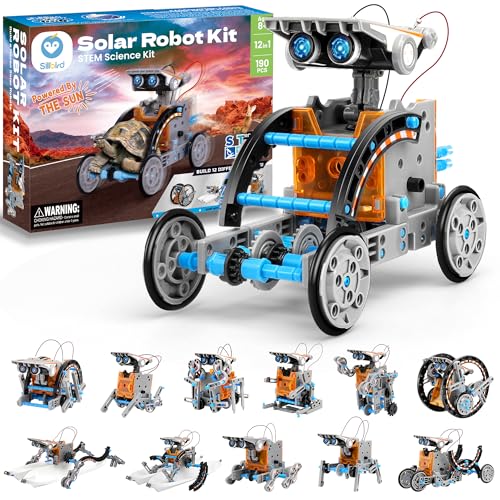
The Sillbird solar robot kit is built around solar power and hands-on construction, encouraging outdoor exploration and renewable energy awareness. With 190 pieces, the kit supports 12 different models, which helps extend the learning period as a child’s skills grow. Solar-powered operation demonstrates practical energy concepts and encourages planning for sunlight exposure and angle optimization to maximize efficiency.
Key benefits include screen-free engagement, opportunities to discuss energy sources, and an open-ended design approach that invites experimentation. The variety of builds fosters problem-solving, sequencing, and creative thinking as kids imagine how different configurations affect mobility and speed. This kit is well-suited for long-term play and family STEM activities outside the classroom.
ELEGOO UNO R3 Smart Robot Car Kit

The ELEGOO UNO R3 kit combines programming, electronics, and robotics for a comprehensive STEM experience. It’s designed for beginners and provides 24 module parts, including obstacle avoidance and line tracing modules. The kit can be controlled via Android and iOS devices, expanding learning into mobile app programming and wireless control. The assembly uses standardized ports and a user-friendly interface, reducing beginner frustration while enabling deeper exploration of coding concepts and hardware integration.
From a cognitive perspective, this kit supports iterative testing, debugging, and refinement—core skills in engineering and software development. For a 10-year-old, the blend of hands-on construction and programming offers a natural progression from simple mechanical builds to more sophisticated, interactive projects. It’s also a strong choice for students who enjoy exploring cause-and-effect relationships and algorithmic thinking.
BeAndge 11-Set STEM Kit

The BeAndge 11-Set STEM Kit offers a broad assortment of projects, from basic circuits to more complex mechanical assemblies. This variety helps accommodate different interests and skill levels, making it a flexible choice for a 10-year-old who wants to explore multiple facets of STEM without committing to a single theme. The included projects often involve both hands-on building and simple electronics, which reinforces practical understanding of physics, engineering, and problem-solving.
Educational value includes exposure to diverse concepts, such as circuits, gears, and basic automation ideas. The bundle format supports guided challenges as well as unstructured play, which can be beneficial for curious learners who prefer to experiment freely. It also serves well for classroom demonstrations or family STEM nights due to its wide range of activities.
Buying Guide: Key Purchase Considerations
Age appropriateness and safety
Look for kits labeled for ages 8-14 or 9-14 to ensure content matches a 10-year-old’s cognitive level. Check for small parts and choking risk where applicable, and choose kits that include secure storage and clear safety instructions.
Learning objectives and skill progression
Assess whether the kit emphasizes foundational concepts (such as gears, electricity, or hydraulics) and whether it offers a progression from simple to more complex tasks. Kits with step-by-step guides plus open-ended experiments tend to support both structure and creativity.
Hands-on experience vs. screen time
Consider the balance between tactile building and digital elements. Screen-free kits foster hands-on problem solving and physical manipulation, while some programs can introduce coding or app-based controls for extended learning.
Durability and replacement parts
Durable components and availability of replacement parts matter for extended use. A free or affordable spare-parts program reduces frustration from breakage and prolongs learning sessions.
Scope of projects and variety
Kits offering multiple builds or expandable modules provide longer value. A wider range of activities supports varied interests, reduces boredom, and invites exploration of different STEM domains.
Support and resources
Quality instructions, illustrated guides, and access to online tutorials or communities can significantly aid learning. Look for kits with comprehensive manuals and troubleshooting tips for beginners.
Across these options, the best choice depends on your child’s interests—whether they lean toward mechanical engineering, electronics and coding, or sustainable energy concepts. A kit with clear instructions, durable parts, and room to grow will best support ongoing curiosity and skill development for a 10-year-old learner.