Best Telescope for Amateur Stargazers: Top Picks for Beginners
Choosing the right telescope as a beginner can be overwhelming. This guide highlights five user-friendly options that balance beginner-friendly features with solid optical performance. Each pick is suitable for both celestial and terrestrial viewing, easy to set up, and includes thoughtful accessories to help new observers start exploring the night sky today.
| Product | Aperture / Focal Length | Best For | Notes |
|---|---|---|---|
| GALAEYES 80mm Aperture | 80mm / 600mm | Beginner celestial and terrestrial views | Smartphone adapter included |
| MEEZAA 90mm Refractor | 90mm / 800mm | Deeper lunar details and brighter planetary views | Multi-coated lenses; AZ mount |
| Gskyer 70mm Refractor | 70mm / 400mm | Travel-friendly beginner kit | Wireless remote and phone adapter |
| HETEKAN 90mm Refractor | 90mm / 1000mm | Wide magnification range for planets and Moon | Three eyepieces + Barlow; dual phone mounts |
| Celestron StarSense LT 114AZ | 114mm / (Newtonian) | Smartphone-assisted sky scanning | StarSense app helps locate objects quickly |
Summary: This article spotlights five beginner-friendly telescopes with multi-use optics, easy alignment, and mobile photography options. Each model supports learning through visual observing and simple astrophotography with a smartphone.
GALAEYES 80mm Aperture Telescope

The GALAEYES telescope features an 80mm aperture and 600mm focal length, delivering bright, sharp images with true-to-life colors. Fully coated green lenses and a matte interior reduce glare for clearer views. It supports terrestrial and celestial viewing through an erect-image prism, enabling easy identification of planets, moons, and distant landscapes. The included smartphone adapter makes it simple to capture observations, encouraging beginners to document their progress.
MEEZAA 90mm Refractor Telescope

The MEEZAA telescope offers a 90mm aperture and 800mm focal length for brighter, more detailed views. Fully multi-coated optics boost light transmission and image clarity, while the included two eyepieces and a 3X Barlow lens expand magnification from 32X to 240X. This setup is well-suited for beginners who want to explore lunar features, planets, and brighter deep-sky objects with room to grow.
Gskyer 70mm Travel Refractor

Gskyer combines portability with solid optics: a 70mm aperture and 400mm focal length provide clear views of the Moon and bright planets. It includes two eyepieces, a 3X Barlow lens for higher magnification, a 5×24 finder scope, and a wireless remote. A smartphone adapter makes it easy to attach a phone and record observations on the go, ideal for camping trips or family astronomy sessions.
ToyerBee 70mm Refractor For Beginners

The ToyerBee telescope is designed for adults and kids just starting out in astronomy. It features a 70mm aperture and 300mm focal length, providing wider fields of view for easier object discovery. Supplied with 3X Barlow lens plus two eyepieces (H20mm and H6mm), it covers 15X to 150X magnification. A wireless remote and phone adapter enable simple smartphone photography and sharing of observing moments.
Celestron StarSense LT 114AZ
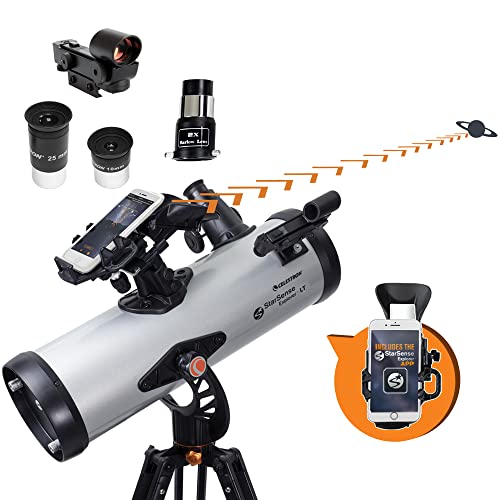
The StarSense LT 114AZ is an app-enabled reflector that uses StarSense technology to map the sky and guide users to objects. The 114mm aperture offers brighter images and easier object detection, making it a strong choice for beginners who want fast, guided observing sessions. The StarSense app presents a curated list of targets based on time and location, helping newcomers locate planets, nebulae, and star clusters with confidence.
Buying Guide
What to consider when choosing a telescope for beginners:
- Aperture size: Larger apertures gather more light and reveal fainter objects, but they can increase size and weight. For beginners, 70–90mm is a practical balance for visual observing.
- Optical design: Refractors are typically low-maintenance and easy to use, while reflectors offer larger apertures at a lower cost but can require occasional collimation. Compound designs are versatile but more complex.
- Mount type: Alt-azimuth mounts are intuitive for beginners, while equatorial mounts provide smoother tracking at higher magnifications but may have a steeper learning curve.
- Ease of setup: Look for models with quick-assembly designs, included tripods, and simple alignment or star-hopping features. Smartphone adapters are a plus for beginners exploring astrophotography.
- Portability: If you plan to travel to dark-sky spots, choose a compact, weight-conscious kit with a carry bag.
- Accessories: Useful extras include a finder scope, multiple eyepieces, a Barlow lens for magnification, and a sturdy carrying case.
- Smartphone integration: Apps and docking systems that help locate objects or capture images can accelerate learning and engagement, especially for younger stargazers.
From an objective standpoint, a beginner-friendly telescope should provide clear views, reliable alignment, and accessible learning resources. Entry-level refractors with 70–90mm apertures address most common observing goals, including Moon details, bright planets, and some brighter deep-sky objects. For those who value guided object targeting, app-enabled options offer a notable advantage. If portability and quick setup are priorities, travel-oriented kits with robust phone adapters deliver an immediate entry into both terrestrial and celestial viewing.