Best Telescopes for Moon Viewing: Clear Night Sky Observations
For Moon enthusiasts, selecting the right telescope can dramatically enhance crater details, maria textures, and lunar features. This article highlights five accessible options that balance beginner-friendly setup with solid lunar performance. Each pick emphasizes lunar viewing, ease of use, and portability, helping you choose a telescope that fits your budget and goals. Read on to compare optics, mounts, and features that specifically support moon watching.
Product Overview
| Product | Brand | Key Focus | Image |
|---|---|---|---|
| MEEZAA 150EQ Newtonian Reflector | MEEZAA | Large aperture, lunar detail | 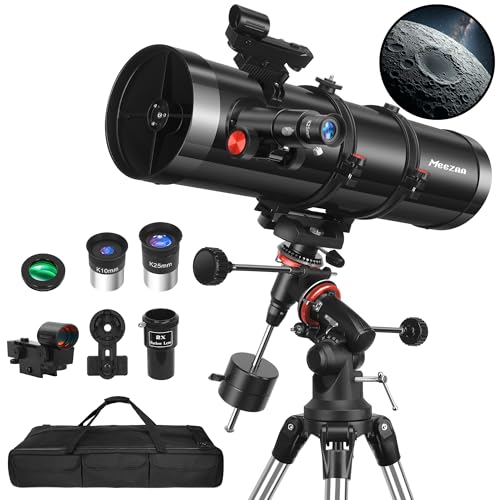 |
| HUGERSTAR 90mm Refractor | HUGERSTAR | Bright moon views, portable |  |
| Celestron 1.25″ Moon Filter | Celestron | Moon glare reduction |  |
| Celestron Signature Moon (Robert Reeves) | Celestron | Premium lunar viewing |  |
| SOLOMARK 130EQ Newtonian | SOLOMARK | Deep-space and lunar tracking |  |
MEEZAA 150EQ Newtonian Reflector
The MEEZAA 150EQ Newtonian Reflector is designed for moon and planetary observing with a large 150mm aperture and a 650mm focal length. It provides bright, detailed lunar images and is beginner-friendly thanks to a user-oriented equatorial mount. Two eyepieces (25mm and 10mm) and a 2X Barlow lens offer magnifications from 26X to 130X. A red dot finder helps with quick targeting, while a moon filter reduces glare for comfortable lunar viewing.
Its upgraded German Equatorial Mount features precision dials and slow-motion controls for smooth tracking as the Moon and planets traverse the sky. Accessories include a phone adapter and large carry bag for transport and storage, making it suitable for backyard use or constellation-hopping trips.
HUGERSTAR 90mm Refractor Telescope
The HUGERSTAR 90mm refractor offers bright, crisp lunar views with fully multi-coated lenses for high light transmission. With 800mm focal length (f/8.89) and two eyepieces (10mm and 25mm), plus a 3X Barlow lens, it delivers magnifications from 32X to 240X. A 5×24 finder scope aids object location, and the adjustable stainless steel tripod enables comfortable observation from various heights. A carrying bag and tray keep accessories organized for on-the-go moon watching.
Celestron Moon Filter 1.25 Inch
The Celestron 1.25-inch Moon Filter reduces glare and increases contrast during lunar viewing, improving detail visibility on bright regions like the maria and craters. It threads onto most 1.25” eyepieces in seconds, making it a practical upgrade for any telescope focusing on the Moon, planets, or terrestrial viewing under varied lighting conditions.
Celestron Signature Series Moon by Robert Reeves
This premium tabletop Dobsonian telescope focuses on lunar exploration with a 76mm reflector optical tube. The design emphasizes portability and ease of use, making it accessible for beginners while offering sharp lunar images suitable for educational display and casual astronomy sessions. Its artwork fosters interest in lunar features, complementing practical lunar viewing with visual appeal.
ToyerBee Kids Telescope for Moon Viewing

This kid-friendly telescope introduces lunar viewing with three eyepieces (20X, 30X, 40X) and a built-in compass to help locate targets. The 360-degree rotating tripod supports flexible observing angles, making it a suitable choice for families seeking an educational tool to observe the Moon and nearby objects. The kit also includes a moon mirror for quick lunar glimpses and encourages exploratory learning in a portable form factor.
SOLOMARK 130EQ Newtonian Reflector
The SOLOMARK 130EQ Newtonian is pitched toward adults seeking a larger aperture with easy tracking. Its 130mm aperture improves light gathering for lunar features and faint deep-sky objects, while a German Equatorial Mount with fine-turned control cables supports precise manual tracking. The package includes a 1.5X Barlow lens and a 13% Moon filter, expanding options for lunar observation and planetary work, alongside a practical build for hobbyist use.
Buying Guide: Moon-Viewing Telescope Considerations
- Aperture size: Larger apertures capture more light and reveal fainter crater details. However, they add weight and cost. For Moon viewing, 90–130mm is a strong balance for beginners to intermediate users.
- Mount type: An equatorial mount (or a simplified alt-az with slow-motion controls) helps with tracking lunar motion. Beginners often start with a stable, easy-to-use mount and upgrade later.
- Magnification options: Multiple eyepieces or a Barlow lens extend magnification, but image quality depends on optical quality and atmospheric conditions. Avoid overspending on maximum magnification; practical lunar views benefit from mid-range settings.
- Filters and accessories: Moon filters reduce glare and enhance contrast. Finder scopes aid in locating lunar features efficiently, while a good carrying case improves portability.
- Portability and setup: Consider weight, balance, and ease of assembly for backyard viewing or travel. Refractors tend to be lighter and more beginner-friendly; reflectors offer larger apertures at lower costs per inch.
- Technology additions: Phone adapters enable quick lunar photography or video capture, useful for documenting features like crater walls and tectonic rims. Ensure compatibility with your device and telescope.
- Education and expansion: Look for kits that include learning materials or guided experiments, especially for kids or new enthusiasts, to build a foundation in lunar observing techniques.
When choosing a moon-focused telescope, align features with your observing goals, whether you want sharp lunar craters, quick setup for backyard sessions, or educational value for a family. The products listed here emphasize lunar viewing capabilities, practical handling, and portable design to suit a range of beginners to intermediate skywatchers.