Best Telescope Kit for Kids: Ample Options for Budding Stargazers
Choosing a kid-friendly telescope kit combines safety, ease of use, and educational value. The right scope can transform curiosity into exploration, helping young astronomers observe the Moon’s craters, planet surfaces, and distant galaxies with manageable magnification. Below is a curated guide to five beginner-friendly telescope kits that balance optical quality, portability, and engaging accessories for American families.
| Product | Brand | Key Benefit |
|---|---|---|
| Gskyer Telescope, 70mm Aperture | Gskyer | Compact travel scope with wireless remote |
| NASA Lunar Telescope for Kids | Blue Marble | Moon-focused detail with tabletop stability |
| Wow in The World Kids’ Telescope | Thames & Kosmos | Two magnifications and kid-friendly guide |
| MEEZAA Telescope for Adults & Kids | MEEZAA | High-clarity optics with versatile tripod |
| HUGERSTAR Telescope for Adults & Kids | HUGERSTAR | All-in-one accessory kit with smartphone adapter |
Gskyer Telescope: Lightweight Refractor For Beginners

The Gskyer 70mm refractor offers a practical entry point for young observers. Its 400mm focal length and 70mm aperture provide bright, sharp views suitable for Moon details and easy planetary glimpses. The fully coated optics protect eyes while maintaining high transmission, reducing glare during daylight and dawn observations. The kit includes two eyepieces and a 3x Barlow lens, expanding the magnification options without sacrificing performance for beginners. A 5×24 finder scope with cross-hair lines helps locate objects quickly, which is a critical skill for new stargazers.
Additionally, this model supports wireless photography through a smartphone adapter and remote control. Kids can capture and share celestial moments without complex setup, reinforcing curiosity and learning. The telescope is designed for portability with a compact frame and a travel-friendly carry bag, making family campouts and backyard sessions convenient. Educational value comes from practicing alignment, adjusting focus, and identifying visible celestial objects as part of an incremental learning routine.
NASA Lunar Telescope for Kids: Moon-Focused Learning
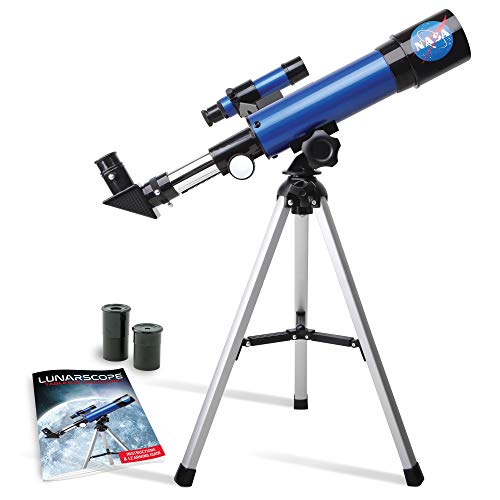
This tabletop telescope centers lunar exploration for younger observers. It includes low- and high-power eyepieces plus a finder scope, enabling kids to locate the Moon and zoom in for crater details. The accompanying tabletop tripod and smooth mount provide stable viewing, which is crucial for beginners who may be unfamiliar with balancing a telescope. The focus on the Moon makes this a visually rewarding entry point that reinforces observational skills and scientific curiosity without overwhelming complexity.
With guided viewing, children can progressively tackle more ambitious targets. The package also supports tabletop use in classrooms or family rooms, enabling hands-on astronomy sessions. The Moon-centric approach helps establish a foundational understanding of phases, surface features, and scale, while encouraging questions about space and exploration.
Wow in The World Kids’ Telescope: 25x and 50x Beginnings

The Thames & Kosmos Wow in The World telescope is designed to spark imagination with two magnifications—25x and 50x—supported by an adjustable aluminum tripod that extends up to 48 inches. This kit includes a star wheel and companion audio content to deepen learning during observations. The 8-page illustrated guide helps kids (and caregivers) understand how tools work, what to look for in the night sky, and how to identify major features on the Moon and planets. It’s a hands-on, story-driven approach to early astronomy that blends science with exploration.
Children can engage in guided discovery, moving from simple lunar views to broader celestial exploration as confidence grows. The included prototype compass-style guidance aids tracking and orientation, which supports early spatial reasoning and observational discipline. The mix of practical tool use and narrative learning makes it an attractive option for homeschoolers and casual stargazers alike.
MEEZAA 80mm Portable Refractor: Clear Images On The Go

The MEEZAA 80mm aperture refractor combines larger light gathering with a compact form, ideal for family travel and backyard sessions. The 500mm focal length supports bright, crisp images of the Moon and brighter planets, while fully multi-coated optics protect eyes and improve clarity. A two-eyepiece setup (25mm and 10mm) plus a 3x Barlow lens broadens the magnification range to 20x–150x, letting young observers experiment with different levels of detail. The 5×24 finder scope helps quickly locate objects, and the included adjustable aluminum tripod provides stability for seated or standing viewing.
Daytime use is also practical for observing landscapes, birds, and wildlife, making this kit a versatile educational tool. The design emphasizes user-friendly assembly and maintenance, with straightforward alignment and focusing steps that reduce frustration for beginners and keep learning momentum high.
HUGERSTAR 80mm Telescope: All-In-One Family Bundle

The HUGERSTAR kit centers a complete learning package with an 80mm aperture and 500mm focal length. Its high-quality optics deliver bright, clear views with a broad field of view, and the set includes two eyepieces (25mm and 10mm) plus a 3x Barlow lens for magnification from 20x to 150x. A 5×24 finder scope, a 45° diagonal mirror for upright terrestrial viewing, and a smartphone adapter support modern sharing and documentation of discoveries. The included adjustable tripod, backpack, and accessories make it an excellent travel companion for family stargazing adventures.
Designed for beginners, this kit emphasizes easy assembly and stable viewing. The smartphone adapter enables quick photo capture of the Moon’s features or distant landscapes, providing a tangible link between observation and memory. The backpack style storage helps keep all parts organized for quick setup on weekends or camping trips.
Buying Guide: Key Purchase Considerations For Kid-Friendly Telescopes
- Age and safety readiness: Look for models with simple assembly, stable tripods, and gentle focusing mechanisms. Avoid complex go-to systems for younger children to reduce frustration and build foundational skills.
- Optical quality vs. portability: A larger aperture (80mm) improves light gathering and image clarity but can add weight. For beginners, a balance of 70–80mm with a sturdy tripod often yields the best mix of performance and ease of use.
- Magnification and eyepieces: Avoid focusing solely on high magnification. Two eyepieces and a Barlow lens offer flexible viewing scales, enabling students to learn how magnification affects brightness and field of view.
- Accessories that boost engagement: Finder scopes, star maps, manuals, and smartphone adapters help kids document findings and share discoveries with friends and family.
- Portability and storage: Lightweight kits with carrying bags or backpacks simplify family outings and camping trips, encouraging frequent practice and exploration.
- Durability and warranty: Look for kid-friendly materials and manufacturer warranties to ensure the telescope remains usable after minor bumps or travel.
- Educational value: Kits that include illustrated guides or companion content can accelerate understanding of lunar geography, planet features, and celestial navigation.
- Cross-generational use: Choose models suitable for both kids and adults for family astronomy nights, ensuring siblings and parents can participate equally.
When evaluating options, consider which celestial targets your child is most excited to explore—whether it is the Moon’s surface, planetary bands, or distant star clusters. The best telescope for kids combines safety, simplicity, and a pathway to deeper inquiry. By starting with a stable, easy-to-use kit, you can foster long-term interest in science and the night sky.