Best Toddler Computer Learning Games for Early Training
Parents seeking engaging, educational computer games for toddlers can explore lightweight, child-friendly laptops and toy computers that combine letters, numbers, colors, and early problem-solving. This guide highlights five popular options designed for kids ages 1 to 5, focusing on interactive play, durable design, and beginner-friendly content. Each product offers learning modes or activities that build foundational skills in literacy, numeracy, and cognitive development, while providing safe, age-appropriate play experiences at home or on the go.
Summary of chosen products:
| Product | Brand | Key Learning Areas | Notes |
|---|---|---|---|
| Kids Laptop, Color Screen Educational Laptop | HAIOUMM | Alphabet, Mathematics, Colors, Animals, Music | 4.3″ color screen; ergonomic design |
| Learning Toy Laptop for Toddlers 1-3 | GMAOPHY | Letters, numbers, colors; 120+ themes | Detachable base; multiple modes |
| Fisher-Price Laugh & Learn Smart Stages Tablet | Fisher-Price | Alphabet, objects, colors; 100+ songs | Three Smart Stages; age-appropriate |
| LEXiBOOK Spider-Man Educational Laptop | LEXiBOOK | Spanish/English; math, music | Two-language learning; 124 activities |
| LESHITIAN Kids Laptop – 80 Learning Modes | LESHITIAN | Alphabet, words, math, music | Realistic keyboard; dual-button mouse |
All prices and availability are subject to change. The following sections provide individual product details, usage notes, and insights to help you compare options for your child’s learning journey.
Haioumm Kids Laptop With 48 Learning Modes

The Haioumm learning laptop is designed to simulate a real laptop experience with a compact, child-friendly form. It includes 48 learning modes covering alphabet, basic mathematics, colors, animals, calendar concepts, and more, supporting early literacy and numeracy through guided activities. The 4.3-inch TFT color screen provides clear visuals, and the device emphasizes an ergonomic feel with a slim profile and a keyboard-like layout, aiming to foster familiarity with computer use in young children.
Key considerations: The breadth of content can help parents target diverse skill areas, though some activities may feel repetitive for advanced toddlers. The plastic construction prioritizes safety and durability, while the built-in learning themes can complement hands-on activities at home or in preschool prep routines.
Best for families seeking a lightweight, screen-based introduction to basic topics with a laptop vibe. Consider pairing with printables or hands-on activities to reinforce concepts learned on-screen.
GMAOPHY Learning Toy Laptop for Toddlers
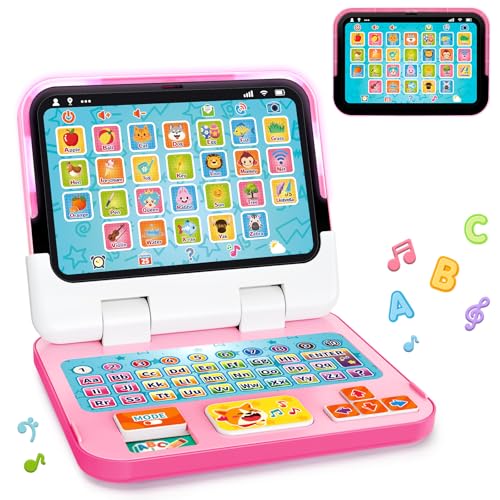
This 2-in-1 learning laptop combines a screen with a detachable base, enabling tablet-style play or desktop use. It offers 120+ learning themes and activities that introduce letters, words, numbers, and colors, along with music and sounds. With multiple modes—Learning, Spelling, Quiz, and Music—children practice early literacy, number recognition, pronunciation, and memory through interactive play. The console design supports fine motor development and pretend-play scenarios that mimic real-life computer use.
Key considerations: The variety of modes fosters exploration, but parents may want to monitor screen time and gradually increase complexity as skills progress. The detachable design adds versatility for travel or shared play sessions with siblings.
Best for families wanting a versatile, multi-mode toy laptop with strong language and early math exposure in a portable package.
VTech Bluey Game Time Laptop

The VTech Bluey Game Time Laptop offers an engaging, character-themed learning experience inspired by the Bluey series. With 10 games and a slider to pick characters, kids engage in activities that incorporate memory, logic, and spacial awareness through familiar Beloved characters. The games emphasize cognitive challenge at an approachable level, blending play with foundational math, logic, and musical activities aligned with early learning milestones.
Key considerations: The theme can boost engagement for Bluey fans but may feel repetitive for children outside the franchise. It is well-suited for solo play and short, structured sessions or as a bridge to more complex learning tools.
LESHITIAN Kids Laptop — 80 Learning Modes

The LESHITIAN kids laptop presents a broad spectrum of activities with 80 learning modes focused on alphabet, words, mathematics, play, and music. Its ergonomic, laptop-style chassis includes a realistic keyboard and a dual-button mouse, designed to help children become familiar with computer layouts while building fine motor coordination. This model emphasizes practical, hands-on learning and simulated typing experiences to support early digital literacy.
Key considerations: A wide range of topics aids varied interests but may require parental guidance to navigate the material effectively. The included keyboard and mouse simulate a real setup, which may enhance readiness for educational software use later on.
Fisher-Price Laugh & Learn Smart Stages Tablet

The Fisher-Price Laugh & Learn tablet introduces a pretend tablet experience with lights, sounds, and more than 100 songs and phrases. It grows with the child through three Smart Stages that align with developmental milestones, introducing the alphabet, objects, and colors. With 28 app-like buttons, this toy encourages interactive exploration and the development of early language and cognitive skills in a familiar, child-friendly format.
Key considerations: The Smart Stages framework helps pacing growth, but content is inherently toy-like and may be most effective when used alongside hands-on and traditional reading activities. It offers motivating feedback and can be a staple for daily routines.
Buying Guide: Key Purchase Considerations for Toddler Computer Learning Games
- Age appropriateness: Choose devices and content aligned with your child’s current developmental level and attention span. Younger toddlers benefit from simpler interactions, while preschoolers can handle more complex modes and activities.
- Content breadth vs. depth: A broader range of topics helps with exposure, but ensure the core skills (letters, numbers, colors, problem-solving) are reinforced consistently without overwhelming the child.
- Durability and safety: Look for sturdy construction, rounded edges, non-toxic materials, and parental controls or timers to manage screen time in young children.
- Language options: For bilingual households or dual-language exploration, units offering Spanish/English or other language modes can support early bilingual development.
- Motor skills development: Toy laptops with physical keyboards or mouse emulation can support fine motor skills, hand-eye coordination, and finger dexterity.
- Portability and versatility: Detachable bases, compact sizes, and lightweight designs facilitate travel and shared play across rooms or with siblings.
- Supplemental activities: Pair screen-based learning with hands-on activities (flashcards, building blocks, tracing) to reinforce concepts and prevent screen fatigue.
- Progression and pacing: Look for devices offering progressive levels or modes that adapt as the child’s skills grow, enabling continued challenge without frustration.
- Privacy and safety: Prefer products that avoid excessive ads or data collection and encourage safe, offline play when necessary.