Best Toy Clocks for Teaching Time to Kids
Teaching children to tell time can be engaging and effective when using hands-on tools. The following hand-picked toy clocks and time-learning sets are designed to build time-telling skills through interactive play, colorful hands, and practical activities. Each option combines visual cues with age-appropriate challenges to support early math and daily routines. Explore a mix of classroom-friendly clocks, talking styles, and wooden learning sets to suit homeschool, preschool, and elementary settings.
| Product | Brand |
|---|---|
| Learning Resources Big Time Mini Clock | Learning Resources |
| BEST LEARNING Learning Clock | BEST LEARNING |
| Melissa & Doug Turn & Tell Wooden Clock | Melissa & Doug |
| Learning Resources Time Activity Set | Learning Resources |
| Coogam Wooden Clock Teaching Time Toy | Coogam |
Learning Resources Big Time Mini Clock

The Learning Resources Big Time Mini Clock uses a hands-on approach to building early time skills. Its design features hidden gears that maintain correct time as you spin the hands, which helps reinforce cause-and-effect learning. Color-coded hour and minute hands align with the clock’s markings, enabling students to distinguish between hours and minutes at a glance. This compact teaching clock is well-suited for small-group instruction or individual practice, making it a staple classroom tool for practicing analog time-telling and basic time concepts.
BEST LEARNING Learning Clock

The BEST LEARNING Learning Clock is an award-winning interactive clock that engages kids with a talking feature and quiz mode. It helps children learn to tell time by aligning the hour hand with the correct numeral and adjusting the minute hand. In addition to teaching time, Sleep Mode provides night-light assistance with classical music options, creating a calm environment for bedtime routines. This toy clock is particularly valuable for young learners who benefit from auditory cues and repetitive exposure to time concepts.
Melissa & Doug Turn & Tell Wooden Clock

The Turn & Tell Wooden Clock from Melissa & Doug offers a sturdy, kid-powered learning experience. It features time cards that fit into a slot on the top for time-matching activities, with a hideaway digital clock that automatically changes to reflect the analog time shown. This combination of tactile play and visual feedback supports independent exploration and collaborative learning, helping children internalize the relationship between analog clocks and real-world time.
Learning Resources Time Activity Set
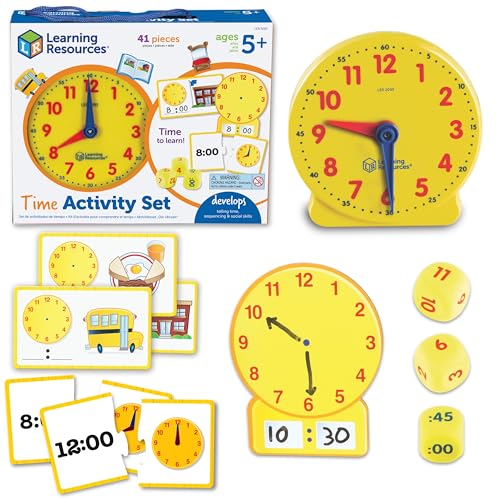
The Learning Resources Time Activity Set provides a comprehensive teaching system for mastering time concepts. It includes a realistic clock with synchronized hands that move together, plus double-sided activity cards, a dry-erase board, puzzles, and foam dice. The multi-sensory approach engages visual, kinesthetic, and spatial learners, helping students grasp how time works in a structured, interactive way. This set is suitable for classrooms and homeschool settings seeking a broad, engaging curriculum around telling time.
Coogam Wooden Clock Teaching Time Toy

The Coogam Wooden Clock combines analog and digital time learning with a fly-telling time board game concept. This Montessori-inspired toy features rotatable hands and four double-sided flashcards for practice, plus a board game element for 2-4 players. It supports collaborative and competitive play, reinforcing recognition of hours, half-hours, and quarter-hours across both clock formats. Its classroom-ready design suits homeschool use and group activities, building foundational time-telling skills in an engaging way.
Buying Guide
Key purchase considerations help match a clock-based learning tool to a child’s needs. First, consider the learner’s age and current skill level. Younger children benefit from clocks with color-coded hands and clear numerals, while older children may prefer clocks with more complex time-telling tasks or bilingual features. Durability matters for classroom use—wooden clocks or sturdy plastic are preferable in high-traffic environments. For hands-on interaction, look for gears or movable hands that allow independent manipulation and immediate feedback, such as hidden gears that ensure accuracy as you rotate the hands.
Accessibility and engagement are essential. Some clocks offer talking functions, music, or quiz modes that aid auditory learners and increase motivation. Others emphasize multi-sensory approaches with flashcards, dice games, and puzzles to reinforce time concepts through multiple modalities. If you plan group activities, consider sets that include multiple components (cards, boards, dice, and cards) to enable collaborative exploration. Bedtime features, like Sleep Mode with a night-light, can support routines and reduce anxiety around learning time at night.
Practical use scenarios vary. For homeschool kits, a comprehensiveTime Activity Set can deliver structured lessons along with daily practice. For small groups in a classroom, a compact clock with hands that move independently supports rotational teaching and center time. For younger beginners, a talking clock with a friendly voice and clear prompts can accelerate familiarity with the concept of telling time. Finally, consider whether you want analog-only practice, digital-analog cross-learning, or a mix to prepare learners for real-world time-reading situations.
In sum, the best choice depends on the learner’s age, preferred learning style, and the setting. All five options highlighted here offer reliable, engaging pathways to mastering time-telling skills—whether through tactile manipulation, interactive dialogue, or collaborative play.