Best Construction Kits for 12-Year-Olds: Hands-on STEM Projects to Spark Creativity
Discover top construction kits that engage preteens in engineering, physics, and problem solving. The following selections emphasize hands-on building, clear instructions, and durable components to suit curious minds aged around 12. Each kit encourages screen-free learning while building confidence through achievement.
| Product | Category | Key Benefit |
|---|---|---|
| Smartivity DIY Robotic Mechanical Hand | Robotics / Mechanical Engineering | Hands-on mechanical hand with replacement parts |
| Snap Circuits Flight Deck | Electrical / STEM | Five projects exploring circuits, air, and propulsion |
| Thames & Kosmos Structural Engineering: Bridges & Skyscrapers | Structural Engineering | Model builds teaching force, load, tension, and compression |
| Engino Structures, Buildings & Bridges | Engineering Kit | 9 working models exploring architectural forces |
| Opmind 5 in 1 STEM Remote Control Kit | Robotics / Mechanisms | Multiple models in one set for varied builds |
Smartivity DIY Robotic Mechanical Hand

The Smartivity kit provides action-packed, screen-free construction focused on building a mechanical hand. The included step-by-step manual guides kids through a deeply engaging DIY experience, helping them construct a functioning device that demonstrates basic mechanical principles. Designed for ages 8 through 14, the kit supports a wide range of learners and emphasizes creativity and problem solving. A lifetime supply of replacement parts minimizes downtime during play and learning. The hands-on focus is ideal for developing spatial reasoning and fine motor skills as kids manipulate pulleys, levers, and linkages to move the hand.
Snap Circuits Flight Deck

Snap Circuits Flight Deck combines electricity, aerodynamics, and physics through five project possibilities. Children can build circuits that launch paper airplanes, flying saucers, and balls, while also exploring how air pressure affects flight. The kit offers accessible explanations about electricity and flight mechanics, with easy-to-follow directions that promote independent work and growing confidence. This option pairs well with older learners who enjoy practical experiments and immediate, visible results. It also supports collaborative learning by allowing siblings or friends to explore different configurations together.
Thames & Kosmos Structural Engineering: Bridges & Skyscrapers

This kit invites curious builders to create 20 different models while teaching core concepts of force, load, compression, and tension. With more than 285 interchangeable building pieces and a detailed 36-page illustrated manual, it provides a structured exploration of structural engineering. The hands-on model-building experience enables learners to visualize how different structures respond under stress, enhancing reasoning about safety, stability, and design trade-offs. The included assembly guides help learners progress from simple to more complex creations as their understanding grows.
Engino Structures, Buildings & Bridges
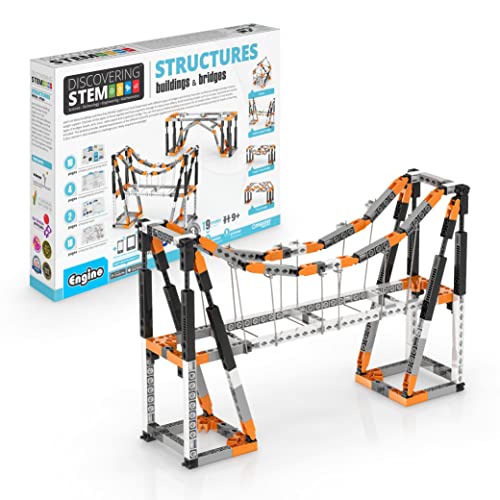
Engino’s 9-model offering introduces essential architectural forces through hands-on construction. Learners explore how various buildings and bridges handle loads, while step-by-step instructions and accompanying theory pages provide context for the experiments. The kit is suitable for classroom or home use, supporting independent work or guided projects. Its structured approach helps students connect practical building with theoretical principles, reinforcing lessons in physics and engineering while encouraging experimentation and iteration.
STEM Kits By Yutin: 4-in-1 Wood Construction

Yutin’s 4-in-1 wood building kit offers a versatile approach with a Tower Crane, a Hydraulic Loader, a Solar-powered Truck, and a Road Roller. This set emphasizes hands-on STEM education through woodworking and mechanical assembly. The wooden components provide a different tactile experience compared to plastic kits, fostering patience and precision. The kit targets ages 8-12 and encourages kids to explore concepts such as simple machines, basic geometry, and problem solving. It’s a strong option for learners who prefer tangible, durable builds and longer play sessions without screens.
BAODLON 361 Pcs 2-in-1 Construction Kit
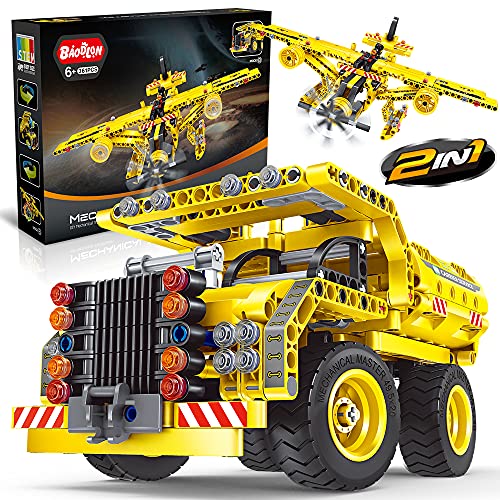
BAODLON’s 2-in-1 kit includes 361+ building pieces that support two distinct models: a dump truck and a propeller plane. The set emphasizes fine motor skills and spatial reasoning through pulling, rotating, and assembling small parts. The design emphasizes durability with high-quality ABS plastics and a bright color scheme to engage young builders. It’s presented as a screen-free activity that strengthens concentration, coordination, and problem-solving as kids follow the included steps to complete each model. It’s well-suited for groups or solo projects that span multiple sessions.
Opmind 5 in 1 STEM Remote Control Kit

Opmind offers five models in one set: RC Off-road Truck, Robot, 360° Tumbling & Spinning Car, and All-Terrain Vehicle, built from 392 pieces. The kit integrates mechanics with engineering concepts, enabling learners to explore how different blocks power movement and control. It emphasizes teamwork and problem solving as kids assemble and test the models, reinforcing STEM knowledge in a practical, engaging way. The diverse build options make it suitable for varied interests, from vehicles to mechanized figures.
Buying Guide: Key Purchase Considerations For 12-Year-Olds
- Learning goals: Choose kits that balance theory with hands-on building. Kits with manuals or accompanying explanations help bridge practical activity with scientific concepts like force, motion, and energy.
- Difficulty level: Look for kits that align with a 12-year-old’s growing abilities—challenging enough to stay engaging but not so difficult that frustration interrupts learning.
- Durability and components: Durable plastics or wood construction improve longevity and allow repeated builds. Check for safety standards and non-toxic materials.
- Versatility: Multi-model kits (like 5-in-1 or 9-model options) provide extended play value and ongoing learning opportunities as skills improve.
- Learning style: Some children prefer robotics and electronics, while others enjoy architectural models or mechanical puzzles. Selecting kits with varied tasks can accommodate multiple interests.
- Screen-free focus: If reducing screen time is a goal, prioritize kits advertised as offline, with clear, printable instructions or manuals.
- Expansion potential: Kits that are compatible with other brands or have modular components offer room to grow and add complexity over time.
- Group usability: Consider whether the kit supports collaborative play, which can be beneficial for classroom settings or family projects.
When evaluating these construction kits, consider both immediate accomplishments and longer-term skill development. The right kit should foster curiosity, encourage experimentation, and provide a tangible sense of achievement through successful builds and functioning models.