Best Educational Toys for One-Year-Olds That Promote Learning
Parents and caregivers seek toys that entertain while fostering early development. This guide highlights five highly interactive educational toys for one-year-olds, drawing on simple, engaging activities that support language, motor, and cognitive growth. Each product is chosen for age-appropriate features, safe materials, and kid-friendly design.
Product Summary
| Product | Brand | Key Benefit |
|---|---|---|
| LeapFrog Learning Friends 100 Words Book, Green | LeapFrog | Introduces 100+ words with sounds, songs, and interactive pages |
| Fisher-Price Laugh & Learn Smart Stages Chair | Fisher-Price | Music, lights, and activities that grow with baby through stages |
| ZCMFHTD Montessori Toys for 1 Year Old | ZCMFHTD | Fine motor development and early math through fishing and sorting |
| Fisher-Price Baby’s First Blocks | Fisher-Price | Colorful shapes for sorting, stacking, and bat/insert play |
| Airbition Talking Flash Cards for Toddlers | Airbition | Vocabulary expansion with 224 words and audible prompts |
LeapFrog Learning Friends 100 Words Book
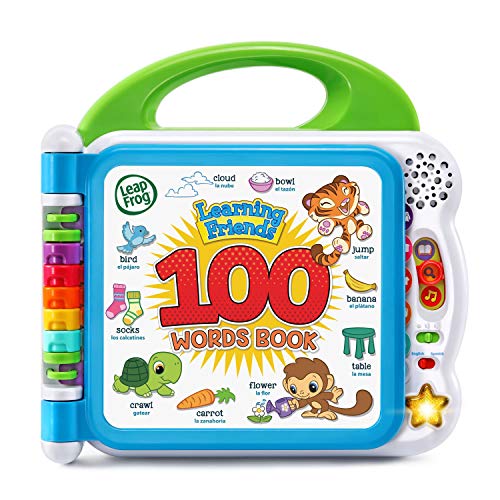
The LeapFrog Learning Friends 100 Words Book blends tactile interaction with language-building content. Featuring Turtle, Tiger, and Monkey, the book presents more than 100 age-appropriate words across diverse categories such as pets, animals, food, colors, and activities. Pressing on the pages triggers word playback, sound effects, and fun facts, while a light-up star button plays the Learning Friends theme song and the My Favorite Word track. This format supports early vocabulary acquisition and word recognition in an engaging, kid-friendly way.
Key considerations: age-appropriate vocabulary selection by learning experts, a focus on interactive word recognition, and music/sound elements that reinforce memory. Consider this option for daily reading sessions that incorporate auditory reinforcement and a simple cause-and-effect pattern for toddlers.
Fisher-Price Laugh & Learn Smart Stages Chair

This interactive chair delivers a compact, all-in-one learning station for infants and toddlers. The chair includes 120+ songs, sounds, and phrases and activates music and phrases when the child sits or stands. Smart Stages technology introduces colors, shapes, numbers, counting, and opposites across three progression levels, ensuring content remains age-appropriate as the child grows. The design combines a cozy seating experience with hands-on activities that encourage exploration and turn-taking behaviors during playtime.
Key considerations: adjustable content that scales with development, multisensory engagement, and a seating-based activity model suitable for small spaces. Ideal for supervised play in living rooms or nurseries where a dedicated toy activity is preferred.
ZCMFHTD Montessori Toys for 1 Year Old

This 22-piece Montessori-inspired fishing set centers fine motor skills, color recognition, counting, and spatial awareness. With a soft-fabric fishing rod, 15 fish pieces, and 5 stackable buckets, the kit facilitates imaginative play and early math concepts through sorting and counting. An ocean mat doubles as a storage bag, aiding tidy-up routines. The materials emphasize safety, with soft fabrics and no sharp edges, and are machine washable for busy families.
Key considerations: hands-on, open-ended play that reinforces cognitive concepts like color and number matching, and the blend of fine motor practice with sensory engagement. Suitable for group play or individual exploration.
Fisher-Price Stacking Toy Baby’s First Blocks

This set includes 10 colorful blocks designed for sorting, stacking, and dropping through a shape-sorter lid. The blocks are sized for little hands, and the bucket provides easy storage and portability. The simple, durable design supports early color and shape recognition, manual dexterity, and problem-solving as toddlers figure out how blocks fit together or fall through the sorter. The compact build makes it convenient for travel or small play spaces.
Key considerations: robust construction and clear cause-and-effect play, which can establish foundational engineering concepts and steady hand-eye coordination. Great for supervised playtime and early social sharing when children experiment with stacking alongside peers.
Airbition Talking Flash Cards for Toddlers

The Airbition talking flash cards deliver 224 illustrations with corresponding sounds to expand vocabulary. The content covers animals, vehicles, food, fruits, and vegetables, supporting language development and cognitive association. The reader features a repeat button, adjustable volume with five levels, and a standard American pronunciation. This device is particularly useful for Montessori-style learning and can assist toddlers in practicing naming, sounds, and basic categorization during independent or guided play.
Key considerations: visual-auditory pairing to reinforce memory, potential utility for speech therapy or autism support through consistent cues, and user-friendly operation for very young children. Consider pairing with paper cards for hands-on tracing and real-world referents to strengthen understanding.
Buying Guide: Key Purchase Considerations
- Developmental fit: Match toys to the child’s current abilities (language, fine motor, cognitive). Toys that adapt through stages help extend engagement without rapid replacement.
- Safety and age appropriateness: Check materials, choking risks, and small parts. Look for age recommendations and certifications that align with one-year-olds’ needs.
- Multisensory learning: Prefer toys that combine sight, sound, and touch to reinforce memory and exploration. Sensory variety sustains attention and encourages problem solving.
- Durability and cleanup: Durable fabrics, easy cleaning, and machine-washable components are beneficial for busy households and everyday use.
- Storage and space: Consider the play area and whether the toy’s footprint is suitable. Stackable or compact items help with organization and travel readiness.
- Parent involvement: Select toys that invite guided play or shared reading to maximize bonding and learning outcomes.
- Longevity: Favor items that grow with the child, offering more advanced features or new ways to play as skills develop.
- Allergen-conscious materials: If sensitive to adhesives or dyes, review product materials or opt for simpler, natural designs where possible.
Comparative Perspectives
- Language-focused tools vs. exploratory toys: Language-based items (like word books and flash cards) reinforce vocabulary, while stacking and fishing sets promote fine motor skills and spatial reasoning.
- Passive vs. interactive play: Interactive devices that require actions (pressing, sitting, or sorting) tend to sustain attention longer and offer immediate feedback, which supports learning loops.
- Screen-free benefits: The listed selections emphasize physical interaction, sound, and tactile feedback, reducing screen time while still delivering meaningful educational content.
Selecting the right educational toys for one-year-olds balances appeal, safety, and developmental value. The products above provide varied approaches—story-based word learning, music- and motion-driven play, STEM-like sorting and counting, and language-rich flash cards—allowing caregivers to tailor play to the child’s pace and interests.