Best Robotic Toys for 10-Year-Olds: Engaging STEM Helpers
Choosing age-appropriate robotics gifts for a curious 10-year-old can boost problem-solving, creativity, and basic coding skills. The following five options offer a mix of remote control, programmable, and hands-on building experiences that align with STEM learning while keeping play engaging. Each product entry includes practical features, build ideas, and how it supports developing motor skills and logic. This guide helps parents, guardians, and caregivers compare options and pick a toy that fits your child’s interests and learning pace.
| Product | Key Benefit | Learning Angle |
|---|---|---|
| Henoda Robot Toys | Multimodal control (APP and remote) with 468+ pieces | STEM building, motor skills, programming basics |
| Ruko 1088 Smart Robots | Large, tall robot with voice control and APP control | Imagination, basic programming concepts, sequencing |
| Thames & Kosmos Mega Cyborg Hand | Hydraulic, motorless pneumatic technology | Principles of hydraulics and mechanical design |
| VAV Remote Control Robot | Gesture sensing and programmable features | Hands-on coding and sensor-based interaction |
| Sillbird Building Robot Dinosaur Kit | Buildable 646-piece kit with coding and sounds | Engineering, problem solving, and creative storytelling |
Henoda Robot Toys for 8-16 Year Olds
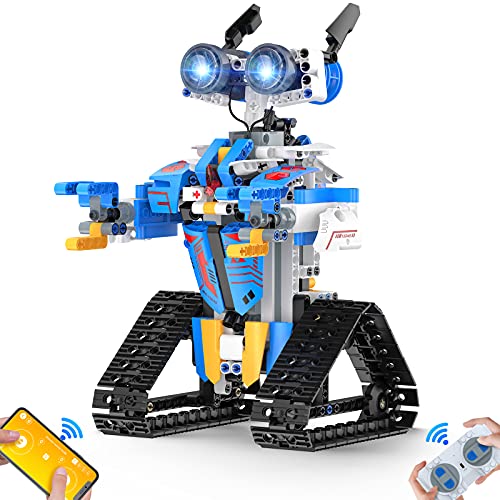
The Henoda set combines a large STEM building block system with programmable remote or app-based control. Supplied with 468+ pieces, it emphasizes hands-on construction, flexible articulation, and glowing eyes for visual appeal. The robot can move left, right, forward, and backward, with a 360-degree spin for action scenes. The remote control distance exceeds 20 meters, enabling outdoor play and longer, more dynamic mission scenarios. This kit encourages kids to put down screens and engage in practical engineering tasks, reinforcing spatial reasoning and dexterity as they assemble and reassemble components. Suitable as a birthday gift or seasonal surprise for children aged 8 and up.
Key features to note include multi-mode control (APP Bluetooth, remote), four remote modes (path, voice, gravity sensor, STEM programming), and sturdy joint design to support repeated transformations. This broad feature set makes it an attractive first programmable robot that grows with a child’s coding curiosity and mechanical understanding, from simple commands to more complex sequences.
Ruko 1088 Smart Robots

The Ruko 1088 stands out due to its height and expressive capabilities. With 10 expressions, 9 flexible joints, and 10 songs, this robot delivers more dynamic play than typical robots, encouraging kids to connect with movement, storytelling, and rhythm. APP control adds a modern, screen-based programming layer that introduces sequencing, conditional actions, and simple logic. The robot offers a versatile play experience—through dancing, storytelling, and recording features—that can support early computational thinking while fostering creativity and a sense of companionship in kids as they design and test routines.
Design-wise, the Ruko is crafted to be both a fun toy and a developmental tool. Its height and presence make it a memorable desk companion and a platform for practicing narration, music, and movement alignment. Parents can use the robot to illustrate cause-and-effect relationships, as children predict what sequence of actions will produce a desired outcome.
Thames & Kosmos Mega Cyborg Hand

This kit introduces pneumatic technology through a giant, wearable hydraulic hand. No motors or batteries are required; air pressure powers the hydraulic pistons that operate the fingers. Each finger joint is adjustable, enabling precise manipulation and object gripping of varying sizes. The hands-on nature of this kit makes it ideal for tactile learners who benefit from understanding how pressure and leverage translate into real-world motion. It emphasizes physical principles, engineering design, and experimentation with different finger configurations to achieve reliable grip and control.
As a long-term project, the Mega Cyborg Hand can be a centerpiece for science fairs or family demonstrations. It provides an approachable gateway to hydraulics, pneumatics, and the fundamentals of automated hand movements—skills that align with middle-school STEM curricula without requiring screens as the sole source of engagement.
VAV Toys Remote Control Robot
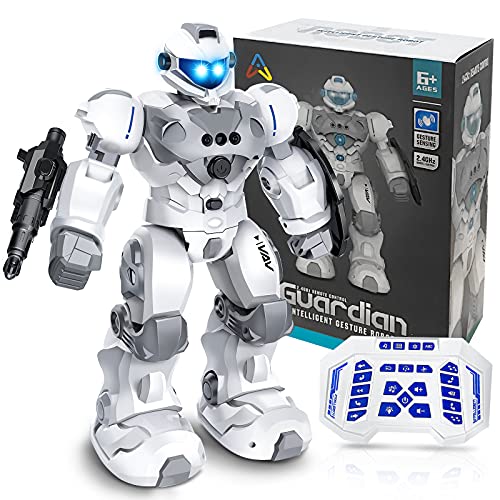
The VAV robot emphasizes gesture sensing and programmable play. It can be controlled via a 2.4 GHz remote and responds to gesture commands, allowing kids to perform movements such as forward, backward, left, and right through natural motions. The built-in programming mode lets children sequence actions step by step, reinforcing logical thinking, planning, and persistence as they test and refine their programs. The larger, eye-catching design, LED features, and protective shield contribute to an engaging, durable toy suitable for daily family play, classroom demonstrations, or STEM workshops for ages 6–10.
With its dual interaction modes—gesture control and programmable sequences—the VAV robot suits learners who benefit from kinesthetic learning while still exploring computational concepts like loops and procedure calls in an age-appropriate way.
KingsDragon RC Robot Toys

KingsDragon offers a gesture and sensing-based programmable robot with a focus on intuitive learning for younger kids and early elementary ages. The infrared remote, combined with hand gesture control, introduces children to multi-modal input. The toy’s forty- to fifty-action programming options provide a structured yet flexible way to practice sequencing, repetition, and conditional actions. Its design supports safe, exploratory play with bright LED eyes and movement sensors that keep kids engaged while learning about automation, timing, and motor coordination. This is well-suited for 3–8-year-olds but also offers a gentle ramp to more complex projects as a child grows.
The KingsDragon robot is a practical entry point into robotics that emphasizes safe handling, durable materials, and straightforward programming workflows that encourage repeat experimentation and incremental mastery.
ELEGOO UNO R3 Smart Robot Car Kit V4

The ELEGOO UNO R3 kit serves as a comprehensive platform for learning programming, electronics, and hardware integration. It includes 24 module parts such as obstacle avoidance, line tracing, infrared remote control, and compatibility with Android and iOS control via phones and tablets. Its modular design makes it accessible for beginners while offering enough complexity for more advanced experimentation as kids grow into mid- to late elementary or early middle school. The kit emphasizes hands-on building, testing, debugging, and iterative improvement—core skills in STEM education.
EduCuties Remote Control Robot

EduCuties presents a programmable remote control robot with gesture sensing and interactive programming similar to the VAV and KingsDragon options. It emphasizes safety, ease of use, and a broad action library. The features include LED-lit eyes, a robust multi-joint structure, and a “moves record” capability that lets kids capture and replay sequences. This approach supports iterative learning, with kids exploring cause-and-effect relationships as they experiment with different action sets, turning play into a structured coding exercise that remains approachable for younger learners while still challenging enough to keep them engaged.
Buying Guide: Key Purchase Considerations
When selecting a robot for a 10-year-old, consider the child’s interest, learning pace, and the balance between screen time and hands-on activity. The following factors help distinguish between options and identify long-term value:
- Learning goals: If you want exposure to programming concepts, prefer kits with app-based controls or programmable sequences. For pure hands-on engineering, choose building kits that emphasize mechanical reasoning and problem solving without screens.
- Complexity and durability: Look for modular kits that scale in difficulty. Durable materials and safe components are crucial for younger users and for extended play.
- Control options: Some toys offer both remote control and gesture or app-based controls. Multi-input methods can sustain interest as a child’s skills advance.
- Educational alignment: Kits that cover basic robotics, hydraulics, sensors, and feedback loops align well with STEM curricula and can support school projects or science fairs.
- Replay value: Bundles with many pieces, transformable models, or programmable sequences are more engaging because the child can build new configurations and test different strategies.
- Safety and age suitability: Ensure the toy is appropriate for a 10-year-old and complies with safety standards. Parental involvement in early stages supports safe exploration and learning.
- Community and support: Availability of tutorials, manuals, and online guidance helps families maximize the learning experience and troubleshoot issues.
In sum, the best choice balances challenge with accessibility, providing a pathway from basic manipulation to programmable logic, while encouraging curiosity and independent experimentation. The five options above cover a spectrum—from large, high-visibility robots to compact STEM kits—enabling parents to tailor a purchase to a child’s curiosity and developmental stage.