Best Robot Toys for 10 Year Olds: STEM, Coding, and Creative Play
Finding engaging robot toys for 10-year-olds means balancing hands-on learning with fun. The following picks offer a mix of remote control, programmable actions, and maker-style challenges that align with STEM education while sparking imagination. Each product supports critical thinking, problem solving, and motor skills development through interactive play. Below is a quick summary of the five highlighted options.
| Product | Brand | Key Play Focus | Age Range |
|---|---|---|---|
| VAV Toys for 6-10 Year Olds | VAV | Gesture control, programmable sequences, LED effects | 6-10 |
| Thames & Kosmos Mega Cyborg Hand | Thames & Kosmos | Hydraulic actuation, pneumatic mechanics, build-your-own hand | 8-12 |
| Henoda Robot Toys | Henoda | 468+ pieces, multi-mode control, remote and app options | 8-16 |
| Ruko 1088 Smart Robots | Ruko | Programmable, voice/app control, expressive features | 4-9 |
| KingsDragon RC Robot Toys | KingsDragon | Gesture sensing, programmable actions, LED effects | 3-8 |
VAV Smart Robot With Gesture Sensing
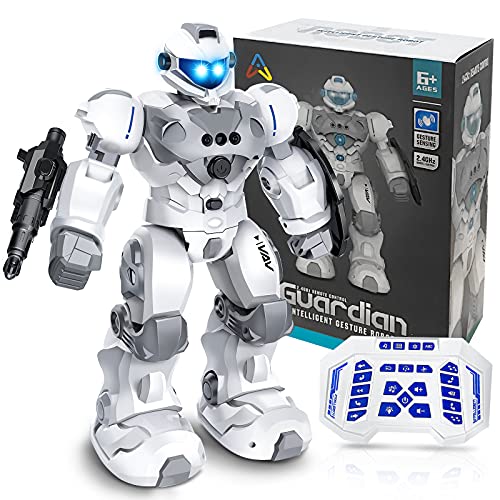
The VAV remote-controlled robot is designed for children aged 6 to 10, combining gesture sensing with programmable features. The remote lets kids issue commands while the robot also responds to gestures, enabling intuitive play. A standout feature is the built-in programming mode, which lets children create sequences such as Programming, Slide Forward, Turn Right, and Music. This encourages early coding concepts and sequencing skills, while the LED eyes and armor-style design add visual appeal for kids who enjoy techy, futuristic toys. The larger chassis provides stability during complex moves, which helps beginners gain confidence as they learn to plan multi-step actions.
Thames & Kosmos Mega Cyborg Hand

This kit focuses on hydraulic and pneumatic logic rather than electric motors. Builders assemble a wearable, giant robotic hand whose fingers open and close using air pressure, enabling a gripping action. No motors or electrical power are used; users rely on their own hand movements to drive the system. Each finger joint is adjustable for precision, and the design scales well for exhibition or classroom demonstrations. The emphasis on pneumatics provides a tangible introduction to fluid power concepts, making it a strong cross-curriculum option for older elementary and early middle school students.
Henoda 468-Piece STEM Building Robot
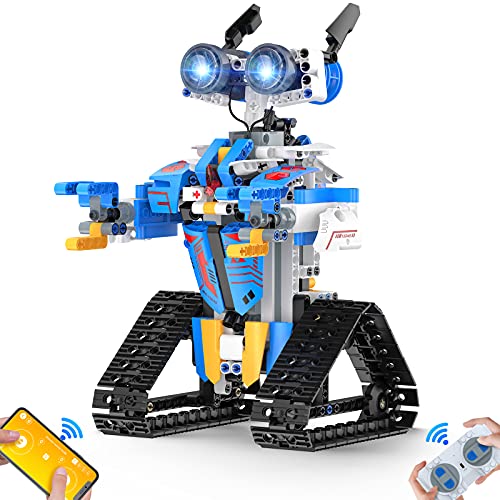
Henoda combines a large parts-count with flexibility in control options. The 468+ piece set invites kids to construct a wide range of robot forms, fostering spatial reasoning, assembly skills, and creativity. The kit supports multiple control modes, including a smartphone app via Bluetooth, 2.4 GHz remote control, path programming, voice control, gravity sensing, and STEM programming. Once built, the robot can move left, right, forward, backward, and perform 360-degree rotations. This breadth of modes makes it suitable for long-term use and progressive challenges as kids grow more proficient.
Ruko 1088 Smart Programming Robot

The Ruko 1088 stands out for its height and expression-rich play. At up to 15.8 inches tall, it offers a variety of interactive modes—gymnastics, storytelling, dancing, music, and recording—designed to boost imagination and early programming concepts. Ten expressive settings, nine joints, and ten songs keep play varied, while building basic computational thinking as kids experiment with sequencing and cause-effect relationships. The combination of physical presence and programmable actions makes it a durable choice for curious 8-to-9-year-olds advancing into older elementary grades.
KingsDragon Gesture Sensing Robot

KingsDragon offers a compact option with gesture sensing and programmable capabilities. The robot responds to infrared or gesture commands, allowing left/right turns, forward/backward slides, and obstacle avoidance. The device also includes an action library of about 50 programmable moves, which can be replayed to animate patterns such as patrols, dances, or sequences that combine multiple actions. The design emphasizes safety with non-toxic ABS plastic and robust joints, making it a reliable option for younger builders who are ready to explore more complex routines.
Buying Guide: How to Choose The Right Robot Toy For Your 10-Year-Old
- Learning goals: Decide whether the priority is programming basics, mechanical systems, or creative play. Kits like the Ruko 1088 and Henoda emphasize programming and multi-mode control, while the Thames & Kosmos Cyborg Hand focuses on hydraulics for hands-on engineering understanding.
- Control methods: Consider whether your child prefers remote control, app-based interaction, gestures, or a combination. More modes typically offer richer learning experiences but can add complexity.
- Age appropriateness: Ensure the toy’s complexity aligns with the child’s experience. Some products target younger end of the range (3-8), while others cater to mid-to-upper elementary ages (8-12).
- Durability and safety: Look for non-toxic materials and robust joints, especially for younger or more active kids who perform repeat actions or aggressive maneuvers.
- Expansion potential: Some kits are modular and support future builds or upgrades. If a child enjoys the learning process, a kit with additional pieces or upgrade paths can extend engagement.
- Maintenance and parts availability: Consider kits that include replacement parts or lifetime spare parts commitments. This reduces downtime during extended projects.
- Screen time balance: If avoiding screens is a goal, prioritize remote-control and mechanical-action kits with limited app use unless critical to progression.
- Price-to-value: Compare the number of functions, piece counts, and learning outcomes against cost. Kits with a diverse feature set (gesture control, programming, sensors) typically offer greater long-term value.
- Storage and space: Larger builds require space for assembly and display. Some kits include storage solutions or organized components to minimize clutter.
Across these options, parents and educators can leverage each robot toy as a hands-on pathway to science, technology, engineering, and math literacy. The best choice depends on whether you want a straightforward, action-oriented companion, or a rich, project-based learning experience that grows with the child’s skills.