Best Science Kits for Kids: Hands-on Learning for Young Scientists
Explore a curated selection of science kits designed to spark curiosity in children. From geology and chemistry to earth science and engineering, these kits offer hands-on activities that promote critical thinking, problem solving, and a love of discovery. Below you’ll find five well-rounded options with clear guides and engaging experiments for budding scientists.
The following table provides a quick snapshot of the chosen products, including key topics and learning angles. This can help you compare at a glance before diving into detailed sections.
| Product | Brand | Focus | Key Feature |
|---|---|---|---|
| UNGLINGA 150 Experiments Science Kits | UNGLINGA | Earth science, chemistry, physics | 150 experiments with kid-friendly tools |
| National Geographic Break Open 10 Premium Geodes | Blue Marble | Geology, crystals | Crack-open geodes with natural crystals |
| Junior Science Kit for Kids Age 4-14 | PW | Color science, chemical reactions | 50+ stem experiments in color exploration |
| Discovery Planet Earth Science Kit | Discovery Kids | Geology, meteorology, archaeology | 65 experiments including volcano, fossils |
| Science Kit for Kids (80 Experiments) | Kuovei | General science, hands-on experiments | 80 experiments with clear guidance |
UNGLINGA 150 Experiments Science Kit

Includes 150 exciting experiments spanning earth science, surface tension, chemistry, and physics. The kit uses a well-illustrated, step-by-step manual to make activities easy to follow. It comes with kid-friendly lab tools and materials, enabling hands-on work while encouraging safe, imaginative exploration with goggles for a real-science feel.
National Geographic Break Open 10 Premium Geodes

Geology-focused kit that invites kids to crack open real geodes to reveal crystals inside. The set emphasizes discovery with natural geodes of varying sizes and colors, supplied with stands and goggles. A tactile way to learn about mineral formation, geology, and crystal beauty while fostering scientific curiosity in a safe, guided environment.
Junior Science Kit for Kids Age 4-14
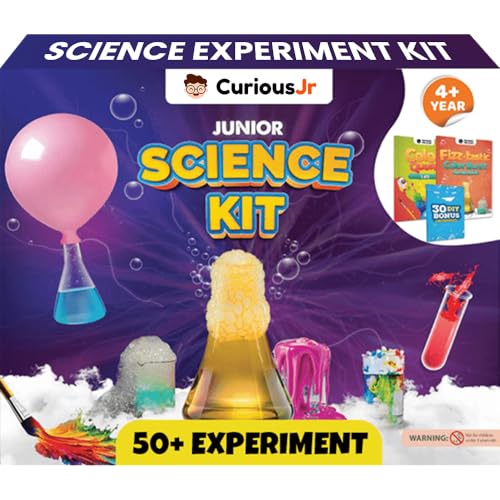
This kit focuses on color science and engaging chemical reactions. Kids explore color mixing, fizzy reactions, and a mystery science experiment designed to wow. The activities are presented with a creative twist—combining art with science to reinforce concepts such as observation, experimentation, and prediction.
NATIONAL GEOGRAPHIC Science Magic Kit

Combines science experiments with magic tricks to engage kids in physics and chemistry concepts. Each activity is designed as a magic illusion, making science approachable and entertaining. The kit includes materials to perform around 20 tricks, encouraging kids to explain the science behind the magic.
Doctor Jupiter My First Science Kit

Designed for early STEM education, this kit features over 100 experiments that build critical thinking and problem-solving skills. Activities emphasize asking questions, making observations, and discovering the world through hands-on projects like Water Fireworks and Walking Water, paired with a curated learning approach that aligns with early grade science standards.
UNGLINGA 70 Lab Experiments Science Kit

Offers 70 diverse experiments, including erupting volcanoes, crystal growth, and fruit-based circuits. The manual provides clear step-by-step instructions and learning insights into chemical reactions. It’s well-suited for family science time or classroom activities, promoting critical thinking and collaborative problem solving.
Buying Guide: Key Purchase Considerations And Comparisons
What to look for when choosing a kids’ science kit
- Age appropriateness: Check recommended ages and adjust for your child’s developmental level. Some kits are designed for younger children with guided experiments, while others target older kids with more complex projects.
- Theme variety: Decide whether you want a broad kit covering multiple science domains or a focused kit (geology, chemistry, astronomy, etc.).
- Materials and safety: Look for non-toxic materials, clearly labeled tools, and safety gear like goggles. A comprehensive manual with safety notes is essential.
- Instruction quality: Step-by-step guidance with illustrations helps kids work independently. A well-written manual reduces parental over-involvement while fostering independence.
- Reusability and waste: Consider whether the kit includes reusable tools and whether consumables are abundant or limited. Some kits allow continued experimentation, while others are one-off.
Educational value and engagement
- Learning objectives: Identify kits that align with core science skills—observation, hypothesis testing, data recording, and explanation of findings.
- Progressive challenge: Some kits offer tiers of difficulty or multiple experiments, which can grow with the child over time.
- Cross-disciplinary appeal: Kits that blend art, math, and storytelling can sustain long-term interest and curiosity.
Practical considerations
- Storage and organization: Check if the kit includes a box or case to keep components tidy and accessible.
- Time commitment: Some experiments take minutes, others span over longer sessions. Consider your child’s attention span and schedule.
- Budget and value: Compare the number of experiments, quality of materials, and longevity. More experiments aren’t always better if quality is lacking.
Comparison highlights
- Geology-focused kits (e.g., geodes) offer tangible, visual rewards through crystals and rocks, but may require delicate handling and longer activity times.
- Large multi-experiment kits (like the 150 or 80+ experiments) provide diverse topics and repeat usage, but ensure the included materials match safety standards and age appropriateness.
- Magic-science hybrids (science magic kits) introduce showmanship, which can boost engagement but may emphasize performance over core science concepts.