Best Stem Sets for Kids: Top DIY Engineering Toys for Young Innovators
Exploring stem sets helps kids develop critical thinking, problem solving, and hands-on engineering skills. The following five selected products offer a range of building challenges—from circuitry and magnets to interlocking discs and 3D construction—that engage children while supporting foundational STEM concepts. Each product includes activity guides, safe materials, and open-ended play to encourage curiosity. Use the quick summary table below to compare core features at a glance.
| Product | Brand | Key Features |
|---|---|---|
| Kids STEM Building Toys | Qirptey | 125 pieces, varied shapes/colors; 3+ year friendly; fosters fine motor skills and creativity |
| Snap Circuits Jr. SC-100 | Snap Circuits | 100+ projects; full color manual; safe electronics introduction |
| Brain Flakes 500 Piece Set | Brain Flakes | 500+ discs; color learning; open-ended construction; family-friendly |
| Learning Resources STEM Explorers | Learning Resources | 39 pieces; magnets; critical thinking; magnetic wand and activity guide |
| NXONE 195 PCS STEM Toys | NXONE | 195 pieces with storage; kid-safe electric drill; teamwork friendly |
125-Piece Kids STEM Building Toys

The 125-piece STEM set from Qirptey provides a variety of colorfully shaped building blocks and an idea booklet with instructions. It supports imaginative play as children construct models such as race cars, robots, trucks, and dinosaurs. The assortment is suitable for ages 3 and up, developing fine motor skills, spatial awareness, and early engineering concepts. The kit’s versatility makes it a strong classroom or home option for both structured activities and free-form play, encouraging collaboration among siblings or classmates.
Educational value centers on transforming simple parts into functional structures, reinforcing measurement, balance, and planning. The included instruction booklet guides kids through initial builds, then invites them to experiment with new designs. This openness helps young builders practice problem solving by iterating on ideas, while the varied pieces accommodate different skill levels as children grow.
Safety and durability are key considerations; the components are designed for routine handling by younger children, with attention to edge comfort and non-toxic materials. Parents can supervise assembly, then step back to observe creativity as kids experiment with movement and stability. For families seeking an affordable, multi-age STEM starter kit, this set offers broad appeal and repeat play value.
Snap Circuits Jr. Electronics Kit

The Snap Circuits Jr. SC-100 kit offers a safe, hands-on introduction to electrical engineering with 100+ projects and a full-color project manual. Designed for ages 8 and up, it provides a modular experience where kids can connect parts with snap-together ease to create working gadgets. The included 29 parts enable experimentation with circuits, sound, and light, helping learners grasp fundamental concepts like circuits, voltage, and continuity in an approachable way.
From a learning perspective, the kit emphasizes iterative testing and problem solving. Children can build a variety of devices—such as a flying saucer or alarm system—then modify configurations to observe outcomes. The portability and repeatability of projects support independent exploration as well as guided activities in a classroom or homeschool setting. This kit is a strong choice for introducing STEM with immediate, visible results.
Safety and child-friendly design are central; the components are durable, with no small loose parts that pose choking hazards for younger children when used with supervision. For parents and educators seeking a robust electronics starter, Snap Circuits Jr. delivers clear demonstrations of core principles along with high replay value.
Brain Flakes 500 Piece Set

The Brain Flakes set features 500 interlocking discs in 12 colors, packaged in a signature yellow cap storage jar. The discs click together easily to form large, colorful structures, encouraging open-ended construction and imaginative play. This kit targets a broad age range from 3 to 99, supporting visual-spatial reasoning, color recognition, and fine motor development.
Educational value centers on spatial awareness, planning, and pattern recognition. The simple disc system allows for quick-start builds, while also offering depth for more complex designs as children gain confidence. Brain Flakes is well suited for families and classrooms seeking a quiet, screen-free activity that promotes collaboration and sustained engagement in STEM-inspired play.
One notable benefit is scalability: kids can start with basic shapes and progressively tackle larger, more intricate projects, improving persistence and teamwork. While it excels in solo exploration, it also invites group challenges where friends or siblings design multi-part builds, making it a versatile addition to any learning toolkit.
STEM Explorers Magnet Movers

The Learning Resources STEM Explorers Magnet Movers introduces magnetism through a 39-piece set, including a magnetic wand and various magnetic accessories. This kit is tailored for ages 5 and up and aims to spark curiosity about physics concepts like attraction, repulsion, and magnetic fields. An activity guide provides structured interaction while still encouraging exploratory play.
Educational value lies in developing critical thinking and hypothesis testing: kids can predict outcomes based on magnet placement and then observe actual results. The magnetic play promotes fine motor skills and spatial reasoning as learners assemble and reconfigure setups. Educators appreciate the compact footprint and the ability to facilitate small-group work, while parents enjoy the open-ended nature that supports differentiated instruction.
While magnets inspire engaging experiments, it’s important to monitor interactions with metal objects and ensure age-appropriate supervision. This kit aligns with early physics curricula and offers repeatable activities that scale with a child’s growing understanding of scientific principles.
NXONE 195 PCS STEM Building Set
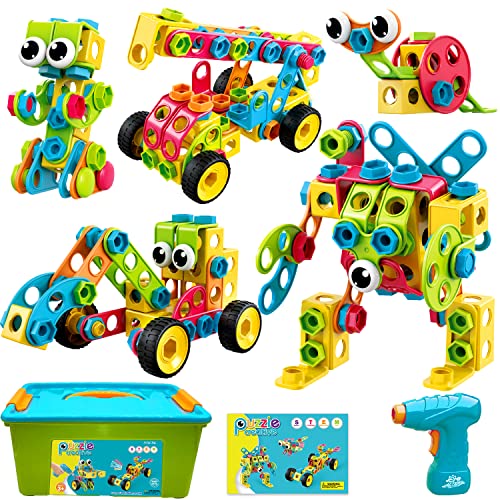
The NXONE 195-piece STEM kit includes a kid-safe electric drill, a storage box, and a wide array of building components suitable for ages up to 10. The set is designed for cooperative play, enabling multiple children to participate in building challenges at once. It supports development across science, technology, engineering, and math through hands-on construction and collaborative problem solving.
The kit emphasizes durability and safety, with non-toxic materials and rounded edges. Children can work on engineering projects individually or as a team, building motorized models or non-electric structures to practice design thinking. The included drill adds a tactile dimension to assembly, reinforcing fine motor control while expanding the range of possible builds. For families seeking a comprehensive, social STEM experience, NXONE provides substantial engagement and long-term play value.
Buying Guide: Key Purchase Considerations
- Age range and safety: Match pieces and complexity to the child’s age, and ensure materials comply with safety standards for younger users.
- Learning goals: Decide whether the priority is introductory electronics, magnetism, interlocking discs, or versatile construction for open-ended exploration.
- Modularity and expansion: Check if the set scales with growth or if additional kits are easily integrated for broader learning experiences.
- Durability and storage: Durable components and convenient storage (like a box or jar) help sustain long-term use and reduce clutter.
- Teacher and parent resources: Look for kits that include activity guides, age-appropriate instructions, and ideas for progressive challenges.
- Group play suitability: Consider kits that support collaboration, encouraging teamwork and social learning in classroom or family settings.
- Budget and value: Compare the number of pieces, project variety, and replay value to determine long-term educational return.
When selecting a stem set, consider blending kits that cover different domains—such as electronics, magnetism, and construction—to expose children to a broader spectrum of STEM disciplines. For families or classrooms, a mix of individual and group activities can optimize engagement and learning outcomes. Finally, evaluate the availability of replacement parts or additional projects to extend the life of the kit and maintain ongoing interest in STEM exploration.