Best Toys for Toddler Boy: Fun Learning Picks for 1-3 Year Olds
Finding the right toys for a toddler boy means balancing safety, engagement, and developmental benefits. This guide highlights five top-rated options designed to spark creativity, motor skills, and early thinking. Each pick comes from trusted brands and is tailored for little hands, with features that support imaginative play, curiosity, and safe exploration. Use this overview to compare options and find the best fit for your child’s interests and age.
The following quick-reference table summarizes key product details to help you compare at a glance.
| Product | Brand | Key Benefit | Age Range |
|---|---|---|---|
| Teriph LCD Writing Tablet | Teriph | Mess-free drawing and early writing practice | 3–8 years |
| iPlay, iLearn Press to Go Car | iPlay, iLearn | Active, battery-free push-and-go play | 6–24 months |
| VTech Drill and Learn Toolbox | VTech | Role-play with tools to build fine motor skills | 12–36 months |
| JOYIN 3 Pack Monster Trucks | JOYIN | Bright, light-up vehicles promoting active play | 12–36 months |
| Airbition Talking Flash Cards | Airbition | Vocabulary building and sensory learning | 12–48 months |
Across these selections, you’ll find toys that minimize messy setups, maximize safe exploration, and offer durable construction for persistent toddler play. The list includes drawing tools, push-and-go vehicles, pretend play workstations, themed trucks, and language-building flash cards—covering a range of interests common to toddler boys.
Teriph LCD Writing Tablet For Kids

The Teriph 8.5-inch LCD writing tablet provides a clean, mess-free surface for drawing, spelling, math practice, and doodling. With a pressure-sensitive screen and vibrant colors, children can freely express creativity using the included stylus. A one-second erase button helps keep sessions quick and focused, while a lock feature prevents accidental erasures. The device uses eye-friendly screen material designed to minimize eye strain, making it suitable for daily use in playtime or simple learning activities. Built with BPA-free, non-toxic ABS materials, it supports safe, long-lasting play for curious toddlers and early learners.
Key benefits include independent creative time, fine motor skill development through tracing and drawing, and a low-muss solution for practicing early writing without traditional paper. The device is lightweight and portable, suitable for car trips, daycare, or quiet time at home. This toy aligns well with toddlers who enjoy art, drawing, and basic writing concepts, while also offering a durable option for growing hands and hands-on exploration.
iPlay, iLearn Press To Go Car

This press-and-go car is designed for very young children, featuring rounded edges and a smooth finish for safe handling. No batteries are required—simply press the head of the car to activate movement, encouraging cause-and-effect learning and fine motor coordination. The bright, friendly colors and cartoon designs stimulate visual tracking and sensory processing, making it appealing for toddlers exploring motion, textures, and basic vehicle concepts. Its compact size is ideal for little hands, car rides, and early pretend play scenarios.
Parents can expect durable construction from high-quality ABS materials, with an emphasis on safety and simplicity. This toy supports early cognitive development through action-reward play and adds interactive motivation for independent playtime, as well as cooperative play with caregivers during “drive” or race-themed activities. It’s a straightforward toy that can adapt to a child’s growing curiosity about how things move and why.
VTech Drill And Learn Toolbox
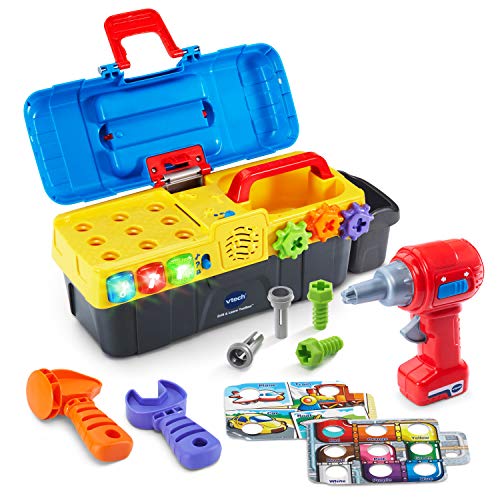
The VTech Drill and Learn Toolbox offers a toddler-friendly pretend workshop with an electronic fix-it tray, working drill, hammer, wrench, nails, and screws. The toy’s gears spin as the drill engages, promoting mechanical understanding and hand-eye coordination. Moving parts encourage cause-and-effect learning as children turn gears and manipulate screws. The light-up buttons provide engaging feedback with songs and tool-related sounds, reinforcing basic tool names and simple problem-solving concepts. This toolbox blends role-play with early STEM exposure in a safe, kid-appropriate format.
Designed to build fine motor skills, concentration, and imaginative play, the toolbox is compact enough for tabletop use or shelf-based storage. Parents can introduce basic sequences—like assembling a pretend project—to foster planning and following steps. The toy’s durability and child-safe design make it a reliable option for toddlers exploring motor tasks and pretend work both at home and in daycare settings.
JOYIN 3 Pack Monster Trucks

The JOYIN trio features press-and-go monster trucks with LED wheel lights and bold, colorful designs. Each truck—shark, bull, and Tyrannosaurus—offers a dynamic play experience that appeals to toddlers who respond to movement, color, and light. The simple “Press & Go” action makes this an ideal toy for independent play or interactive storytelling, as children can create mini-races or pretend rescue missions. The LED wheels add a captivating visual element that enhances engagement and keeps play sessions lively.
These trucks are built to withstand rough toddler play with sturdy plastic construction and rounded edges. They encourage active movement, spatial awareness, and imaginative scenarios—perfect for developing gross motor skills while keeping playtime entertaining. The visually stimulating lights and quick-start action support short attention spans and repetitive play, common in toddlers.
Airbition Talking Flash Cards For Toddlers

The Airbition Talking Flash Cards provide a 224-word set with colorful illustrations across animals, vehicles, foods, fruits, and vegetables. The talking feature supports language development, pronunciation, and vocabulary expansion. The device is designed for Montessori-style learning with a standard American accent and adjustable volume, including a repeat function. It’s a practical tool for sensory learning and early phonics, helpful for children who benefit from auditory reinforcement. The cards make a useful resource for speech therapy support and inclusive learning at home or in early education settings.
Parents can use the device to reinforce daily routines, label common objects, and engage in interactive storytelling. The system’s simple one-button operation makes it accessible for toddlers while allowing caregivers to guide more complex activities as the child grows. The combination of sounds and visuals offers a multi-sensory approach to early language acquisition and cognitive development.
Buying Guide: Key Purchase Considerations
When evaluating toys for a toddler boy, consider safety, durability, age-appropriateness, and developmental benefits. Look for rounded edges, non-toxic materials, and certifications where applicable. Choose toys that align with the child’s interests to encourage independent play and exploration, while also supporting caregiver-led activities to extend learning moments.
Durability is essential at this stage. Items like the writing tablet and push-and-go cars are designed for heavy handling, while wooden toys and chunky plastics should resist rough play. For language development, tools such as talking flash cards provide structured learning with flexible usage. For motor skills, tools with gears, wheels, and action-based play promote coordination and sequencing.
As your child grows, you’ll want to vary play styles between imaginative pretend play (tool sets and monster trucks), creative expression (drawing tablets), and cognitive development (flash cards and shape sorters). Consider a mix that includes both screen-free options and interactive features to balance screen time and hands-on learning. Finally, ensure the toy’s size and weight are appropriate for toddlers to minimize choking hazards and support safe handling during playtime.
In terms of scoring the best fit, parents should observe how a toy encourages curiosity, how safe and sturdy the construction feels, and whether the toy can be used in multiple play scenarios. Matching the toy to a child’s current interest—whether vehicles, art, or language—can boost engagement and extend play value over months rather than days.