Best Toys for Language Development: Engaging Tools to Build Vocabulary and Communication
Discover a curated set of toys designed to boost language skills for toddlers and preschoolers. This guide highlights engaging flash cards, interactive books, and hands-on puzzles that support vocabulary growth, sound recognition, and independent learning. Each choice emphasizes clear language delivery, multisensory cues, andMontessori-inspired exercises to help children develop speech and listening abilities through play.
| Product | Brand |
|---|---|
| Airbition Talking Flash Cards for Toddlers | Airbition |
| LeapFrog Learning Friends 100 Words Book | LeapFrog |
| Learning Toy for Toddlers — Train Set | Play-Act |
| Imitation Book: Learn To Talk | Twin Cities Speech Therapy Publishing |
| Zeoddler Alphabet Puzzles | Zeoddler |
Airbition Talking Flash Cards for Toddlers

Airbition’s Talking Flash Cards combine 224 vivid illustrations with engaging sounds to support vocabulary expansion across animals, vehicles, foods, fruits, and vegetables. The device operates in a Montessori-inspired style that can benefit children with autism or speech therapy needs by pairing audio with imagery. Setup is quick: switch on, insert a card, and listen to content in a standard American accent. It offers real animal sounds and a repeat button, plus a five-level volume control for gentle, child-friendly listening.
Key features
- Montessori-inspired vocabulary builder with 224 words
- Audio-visual pairing supporting speech therapy and autism play
- User-friendly: simple switch-on, card insertion, standard American voice
- Real animal sounds, repeat function, adjustable volume
Airbition Pink Talking Flash Cards for Toddlers

This variant mirrors the 224-word content with a pink aesthetic, offering similar cognitive and language benefits. The device reinforces recognition of numbers, shapes, colors, animals, transportation, and foods, supporting independent use through Montessori-style interaction. Clear American-accent narration aids pronunciation and comprehension. The reader accepts cards easily, and the design encourages self-directed learning and focus during play sessions.
LeapFrog Learning Friends 100 Words Book
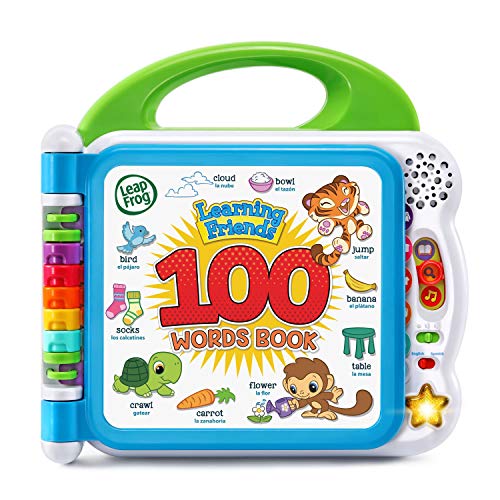
LeapFrog’s Learning Friends 100 Words Book introduces over 100 age-appropriate words with learning friends Turtle, Tiger, and Monkey. Content spans pets, animals, food, colors, activities, opposites, and outdoor scenes. Kids interact with touch-enabled pages to trigger words, sound effects, and a catchy theme song. This book blends tactile exploration with auditory reinforcement, supporting vocabulary acquisition through repeated, engaging experiences.
Learning Toy for Toddlers — Train Set

This Montessori-inspired train set includes 9 farm animals and a farmer, plus colorful barns and carriages. Children engage in counting, sorting, and matching as they load and unload figures along the track. The open train design encourages interactive play, while the color and number activities help build early numeracy and vocabulary. The detachable roof feature adds an extra layer of pretend play, supporting narrative language and attention.
Imitation Book: Learn To Talk

This interactive board book from Twin Cities Speech Therapy Publishing focuses on early speech development for ages 0-4. It emphasizes imitation as a core strategy for language growth, offering activities that target toddler language milestones and late talker challenges. The book is designed to accompany speech-language therapy or home practice, promoting observational learning and expressive language through guided imitation.
Zeoddler Alphabet Puzzles

Zeoddler Alphabet Puzzles present 26 uppercase letters in a natural wood format, designed for preschool learning through play. The wooden pieces support fine motor development, hand-eye coordination, and early letter recognition. The puzzle’s durable construction makes it suitable for repeated use, and its size is tailored to little hands for easy grasping. This activity encourages children to explore letters while engaging in self-guided problem solving.
Buying Guide
When selecting language-development toys, consider how each option supports speech, listening, and vocabulary growth. Look for multisensory features—visuals, sounds, and touch—that reinforce word meaning and pronunciation. Consider the child’s age, attention span, and whether the toy encourages independent exploration or guided interaction with a caregiver.
- Age and developmental appropriateness: Choose toys that align with current speech milestones and can scale with progress.
- Voice clarity and accent: Clear, standard American pronunciation helps with familiarizing children to correct speech patterns.
- Reinforcement methods: Repetition, associations (sound-image), and reward cues can support memory and retention.
- Interactivity level: Some kids prefer solitary play while others respond better to guided sessions with a caregiver.
- Durability and material safety: Prefer sturdy, non-toxic materials, especially for younger children who explore with hands and mouth.
- Montessori alignment: Toys designed for independent, hands-on exploration can promote focused attention and self-directed learning.
Across these selections, multiple perspectives emerge: high-tech audio-visual tools can boost vocabulary quickly, while traditional wooden puzzles encourage fine motor skills and letter recognition. Combining a mix of flash cards, interactive books, and open-ended play sets can provide a well-rounded approach to language development and early literacy for children in the 1–4 year range.