Best Weather Station for Kids: Fun STEM Kits for Young Scientists
Kids learn best when curiosity meets hands-on exploration. A dedicated weather station for kids turns abstract meteorology into tangible experiments, helping young observers track temperature, humidity, wind, and pressure while connecting classroom science to real-world weather events. This article highlights five engaging options that balance learning with play, featuring built-in sensors, outdoor usability, and age-appropriate experiments. Use the quick reference table below to compare features at a glance and choose a kit that fits your child’s interests and space.
| Product | Type | Key Features | Best For |
|---|---|---|---|
| Thames & Kosmos Weather & Climate Lab | 5-in-1 Weather Station | Wind vane, compass, rain gauge, anemometer, thermometer; outdoor stake | Outdoor experiments and real-time data |
| AcuRite What-to-Wear Weather Station | Hyperlocal Forecast Station | Wireless outdoor sensor; alarm clock; outfit recommendations | Kids learning daily dressing decisions |
| Newentor Weather Station | Color display indoor/outdoor | 7.5″ LCD; 3 remote sensors; barometric pressure; forecast | Clear, kid-friendly readouts |
| SMARTLAB Storm Watcher Weather Lab | Experiments kit with weather instruments | 18 experiments; weather instruments; illustrated guide | Science-curious learners |
| 4M Weather Science Kit | Desk-top weather activities | Air currents; water cycle model; clouds project | Hands-on foundational weather concepts |
The following sections present five carefully chosen products. Each entry includes a concise overview, practical considerations, and what makes it suitable for kids curious about weather. All sections stay focused on educational value, safety, and ease of use for households, classrooms, or homeschooling setups.
Thames & Kosmos Weather & Climate Lab

The Thames & Kosmos Weather & Climate Lab is a compact 5-in-1 station that invites kids to explore weather phenomena and the broader Earth climate system. Its built-in tools include a wind vane, compass, rain gauge, anemometer, and thermometer, enabling observers to monitor and record diverse data points. An outdoor stake supports real-time measurements in a yard or garden, making it ideal for hands-on experiments outside the classroom. The kit blends observation with data collection, reinforcing scientific methods while engaging young learners in climate science.
AcuRite What-to-Wear Weather Station

The AcuRite What-to-Wear Weather Station combines practical forecasting with a fun, kid-focused twist: dressing for the weather. With an alarm clock, date, and time, the unit emphasizes daily readiness. A wireless outdoor sensor fuels hyperlocal forecasts, delivering 12-hour projections that reflect backyard conditions. This station’s educational edge lies in tying weather data to everyday decisions, helping children translate meteorology into personal planning and awareness of how local conditions shift from day to day.
Newentor Weather Station

The Newentor Weather Station features a large 7.5-inch color LCD that displays both indoor and outdoor conditions, including temperature, humidity, and barometric pressure with high/low readings. The system supports up to three remote sensors, allowing multiple indoor or outdoor monitoring points. Its forecast capability covers the next 12-24 hours, with calibration designed to improve accuracy for a child’s local area. The clear, vivid display makes it easy for kids to compare data across rooms or yard areas while learning weather patterns over time.
SMARTLAB Storm Watcher Weather Lab
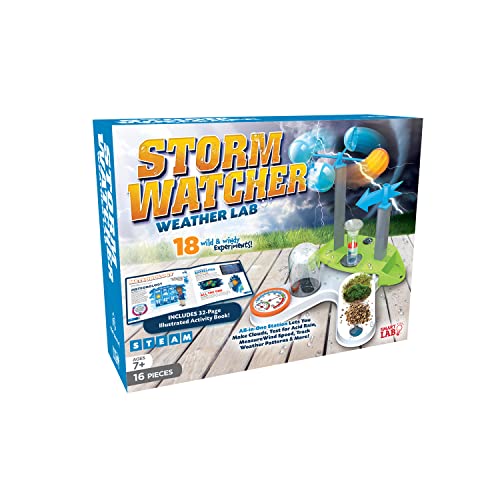
The SMARTLAB Storm Watcher Weather Lab provides an engaging set of 18 experiments focused on weather science. The kit includes a weather station base, a lab station with wells for experiments, and essential instruments such as a weather vane, rain gauge, anemometer, compass, thermometer with hygrometer, and a conjoined activity book. It guides children through real-world weather phenomena, including cloud identification and barometer construction, while illustrating how climate and weather interact with ocean systems and tornado scales. It is well-suited for STEM-focused play and guided lessons.
4M Weather Science Kit
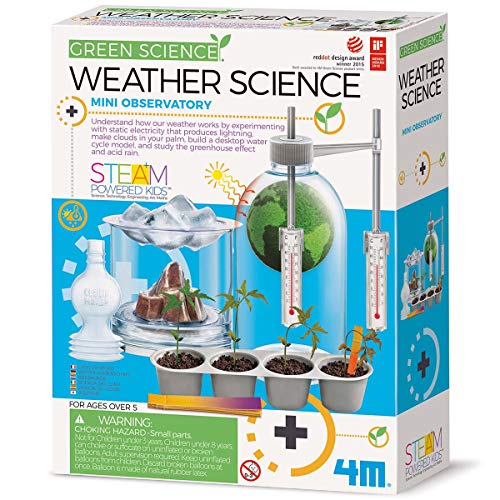
The 4M Weather Science Kit explores foundational weather concepts through hands-on activities. Kids can observe static electricity related to lightning, assemble a desktop water cycle model, and simulate cloud formation in a child’s palm. The kit also encourages experimentation with air currents to understand wind and examines the greenhouse effect and acid rain. This option emphasizes accessible, entry-level activities that clearly demonstrate how weather works, making it a solid fit for younger children or newcomers to weather science.
Buying Guide: Key Purchase Considerations
- Age appropriateness and learning goals: Match the kit to your child’s age, curiosity, and science curriculum. Some sets emphasize hands-on experiments, while others focus on data collection and forecasting.
- Sensor reliability and readability: Look for clear displays, color-coded readings, and durable outdoor sensors when choosing a model intended for yard or porch use.
- Outdoor durability and setup: If outdoor use matters, ensure the station has weather-resistant materials and a stable stake or mounting option.
- Data interpretation support: Kits with journals, illustrated guides, or accompanying books help kids translate measurements into insights about weather patterns.
- Expansion and future projects: Consider whether the system supports adding sensors or pairing with additional kits to grow with your child’s interest.
- Safety and assembly: Check for child-friendly assembly steps, non-toxic materials, and age-appropriate supervision requirements.
- Educational breadth: Some kits emphasize engineering challenges (barometers, wind gauges), while others focus on daily forecasting and personal weather awareness.
Comparative Considerations Across The Five Options
- Outdoor capability: Thames & Kosmos and SMARTLAB provide components suitable for outdoor experiments, enabling real-time data collection in a yard or garden.
- Display clarity: Newentor offers a large color display that is easy for kids to read, which supports quick comparisons over time.
- Forecasting depth: AcuRite and Newentor include forecasting elements, helping children predict upcoming conditions based on sensor data.
- Educational depth: SMARTLAB’s 18 experiments and the extensive activity book deliver a broader exploration of weather concepts beyond basic measurements.
- Starter versus advanced: 4M and AcuRite provide approachable activities for beginners, while Thames & Kosmos and SMARTLAB cater to more advanced curiosity and hands-on experimentation.
Weather stations for kids combine play with science literacy, teaching observation, data collection, and critical thinking. When selecting a kit, prioritize a balance between engaging activities, ease of use, and long-term educational value. The right choice can spark ongoing curiosity about how atmospheric conditions shape daily life and the environment.